
A scientific communications internship cover letter should prove that you can turn a technical source into clear, accurate writing for a defined audience while respecting scientific review. This is not the same as claiming you independently validated research or approved medical, product or regulatory statements. Select one real class paper, poster, lab presentation or permitted writing sample; explain its audience, your source checking and the feedback you used. Review the employer’s exact content tasks and submission instructions, because science communication roles can range from educational materials to technical marketing.
Identify the audience and content type in the posting
A scientific communications placement may involve presentations for researchers, explanatory web pages, application notes, customer-facing copy, event summaries or social posts. The writing style and verification requirements differ by audience. Read the current description and underline the deliverables, scientific areas and approval process. Select examples from your own work that show comparable thinking. A biology presentation for classmates can support an educational writing task; it does not automatically establish experience preparing approved commercial claims.
A university-posted scientific marketing internship describes technical writing, presentations and communicating science for different audiences under a multidisciplinary team. Treat that as an example of possible role scope, not evidence that every science communications internship has the same duties or credentials. The best opener names a genuine audience problem and why the position’s scientific focus interests you. Avoid writing a technical paragraph so dense that a reader cannot see your main contribution.
Show a source-to-sentence workflow
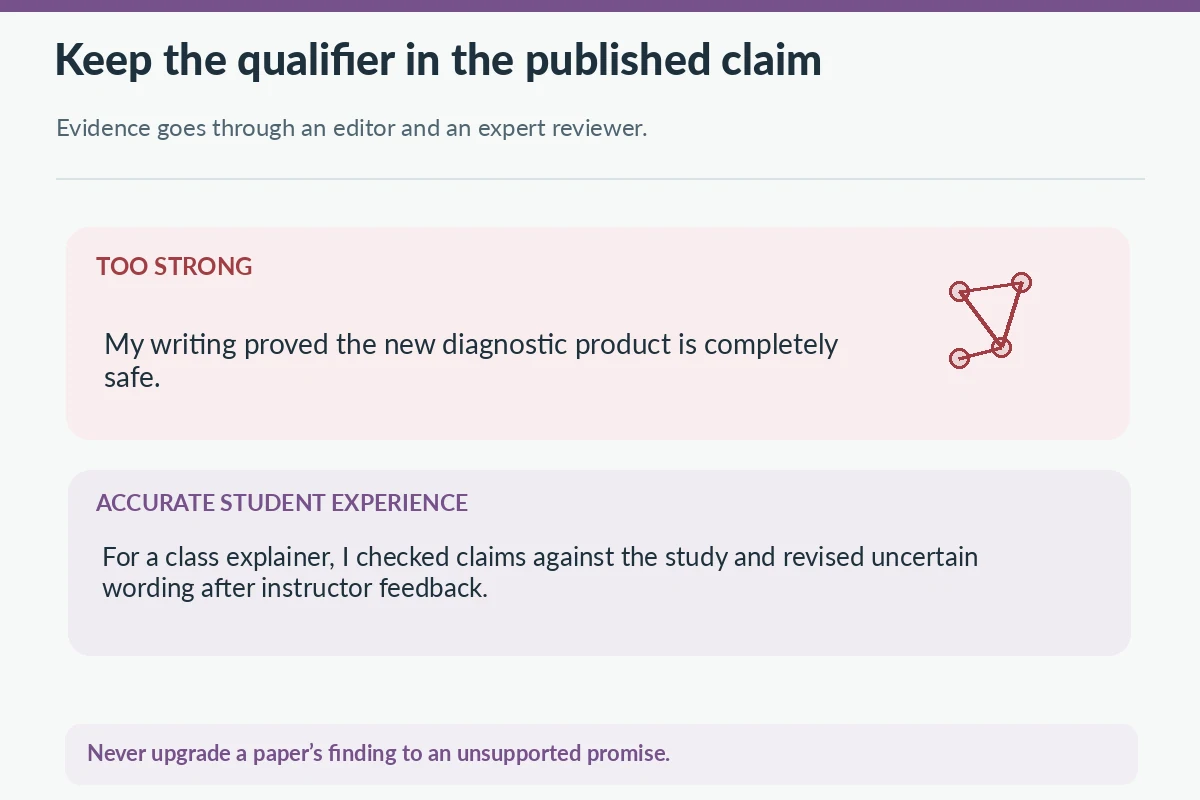
A credible example might be a class explainer about a published study. Explain that you located the original source, checked what population or model it studied and rewrote the main finding for a non-specialist audience. If a result was preliminary, you retained that qualifier. A line such as ‘I rewrote a class research summary for non-scientists and checked the final claims against the assigned paper’ is more informative than ‘I make complex science simple.’ State your role without implying ownership of the study itself.
When using statistics, keep units, comparison groups and uncertainty. Do not claim an intervention works for patients because a laboratory result looks promising. Likewise, technical marketing may have product-specific approval steps: a student should not imply authority to sign off on performance specifications or regulated statements. Show that you know when to escalate to a scientist, legal reviewer or designated content owner. Asking for expert review is an important part of reliable communication.
Discuss writing samples and publication permission
A portfolio can contain a student poster, public article or self-authored science explainer if you have permission to share it. When a group completed the work, identify which charts or paragraphs you created. Remove unpublished results, customer details, confidential lab images and any claims you cannot document. If a link requires access to a school system, provide a permitted public version only when it is genuinely yours to release and the employer accepts a link.
If your strongest sample contains heavy instructor edits, explain that you revised it after feedback rather than asserting it was published professionally. You might mention improving figure captions for readers who did not know the method. This proves responsiveness and audience awareness. Do not attach a 40-page lab report when the internship asks for a concise cover letter and one writing example. Follow the exact number, length and format of samples requested.

Draft a science communication internship letter
Illustrative letter: Dear Scientific Communications Hiring Team, I am applying for the Scientific Communications Internship because your description emphasizes making technical research understandable to different audiences. In a molecular biology course, I prepared a two-page explainer from an assigned peer-reviewed article. I checked which experiments the paper actually reported, defined unfamiliar terms for classmates and asked my instructor to review wording that might overstate the findings.
For a separate group poster, I wrote the figure captions and revised them after feedback so readers could identify the measurement and its limitations. These were academic projects, and I have not independently approved scientific or product claims. I would enjoy supporting your team with accurate source checks, organized drafts and clear handoffs to scientific reviewers. Thank you for considering my application. Sincerely, [Applicant]. This sample is hypothetical; replace its projects, discipline and responsibilities with evidence from your own work.
Distinguish editing from scientific approval
An intern may simplify wording, build a content calendar or propose a slide, while a designated scientist or communications owner approves final claims. Describe the review handoff. If a sentence about a study seems too strong, cite the original paper and ask whether the claim should be narrowed. A writer can flag the issue without making an unqualified scientific judgment. This is particularly important when materials mention clinical use, diagnostics, proprietary technology or sensitive results.
In the letter, choose verbs such as drafted, revised, compared and checked when those reflect your experience. Use ‘approved’ only if you actually had that responsibility in a legitimate setting. Avoid claims that you ‘translated all research into public truth’ or ‘guaranteed compliance.’ A hiring reader can assess a careful junior editor more easily than a candidate who conflates communication work with authority over laboratory findings or product performance.
Connect technical interest to a usable audience example
If the company works in genomics, energy systems or engineering, explain why that technical area interests you and which public materials you read. Do not say you have mastered its technology after browsing an internship page. One appropriate sentence could discuss translating a technical method into a short poster caption for first-year students. Another could explain that you recorded unanswered questions from a class presentation and used them to revise an introduction.
University career-center postings sometimes ask for a statement about why the applicant wants to gain experience and how that relates to growth. Answer that prompt directly. A candidate interested in medical technology should not imply they can write clinical recommendations without expert review. An internship is a chance to practice reliable translation and collaboration; an honest learning goal is much more persuasive than a claim to already know everything about a specialized domain.
Check accuracy, style and confidentiality together
Before submitting, trace each technical term in the letter to something you understand. If you name a method, be prepared to explain what you personally did with it. Where you mention a result, make sure your wording reflects the source. An excellent science letter can be short, because one evidence-rich story about source checking is more useful than a list of fashionable terms. Check the writing sample’s captions, citations and accessibility as carefully as the cover letter itself.
Keep unpublished research, collaborator identities, customer information and internal slides out of an application unless you have permission and a secure approved submission route. If you are not certain whether a figure is public, substitute an original explanatory diagram using public data. An internship letter should not become a disclosure of intellectual property. A reviewer should see respect for scientific detail and the team’s approval process in both your words and your sample selection.

Finish with a realistic submission and review promise
Confirm the exact role title, recipient, science focus, work location and application channel. If the posting requests a specific content sample or short statement, supply that item rather than a generic portfolio dump. The University of Washington’s cover-letter guidance emphasizes a clear fit between experience and role, which is especially useful when the applicant is early in training. Keep the technical details enough to demonstrate comprehension but not so much that they bury the reason you are applying.
At the close, offer to discuss your workflow, sources and feedback experience. Do not promise a quantified marketing result or claim a study is ready for clinical application. The value you offer is disciplined writing: choosing a credible source, understanding its limits, adjusting language for an audience and routing uncertainty to an authorized reviewer. That is a concrete and honest pitch for a scientific communications internship.
| Area | Useful evidence | What not to imply |
|---|---|---|
| Research finding | Original published source | Respect limits and uncertainty |
| Public wording | Audience-ready draft | Do not add unsupported promise |
| Final approval | Designated science reviewer | Intern does not sign off |
How We Research Internship Cover Letters
We compared general career-center cover-letter guidance with role-specific institutional internship materials and the JobAsk topic inventory. We reviewed the sources listed below on 2026-11-05. Job and program descriptions illustrate tasks, not guaranteed current openings or universal eligibility. All sample letters and candidate histories in this guide are hypothetical. Follow the current official posting and protect sensitive records. For affiliations and funding transparency, see our affiliate disclosure.
Sources checked: University of Washington Career & Internship Center — A university-posted scientific marketing internship illustrates technical writing, audiences and multidisciplinary scientific review needs.; University of Washington Career & Internship Center — UW career services recommends a role-specific letter grounded in one or two relevant examples.; University of Washington Career & Internship Center — A communications internship posting demonstrates that employers may ask applicants to address audience work and learning goals directly.. Verify the latest instructions for the exact internship you are considering.
More Resume and Cover Letter Guides
Yes, when permitted. Explain its audience, sources, your contribution and any review rather than implying it was professionally published.
Only if you are allowed to share it and the employer requests it. Otherwise use a public or original sample without confidential information.
Only if you had formal authority and actually performed that work. Most interns should describe drafting and review support instead.
Technical enough to demonstrate genuine understanding, but clear about the role, audience and one concrete evidence example.
Identify which sections or captions you created and who reviewed them; do not claim the entire team product as your sole work.