
For security guard situational interview questions, interviewers may describe an unfamiliar event and ask what you would do next. A useful answer begins with the real-world risk, identifies the records or facts you can verify, and explains who has authority over the next decision. For example: A visitor lacks a credential and asks to enter a restricted area. You do not need to invent the employer’s policies, assume an outcome, or claim powers outside the advertised position. Use this practical framework: check site requirements, use approved response, and document observations. All sample answers below are hypothetical practice examples, not statements about actual employers or candidates. Replace generic claims with the employer’s published procedures, protect confidential information, and ask a follow-up question when the scenario leaves a material fact unknown.
Explain the scope of a guard before the scenario
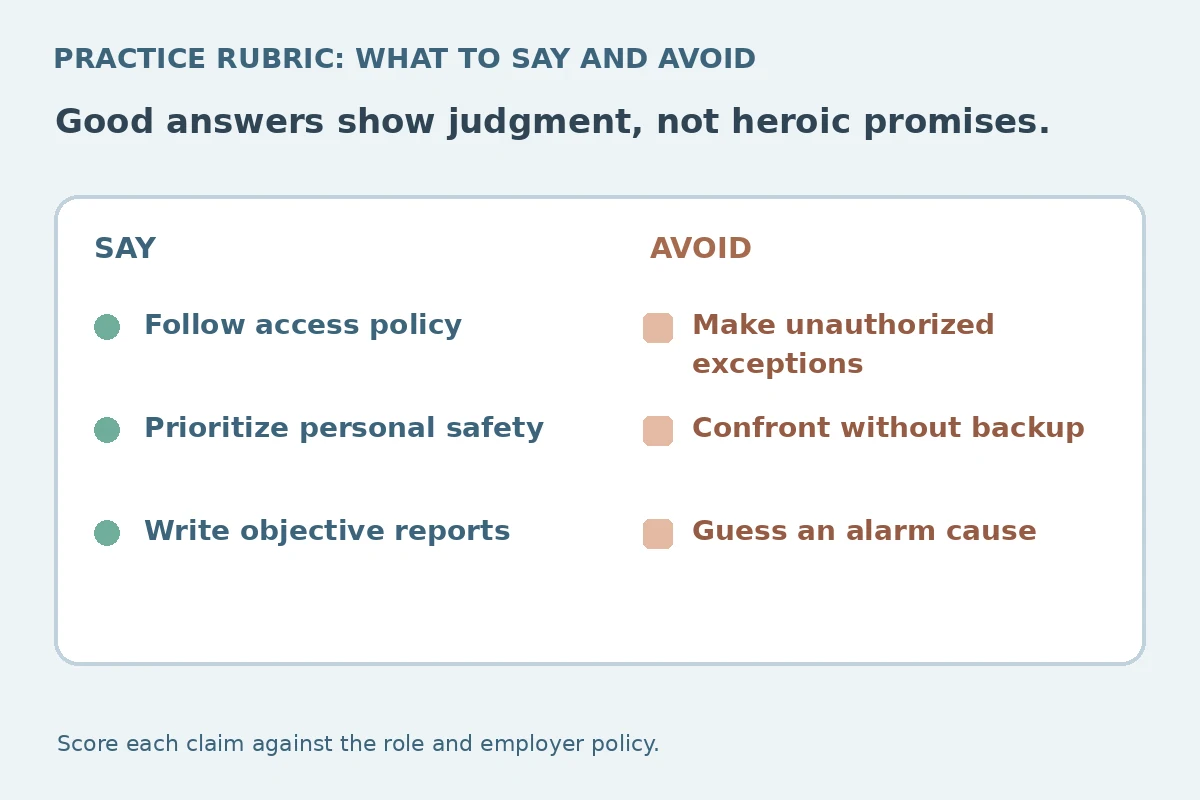
A security guard situational interview tests observation, communication, policy compliance, and safe reporting. The right action varies by worksite, license, training, and employer directions. Start by stating what you can verify under site rules, what you would do to keep people safe, and when you would notify a supervisor or emergency service. Do not imply the guard has unlimited police authority. Avoid inventing rules about detention, searches, or force. A steady, legally cautious response is more relevant than a dramatic promise to handle every confrontation alone.
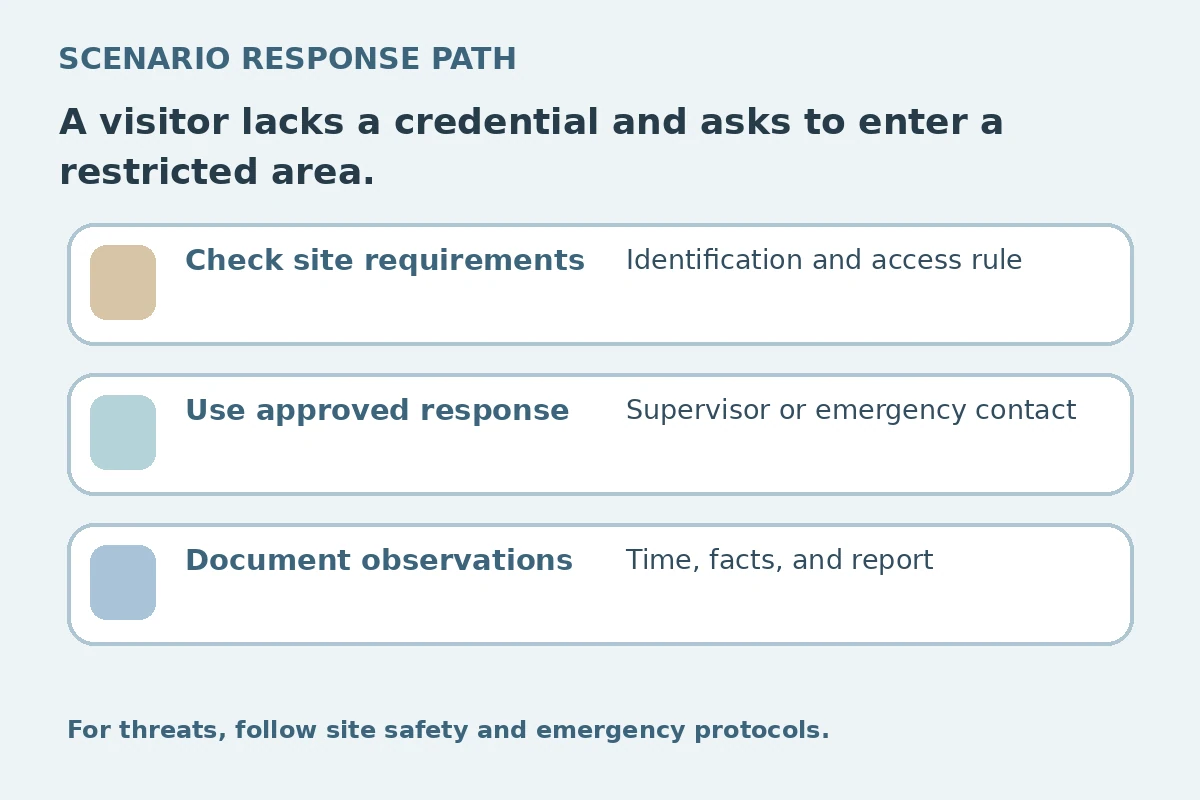
Scenario: a visitor cannot show proper access credentials
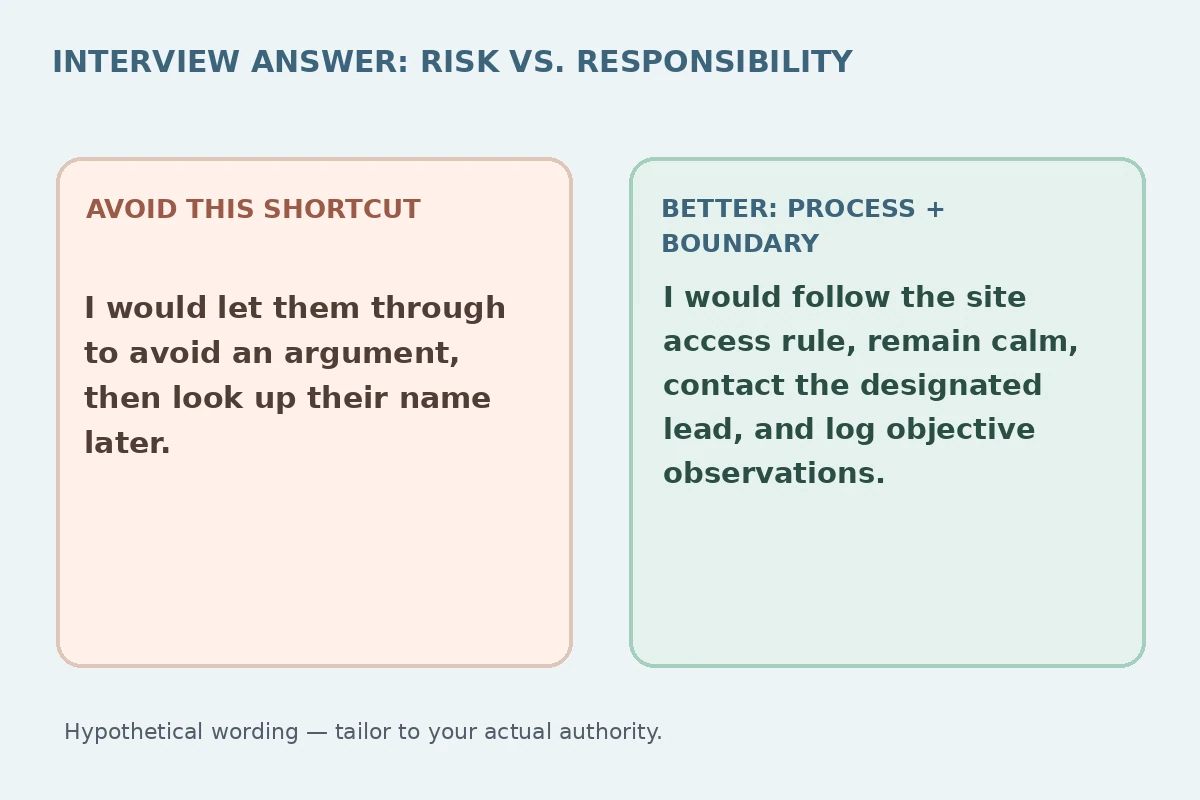
Suppose someone asks to enter an employee-only area but cannot present the required authorization. Explain that you would follow the site’s visitor-access procedure, communicate the requirement respectfully, and use the designated contact or supervisor for exceptions. Do not say you would bypass the check because the person appears familiar or insists they are late. If the encounter becomes threatening, prioritize safety and the established emergency or escalation process rather than attempting an improvised physical confrontation. Document what you observed and the authorized outcome without publishing private visitor data.
Scenario: an alarm activates during a busy shift
An alarm may have several causes, and a candidate should not announce that it is false without checking the approved response plan. Explain that you would recognize the alert, use the site’s notification protocol, maintain your assigned safety role, and involve designated responders. Do not provide technical instructions for defeating or resetting safety systems. If there is an immediate hazard, emergency procedures take precedence over administrative reporting. Only after the appropriate staff resolve the concern should you prepare an accurate incident summary that distinguishes signals, observations, and confirmed findings.
Scenario: a frustrated employee challenges the rules
Some workers may object to badge checks or restrictions. Give a calm, respectful explanation of the established entry requirements and offer the designated route to resolve authorization issues. Do not invent new exemptions or use insulting language. Explain that your role is to apply the site policy consistently, not to settle personal disputes. If the situation escalates or there is a threat, seek appropriate support under workplace procedures. The interviewer should hear that your tone is professional while your security decision remains bounded by the authority actually assigned to you.
Scenario: you observe something unusual on patrol
When a patrol reveals an open door or unexpected condition, describe recognizing the observation, maintaining personal safety, and contacting the appropriate owner or dispatcher according to site policy. Do not assume a crime occurred or claim you would enter unsafe areas alone. Report the location and observable facts through authorized channels without broadcasting sensitive operational details. Later, distinguish your observation from any conclusion made by investigators or emergency responders. Reliable guards provide good information and follow procedures; they do not need to invent a heroic intervention for an interview answer.
Write a factual incident report rather than a story
A useful security report identifies the relevant date, time, location, people to the extent authorized, observable behavior, alerts received, notifications made, and how the matter was handed off. Separate direct observations from what another person reported. Avoid speculative diagnoses, accusations, and unnecessary identifying details. If a report is reviewed by a supervisor, explain the review chain instead of claiming you can close every matter yourself. Do not share actual confidential building plans, camera details, or incident records with an interviewer. A fictional sample can show writing skill without exposing restricted information.
| Question to ask yourself | Evidence or action to describe |
|---|---|
| What is the immediate issue? | Check site requirements: Identification and access rule |
| What can I verify? | Use approved response: Supervisor or emergency contact |
| Who owns the next action? | Document observations: Time, facts, and report |
Explain how your response changes during an emergency
Interviewers may ask about a possible fire, injury, violence, or security threat. Avoid a one-size-fits-all physical response. State that you would use the employer’s emergency action procedures, notify appropriate responders, and act only within training and assigned duties. OSHA emphasizes workplace violence prevention and training rather than improvisation. Do not suggest unsafe pursuit or tactical engagement. It is more important to recognize what exceeds your training and arrange prompt professional help than to claim you would personally resolve a dangerous incident.
Understand the difference between observation and authority
Guards may monitor an area, verify access, and document incidents, but legal authority and licensure vary widely. Do not call every rule violation a criminal offense or describe independent powers to search, restrain, or interrogate a person. A strong answer says you would refer to employer instructions and applicable law before taking a nonroutine action. If the question concerns armed or specialized assignments, note that they have additional requirements and training; an applicant should not imply qualification without that background. Interviews reward sound boundaries as well as alertness.
Practice an access-control answer with measured language
Try this hypothetical wording: “I would explain the credential requirement, verify the approved visitor process, and contact the designated person if the visitor cannot be cleared. I would remain professional and document the result.” It is an example of a process, not a claim about a real facility. Improve it by adding what you would do if a safety threat emerged, without detailing confrontational tactics. Remove invented incidents, arrest claims, or assertions that you alone authorized access. The response should remain short enough that an interviewer can easily follow its decision points.
Ask about site procedures and reporting ownership
To conclude, ask how visitor exceptions are handled, who receives incident reports, which emergencies require calling external responders, and what training is provided. Site-specific instructions matter more than a generic online answer. If you have previous relevant experience, describe only duties and incident examples you are allowed to share, with names and facility details removed. Explain how your attention to clear communication, nonjudgmental observation and proper handoffs would help the team, while acknowledging rules you would need to learn before your first shift.
How We Research Security Guard Interview Scenarios
JobAsk reviewed the following primary occupational and agency sources on November 17, 2026: BLS describes guards’ access-control, observation, emergency-contact, reporting, and site-specific training duties. OSHA discusses training, workplace violence prevention policies and the need to understand procedures for responding to incidents. O*NET details security guards’ visitor access, observation, communication and incident-reporting activities. They explain broad responsibilities and information-handling boundaries, not any particular employer’s selection criteria or the outcome of a real interview. Hypothetical questions and answers are editorial teaching examples. Follow the actual employer’s written procedures, training and legal obligations. We do not claim that an answer ensures hiring. See our affiliate disclosure for relationship transparency.
More Interview Preparation Guides
Do not invent an exception. Follow the authorized entry procedure and contact the designated supervisor or host.
No. Acknowledge the alert, follow the site response plan and report observed information without guessing the cause.
Do not assume broad powers. Duties and legal authority depend on jurisdiction, assignment, licensure, training and employer policy.
Relevant objective observations, times, authorized identifying details, notifications, actions and handoff; clearly separate facts from secondhand reports.
Prioritize personal safety, use the employer’s emergency procedures and involve the appropriate trained responders. Avoid improvising confrontational tactics.