
Restaurant situational interview questions ask how you would act in a future shift, not whether you can recite a script about being friendly. A strong answer identifies the immediate concern, checks the information available, coordinates with the right coworker, and follows through without promising what you cannot authorize. Servers, hosts and food runners have different responsibilities, so adapt the wording to the job you are interviewing for. Food allergies, incorrect orders, delayed dishes and payment disputes should never be treated as a competition to invent the quickest-sounding solution.
The Bureau of Labor Statistics describes servers as connecting guests with the kitchen, delivering orders and checking on service; it also notes that menus and potential allergens may be discussed with managers and chefs before a shift. O*NET includes taking orders, preparing checks and correcting customer problems. Those are occupational examples, not permission for every employee to alter ingredients, waive charges or make health assurances. Good answers keep the guest informed while protecting the kitchen’s verification and the manager’s approval process.
Use a Guest–Kitchen–Manager Decision Sequence
For a hypothetical answer, begin with the guest’s stated need and what you know for certain. Next name the record or person you would check: the order ticket, kitchen lead, published restaurant procedure or shift manager. State the safe immediate action within your role, describe when you would escalate, and close with what you would confirm with the guest. Use “I would” unless you truly have a comparable past example. An interview answer should demonstrate judgment, not claim a guaranteed dining outcome.
Four Restaurant Scenarios With Model Answers
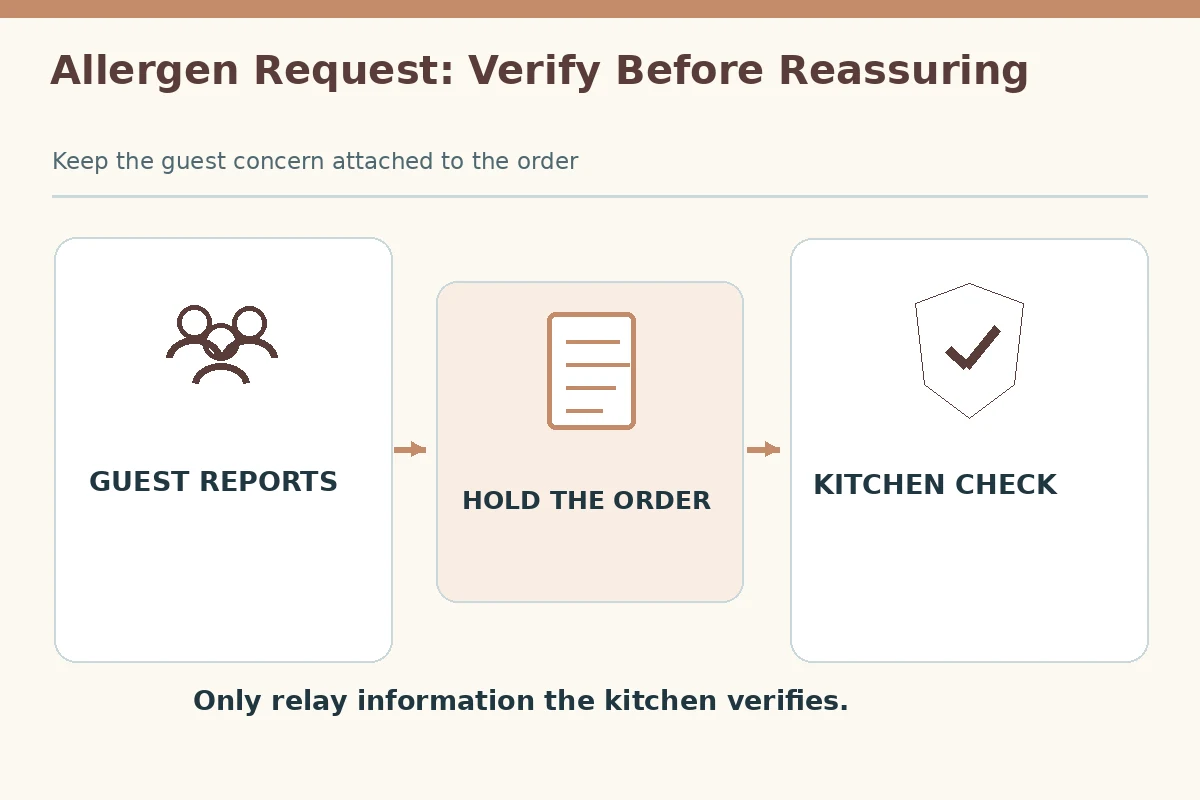
Scenario 1: A guest reports a serious ingredient allergy after ordering
Model answer (hypothetical): “I would treat the information as important rather than assume the dish is safe because I have seen it prepared before. I would pause the order handoff, confirm the guest’s stated concern, and ask the kitchen or designated manager to verify ingredients and the restaurant’s allergen-handling procedure. I would relay only what the team can substantiate, offer to seek an approved alternative, and make sure the information follows the order. I would not promise an allergen-free meal without an authorized check.”
Why this works: The interviewer is checking that you distinguish empathy and careful communication from professional food-safety verification. The correct decision depends on restaurant procedures and current ingredient information, not personal guesses. Do not claim: Avoid saying you would remove an ingredient yourself or guarantee there is no cross-contact.
Scenario 2: The kitchen tells you an order will be delayed
Model answer (hypothetical): “I would check the realistic status with the kitchen rather than invent a time. Then I would update the table clearly, acknowledge the delay without blaming coworkers, and ask the appropriate lead what options are actually available. If the delay affects another course or a customer deadline, I would explain the concern to the person who can coordinate changes. I would return with an update once I have reliable information and confirm any approved alternative with the guest.”
Why this works: This response separates a factual status update from a promise the server cannot keep and shows the handoff between the guest and kitchen. Do not claim: Avoid manufacturing a five-minute estimate or offering a free item without approval.

Scenario 3: A customer says the check includes an item they never ordered
Model answer (hypothetical): “I would compare the guest’s concern with the itemized ticket and the restaurant’s record before changing anything. I would acknowledge the discrepancy calmly, ask a manager or authorized coworker to make any required adjustment, and explain the corrected total before payment is finalized. If the order is connected to a shared table, I would confirm which items belong on which check. I would avoid exposing another guest’s payment details while resolving the issue.”
Why this works: Good financial judgment means finding the error and using the documented correction route rather than quietly altering a register entry. Do not claim: Avoid bypassing a supervisor’s approval requirements or disclosing payment information.
Scenario 4: Two tables need help at the same moment
Model answer (hypothetical): “I would quickly distinguish an urgent concern, such as a safety or allergen issue, from a routine refill or timing request. I would acknowledge both tables, handle the higher-priority need through the right person, and ask a teammate for permitted coverage if necessary. For the waiting table, I would give a realistic update and return as soon as I can. Afterward I would confirm that both requests were completed rather than assume that someone else took care of them.”
Why this works: The interviewer wants evidence that priorities and teamwork are linked to actual guest needs, not to whoever complains the loudest. Do not claim: Avoid describing a speed contest or leaving a possible safety issue unreported.
What the Interviewer Is Really Listening For
| Interview complication | Responsible next step | Unsupported response to avoid |
|---|---|---|
| Allergy or ingredient uncertainty | Stop assumptions; ask authorized kitchen/manager | Guarantee a dish is allergen-free |
| Delayed ticket | Confirm status and communicate honestly | Promise an invented completion time |
| Billing discrepancy | Check itemized record; seek approved correction | Modify payments without authorization |
Practice aloud by naming a role-specific fact: the menu item, order ticket, manager’s authorization or kitchen handoff. Keep the answer short enough that the interviewer can follow the decision. When asked a follow-up such as “What if the guest gets upset?”, acknowledge the frustration while keeping your original accuracy and safety boundaries. If you have been a host rather than a server, do not claim you personally processed payments; explain which teammate you would contact and what you would communicate.

Practice Clear Order and Payment Handoffs
The interviewer may deliberately add an uncomfortable detail: the guest insists that a familiar item cannot contain an allergen, a teammate says the ticket has already left the kitchen, or a customer demands an immediate refund. Explain how the new detail affects the priority without changing facts you have not verified. If the person making the request seems angry, you can acknowledge the frustration and repeat the practical next step. Avoid treating an upset guest as permission to bypass food-handling, recordkeeping, or manager-approval rules. Calm communication and procedural accuracy belong together.
Before the interview, read the posting to learn whether the role is server, host, food runner or shift supervisor. A host might direct an allergy concern to the assigned server and kitchen; a supervisor might have authority to review a check adjustment. Those are not interchangeable claims. If asked how you know a process works, say you would learn the employer’s written procedure and current menu information. This answer does not pretend that all kitchens share identical systems or that a student or volunteer has restaurant experience.
Review Every Claim for Accuracy
After each mock answer, ask whether you verified facts, used the proper channel, protected guest information and closed the loop. A thoughtful answer does not need to make the guest happy instantly. It should show the process by which an employee avoids compounding an error. Replace generic phrases such as “I would provide excellent service” with a specific verification step and a realistic final update. Your example is hypothetical unless you disclose a true prior situation.
How We Research and Check These Scenarios
We reviewed occupational information and university career guidance on 2026-11-14. www.onetonline.org explains o*NET identifies order taking, customer service, billing, and coordination with kitchen staff as server duties. www.bls.gov explains bLS describes shift briefings about menu items, potential allergens, and dining-room/kitchen coordination. students.ubc.ca explains uBC explains that situational questions assess judgment in hypothetical future situations, unlike past-behavior prompts. All model responses are hypothetical, not employer-specific safety protocols, verified candidate accomplishments or actual hiring outcomes. Check the current job description and employer procedures before using an example. See our affiliate disclosure.
More Interview Preparation Guides
A situational question describes something that might happen and asks how you would respond. A behavioral question asks for a real event from your past. Use conditional language for the first and factual past tense for the second.
Only if the job and restaurant procedure authorize that action. Otherwise explain that you would consult the responsible manager about approved options.
Use an accurate hypothetical sequence and relate it to genuine service, classroom or volunteer experience without claiming restaurant duties you have not performed.
Do not make that assumption. Explain that you would seek current, authorized verification and use the restaurant’s established allergen procedures.
Assess urgency, acknowledge both needs, get permitted teammate coverage, and confirm that neither request was lost in the handoff.