
Search social work job boards by the work you are qualified to perform, not only by the phrase “social worker.” The NASW JobLink board can reveal employers and role titles, but a job seeker should compare each vacancy with their own state license, degree, supervised-experience status, service setting, and the employer’s official description. A clinical supervisor position, a nonclinical program coordinator job, and a case manager role are not interchangeable. This guide shows how to separate them before applying.
Define your credential and supervision status first
Write down your completed education, current license title and issuing jurisdiction if any, expiration status, and documented supervised experience. If you are still studying or working toward licensure, identify that stage accurately. Do not apply a license abbreviation from one state to another without verification. The Association of Social Work Boards provides a database of jurisdiction-specific rules; it is a research aid, not a replacement for the current requirements on your state regulator’s website.
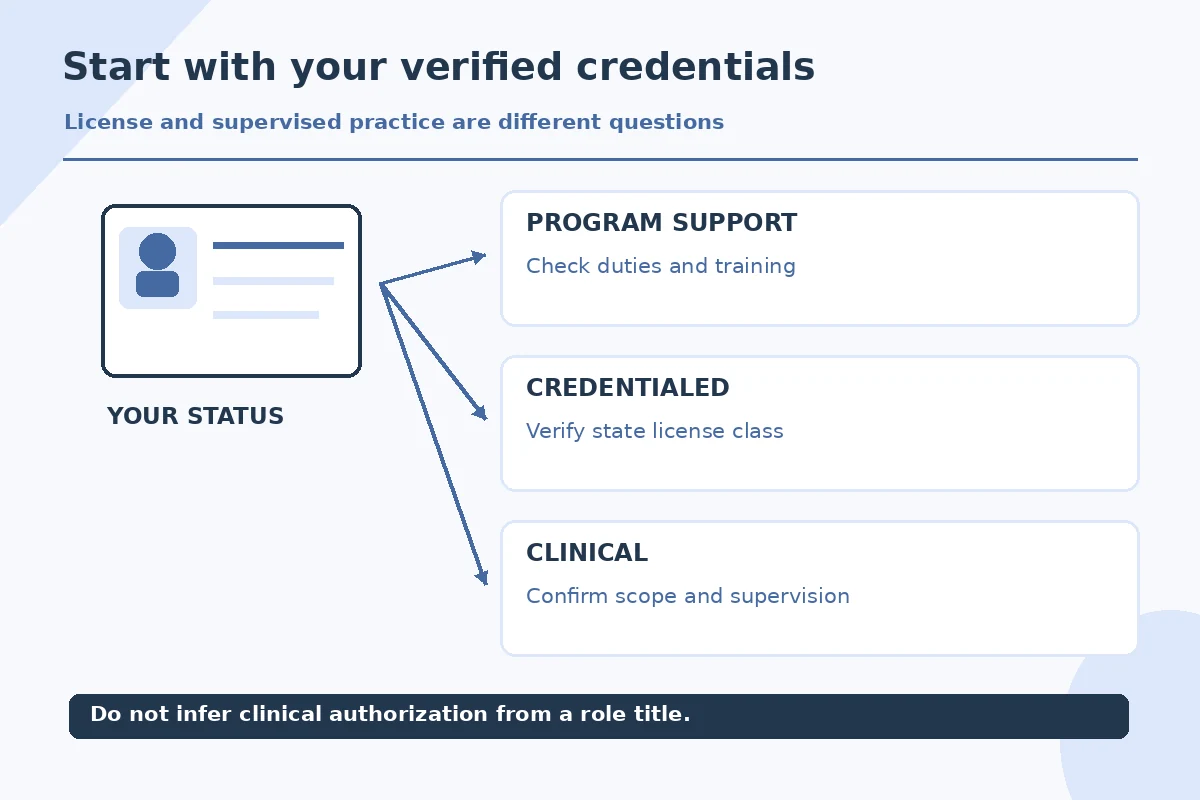
Then separate roles into three lanes: nonclinical program or resource coordination, social work positions with a listed credential threshold, and clinical practice or independent supervision roles. Read for activities such as counseling, diagnosis, treatment planning, crisis response, and clinical supervision. Do not assume that similar job titles confer permission to perform those tasks. Where a listing asks for eligibility to obtain a license, ask when it is required and what supervision, if any, the employer provides.
Search NASW and official public-service employers together
NASW JobLink lists openings across professional settings and lets job seekers search jobs. Use search terms combining the real job function with setting: “hospital discharge,” “school social worker,” “community outreach,” or “program coordination.” Refine by geography and experience, then open the full job notice. Some vacancies will be for licensed professionals; others may refer to human services support or program operations. Treat the wording and qualification section as the deciding evidence.
Also search public agency, hospital, university, and nonprofit employer websites. These organizations may use their own applicant-tracking systems and sometimes repost roles on a professional board. Compare the employer name, requisition number, location, work arrangement, and deadline in both places. If the board links to an unfamiliar third-party form, confirm the destination with the employer before supplying professional credentials or identifying information.
Check scope, client populations, and supervision
The role’s service setting affects both the qualifications and practical day. School support, hospital discharge planning, residential services, child welfare, community programs, and mental health clinics may have different scheduling, recordkeeping, and authorization needs. Read whether the posting requests home visits, overnight coverage, on-call work, driving, or travel between sites. These are practical job-fit questions rather than automatic disqualifiers, but they should be known before you accept interviews.
For applicants seeking supervised hours, ask who holds the supervision responsibility, whether their credential and availability match the applicable rules, and whether the tasks would count toward your specific requirements. Do not assume any manager can verify a supervised clinical hour. Use ASWB or the appropriate state board to understand the regulation, then confirm the employer’s actual arrangement. Do not share client case records or private notes as evidence of work quality.

Use a role-fit matrix before spending time applying
A hypothetical listing for a community program assistant may emphasize referrals, appointment coordination, accurate records, and communication under assigned procedures. A clinical social worker listing may require a particular active license, assessments, and permitted clinical decisions. Both can involve vulnerable clients, but the required authority is different. Match the duties you have actually performed and the credentials you possess to the posting rather than relying on a broad phrase such as “people person.”
For each vacancy, mark four columns: license match, experience match, supervision clarified, and schedule feasible. If one requirement is unclear, ask a concise question through the employer’s official contact: “Is an active license required at application, or by the start date?” Do not claim provisional eligibility without checking the state’s rules. For a role you cannot yet perform, record the gap and search for a genuinely appropriate earlier-career pathway.
| Role lane | Typical work to check | Evidence to verify |
|---|---|---|
| Program support | Coordination, referrals, records | Check employer training and privacy rules |
| Credentialed social work | Practice within listed license class | Verify jurisdiction and license status |
| Clinical supervision | Clinical oversight and approvals | Verify supervisor authority and experience |
Build application evidence without exposing client data
Choose examples that demonstrate professional boundaries: documented handoffs, accurately maintained nonidentifying reports, coordinated meeting schedules, or participation in an approved community program. A good resume bullet identifies your part in the process and the scope of supervision. Avoid case narratives with dates, locations, diagnoses, or combinations of details that could identify a client. Use approved, anonymized descriptions; when in doubt, keep the example procedural rather than personal.
For interviews, practice explaining when you would seek clinical guidance or follow an emergency protocol, not inventing a crisis intervention outcome. In a cover letter, distinguish what you can do immediately from what you are seeking to learn. A board may suggest jobs across many levels, but only the employer and appropriate regulator can determine if you satisfy a credential requirement for that specific practice setting.

Protect your identity and manage the search
Track the posting source, employer site, job number, credential requirement, supervision contact, deadline, and actual application confirmation. If a position is reposted, check whether the qualifications or location changed before reusing materials. Preserve any relevant professional license documentation securely, and share it only through a verified employer request channel. Some employers may request references, but do not hand out clients’ identities or private agency documents.
Be wary of recruiting messages promising immediate clinical work without checking a listed license or directing you to pay for an interview. The FTC advises against payment-for-job schemes. Verification should be routine even when a posting appears on a professional platform. If state requirements are unclear, consult the regulating board, not anonymous social media advice. A narrower, properly qualified search is more useful than applying indiscriminately to positions requiring a credential you lack.
How We Research These Job Boards and Role Requirements
We checked the following primary professional and government sources on November 7, 2026. Each link supports a specific distinction used above; job listings, application deadlines, and professional requirements can change, so confirm the current employer posting and regulator before acting. The examples are illustrative and do not describe actual vacancies: joblink.socialworkers.org (NASW JobLink is a professional platform for social work vacancies and job alerts.) www.aswb.org (ASWB describes differing social work licensure and supervision requirements by state and province.) www.socialworkers.org (NASW explains its national professional job resources and employer recruiting services.) consumer.ftc.gov (FTC guidance identifies common job scam payment and impersonation patterns.).
No affiliate placements or paid rankings are used in this comparison. Our affiliate disclosure explains how commercial relationships are disclosed. A featured career center is an example of a source to inspect, not an endorsement or a promise that a particular vacancy is available.
Related Job Search Guides
It presents professional social work opportunities across settings, but qualifications differ by employer and role. Check each posting for the actual license and experience requirements.
Only where the specific role and applicable law allow it. Some support and program roles may not require a social work license; regulated practice must meet the jurisdiction’s rules.
No. Credential categories, supervision, and licensing rules vary. Use your state board and ASWB resources rather than interpreting an abbreviation alone.
Search for postings that specify supervision and ask who provides it, how it is documented, and whether it meets the exact board requirements you must satisfy.
Avoid identifying client information. Use approved nonidentifying descriptions of your process and responsibilities; follow agency confidentiality rules.