
Social worker career goals should strengthen client-centered practice while protecting confidentiality and remaining within your actual training, supervision, and state-specific scope. An actionable goal might be “improve the clarity of referral follow-up notes using the agency’s approved template, then ask a supervisor to review a de-identified practice example.” That is a meaningful professional milestone; “solve all client problems” is neither measurable nor a fair promise to clients.
The Bureau of Labor Statistics describes several areas of social work, from assessing needs and connecting people with resources to maintaining records. Clinical social work involves additional qualification and is not interchangeable with general case coordination. The National Association of Social Workers emphasizes confidentiality, competent supervision, and relevant documentation. An appropriate plan makes those boundaries visible and never assumes a course or goal itself grants permission to practice beyond your credentials.
Separate Service Skills From Clinical Authority
Begin by listing the exact services your current appointment permits. A support worker may provide resource information, track a referral, or prepare case notes for review, depending on local policy. A licensed clinical social worker may carry out clinical tasks within their credential and setting. Do not use “assessment,” “therapy,” “diagnosis,” or “clinical supervision” in a goal without knowing precisely what those words mean in your state and employer context.
Ask your supervisor which decisions require consultation, who may contact external providers, what information can leave the agency, and how urgent concerns are escalated. The development objective is to recognize the decision boundary before acting. If your goal is to pursue additional qualifications, keep the application, required supervised hours, license, and authorized practice separate. Check your licensing board for actual rules.
| Career growth area | Reviewable proof | Boundary to preserve |
|---|---|---|
| Resource referral | Verify information and approved handoff | Do not guarantee placement |
| Case notes | Relevant, timely and factual documentation | No client identifiers in samples |
| Clinical pathway | Check qualification and supervision requirements | Do not imply a new scope from a class |

Make Referral Quality a Practical Learning Goal
A referral is not complete merely because a phone number was given to a client. Depending on program policy, the work may involve verifying eligibility, explaining available options, obtaining consent for information sharing, and documenting the agreed next step. Set a goal around the process you can control: accurate resource information, clear handoffs, and documented follow-up according to service protocols—not guaranteeing that an outside organization accepts a referral.
Use fictional scenarios for practice. A person needs food assistance; you verify the current source for program details, identify what the client has agreed to share, and record only necessary information in the approved system. A supervisor can review whether you used respectful language and followed policy. No actual client names, addresses, health information, or case histories should appear in a public learning portfolio.
Improve Documentation Without Increasing Disclosure
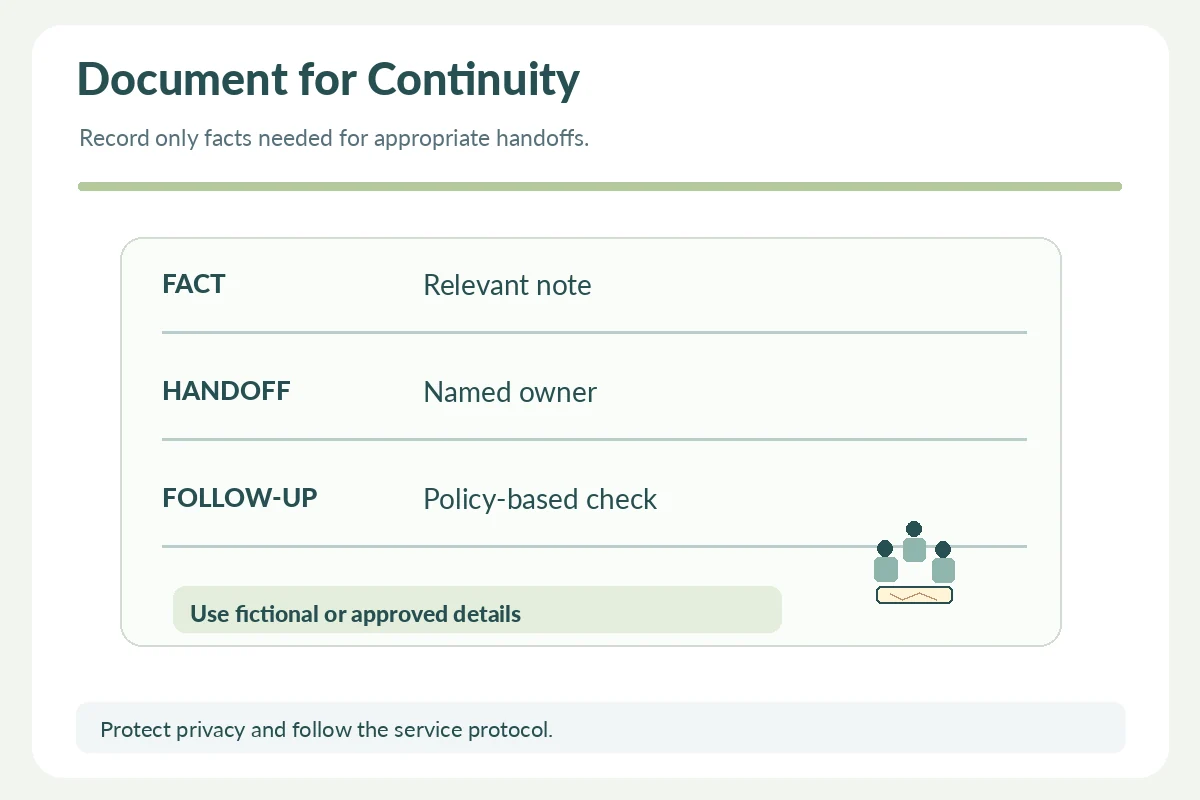
An accurate record should communicate relevant actions, dates, and follow-up responsibilities without speculative judgments about a person’s motives. The NASW Code of Ethics describes timely, relevant client records and protection of privacy in practice settings. A professional goal might be to improve the distinction between client-reported information, worker observation, and next action, using a supervisor-approved note structure.
If a record seems incomplete, correct it only through the organization’s authorized documentation method. Do not silently rewrite a colleague’s note or keep personal copies of a case file. Review de-identified learning examples if the agency permits them; otherwise practice with entirely fictional content. Quality is not simply writing longer notes. It is writing the information needed for lawful and safe continuity of service.
Illustrative goal: “Over the next supervision cycle, practice two fictional resource-referral scenarios, write clear consent and follow-up notes, and ask a supervisor to review whether I used the correct escalation path.” No real client data is used.

Use Supervision for Difficult Ethical Decisions
Supervision and consultation are opportunities to improve how you recognize uncertainty. Bring a question about privacy, a referral barrier, or a conflict between requested service and agency scope—not a story that discloses a client’s identity in an inappropriate setting. Write down the professional issue, the policy you consulted, the choice that requires supervisory input, and the agreed next action.
Do not set a career goal such as “handle all crises alone.” The safer milestone is recognizing the crisis policy, knowing emergency escalation contacts, and following trained procedures promptly. Because circumstances and state rules differ, neither a generic chart nor an online article can authorize an intervention. Ask the designated supervisor when unsure and follow the agency’s safeguarding and emergency plans.
Track Learning and Continuing Education Carefully
Choose continuing education for a documented gap: ethical recordkeeping, community resources, culturally responsive communication, or a method relevant to your authorized role. NASW describes continuing-education offerings, but explicitly notes that accreditation does not automatically mean every state board will accept a course. Verify eligibility, course acceptance, and renewal requirements with your actual licensing authority before treating training as compliance.
An illustrative ninety-day plan begins with identifying one documentation or referral gap, continues with a supervisor-reviewed practice exercise, and ends with a reflection on one workflow change. A longer-term plan may involve formal education or supervision if required for a different role. Keep “interested in,” “enrolled in,” “completed,” and “authorized to practice” as separate statuses.
Measure the Process, Not a Client’s Personal Outcome
A client’s situation can depend on housing, transportation, waitlists, health, family needs, and agencies outside your control. Avoid making your annual review depend on a promised referral placement or a client improvement percentage you cannot verify fairly. Instead evaluate whether information was checked, consent requirements were met, documentation was accurate, and follow-up responsibilities were communicated. Consider service user feedback only through approved collection methods.
A career development summary might say: “Improved ability to identify referral eligibility questions and prepare accurate, supervisor-reviewed follow-up notes.” State the actual work completed and the source of any review. Respect the client’s right to privacy when presenting examples to a hiring manager or an educational program, even when a story would sound compelling.
How We Research Career Development Guidance
We checked these occupational and professional-development sources on 2026-11-14: Bureau of Labor Statistics (BLS describes social work case coordination, referrals, recordkeeping and the difference between clinical and nonclinical practice.); National Association of Social Workers (NASW provides privacy, confidentiality and professional boundaries guidance.); National Association of Social Workers (NASW addresses supervision, consultation, accurate client records and responsible handoffs.); National Association of Social Workers (NASW advises checking state-board acceptance of continuing education activities.). We also compared the topic with the provided JobAsk WordPress title inventory and recent local packages. The examples and time windows in this page are illustrative, not employer policies, promised outcomes, verified applicant histories, or permission to work outside a professional scope. Readers should confirm local licensing, delegation and privacy policies with their own supervisor or responsible authority. See the JobAsk affiliate disclosure; this page does not imply that any named organization endorses a product or relationship.
Explore Related Career Guides
Accurate referrals, clear documentation, appropriate consultation, and understanding role boundaries are useful starting goals.
No. Check licensing board requirements, employment policy, and any needed supervision; course completion alone may not grant new authority.
Use supervisor feedback, approved de-identified summaries when allowed, or entirely fictional examples to demonstrate the workflow.
Not as a blanket goal. Learn and follow the designated crisis response and escalation protocols appropriate to your credential and setting.
Verified information, consent checks, accurate documentation, and clear follow-up within your control—not guaranteed outcomes from outside providers.