
A civil engineering internship cover letter should show that you understand how designs, measurements, and field observations move through a reviewed workflow. The most useful evidence is often a class drawing, quantity takeoff, materials lab, survey exercise, or project notebook you can explain. Open with the specific civil engineering internship and the project activity that matches it. Never describe a student’s unchecked design as a permitted final plan or imply professional licensure you do not hold.
BLS describes civil engineers as analyzing drawings and site information, making plans and estimates, and overseeing infrastructure work. Those are professional duties, not automatic intern privileges. Students can prepare draft calculations, document assumptions, follow safety instructions, and seek supervisory review. Your letter should present learning readiness, technical care, and clear communication without claiming responsibility for a bridge design, construction approval, inspection certificate, or engineer-of-record decision.
Translate the Vacancy Into Technical Tasks
Locate the practice area first: transportation, water resources, structural, geotechnical, construction, land development, or municipal works. A stormwater position may emphasize surface runoff and CAD; a construction internship may emphasize quantity tracking, field notes, and drawing revisions. Read what the posting says interns will actually do and tailor the proof accordingly. Do not fill the letter with unrelated software names or professional specialties merely to look broad.
Check the requested class standing, driver’s license, travel expectations, worksite equipment, and software. A program may require field availability and safety orientations. If you have only completed an academic surveying lab, call it that; do not say you performed licensed surveying for a client. If the internship may include construction-site visits, explain your willingness to follow the employer’s training and access rules rather than asserting that you can independently inspect hazardous work.

Choose a Drawing or Calculation You Can Explain
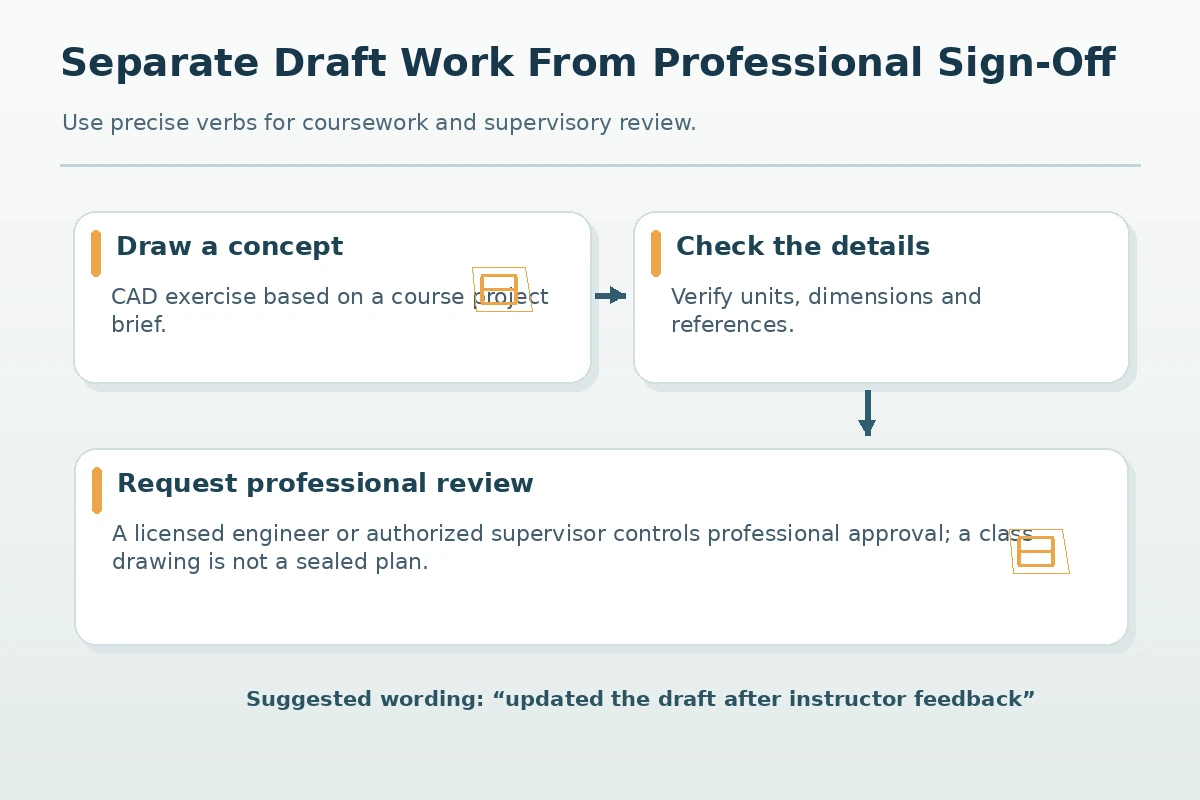
A good evidence paragraph identifies the assignment, the input, and the check. For instance, you may have prepared a conceptual grading drawing, compared quantities with a teammate, and revised a labeled sheet after receiving instructor comments. State the type of drawing and the review stage. “Updated a class site-plan draft after checking dimensions against the assignment brief” conveys more than “delivered engineering designs” and avoids suggesting the drawing was approved for construction.
For a materials course, describe the procedures you followed and the record you produced. You can explain tabulating test results, recording a measurement uncertainty, or flagging an inconsistent reading for the lab instructor. Resist turning these into certified test findings or official site conclusions. If a class team had different roles, mention the specific portion you handled, such as a CAD layer check or quantities worksheet, so an interviewer can evaluate your contribution.
Make Review and Safety Part of the Letter
A promising intern notices uncertainty and asks for review before a draft is used. Write about a controlled correction: finding a unit mismatch, checking a drawing reference, or updating a calculation after feedback. Do not portray correction as embarrassing; it is precisely the step that makes a technical process auditable. If you have real summer work experience, distinguish supervised field documentation from authority to approve construction changes or direct crews.
Match the employer’s emphasis on safety with truthful behavior. A class site visit may have involved protective equipment, instructor-led access, and observation rather than independent inspection. Explain that you followed the established procedure, kept safe distances, and recorded questions for the responsible professional. Do not promise that you can perform licensed design work, operate equipment, or certify materials tests without the required training and authorization.
| Experience to cite | Useful proof | Scope to keep clear |
|---|---|---|
| CAD class project | Labeled drawing with revision notes | Not a sealed design |
| Quantity takeoff | Checked units and sources | Review before use |
| Site observation | Supervised notes and PPE | No independent inspection |
Build a Concise Engineering Letter Structure
Use a first paragraph that identifies the project team or internship and your relevant technical preparation. Follow with one technical example and one collaboration example: updating a CAD sheet, validating a quantity, or explaining an assumption in a team review. Conclude by naming your readiness to learn the organization’s review and site protocols. Keep acronyms only where the reader is likely to recognize them, and expand specialized terms if clarity would help.
Check an employer-specific detail on the official careers page or posting. You can refer to stormwater, transportation, or site development work if those activities are actually advertised. Avoid saying you have always dreamed of building the company’s named project if you cannot verify your involvement or its current stage. In engineering applications, accurate scope and careful documentation often make a more persuasive point than dramatic language.
Check the Supporting Portfolio and Submission
Use work samples only if permitted. A class site plan can be clearly marked “course project, not for construction,” with actual authorship stated. Remove coordinates, client names, or proprietary drawings from prior internships unless your supervisor has authorized disclosure. If a sample contains other students’ designs, obtain appropriate permission or show only your contribution. Do not recreate a professional engineering seal or approval stamp for a portfolio.
Proofread units, symbols, titles, and project names; an incorrect dimension in a cover letter is distracting. Verify that your resume and letter agree about the software, project dates, and number of students involved. Follow the employer’s accepted file formats and keep the PDF legible at ordinary width. Save the posting and your submission privately, and prepare to describe one design revision and one safety boundary in an interview.

A Complete Example Letter With Truthful Project Details
Illustrative example only: The application below is fictional and must be rewritten using the applicant’s real work, program, employer, and availability. Do not copy any hypothetical experience as a factual achievement.
Dear Civil Engineering Internship Hiring Team,
I am applying for the Civil Engineering Intern position. In a university site-design course, I drafted a conceptual plan in CAD and maintained a quantity worksheet for our team’s design review. I compared dimensions against the assignment requirements, identified an inconsistent unit in an early calculation, and revised the working sheet after instructor feedback. The drawing was an academic exercise, not an approved construction document.
That experience made me interested in how accurate draft records and clear questions support engineers reviewing larger projects. I also completed a supervised materials lab in which I recorded observations and documented unexpected readings rather than deciding the final interpretation alone. I would welcome the opportunity to support your team’s drafting, checking, and field-documentation tasks while learning its review and safety procedures.
Thank you for your consideration. I would be glad to discuss the class plan and the parts of the work I personally completed.
What a Realistic Revision Looks Like in Practice
A fictional student applying to a transportation internship writes “designed a safe roadway” because a class group completed a street cross-section exercise. That overstates both safety verification and professional responsibility. A better sentence identifies the class context, the cross-section drawing, and the dimensions the student checked. The employer can then ask how the student handled standards and instructor feedback. This example offers no prediction of the student’s hiring outcome.
The same applicant sees that the posting values documentation and site visits. They shift attention from an unrelated model bridge to their supervised lab notes and describe how they logged an unexpected reading for instructor review. They keep any drawing labeled as a class concept and avoid a fictitious approval seal. The revised letter is more targeted and honest: it shows readiness to work within a professional review process instead of pretending that the applicant can authorize engineering decisions.
How We Research and Verify Internship Letters
We checked primary occupational guidance and career-center writing advice on 2026-11-14. The UC Berkeley Career Engagement cover letter guide recommends relating an applicant’s concrete experience to the exact organization and role. The BLS civil engineers profile supports this article’s treatment of drawings, calculations, permits, and professional engineering scope. Descriptions of class projects and model letters here are hypothetical teaching examples, not reports of applicants or actual hiring outcomes. Sources describe general work and eligibility; the employer notice and authorized supervisors determine internship duties. For commercial relationships and editorial transparency, see our affiliate disclosure.
More Resume and Cover Letter Guides
Yes. Identify it as a class or personal project and specify your contribution and review stage.
Only if that status is verifiable and you were authorized to state it. Academic designs are not automatically approved for construction.
Use relevant labs, drawings, calculations, team reviews and willingness to learn site protocols under supervision.
No. Highlight the tools required by the actual posting that you can demonstrate and explain in an interview.
Only with permission from the owner or supervisor and after checking confidentiality and contractual restrictions.