
When an interviewer asks “Where do you see yourself in five years?”, describe a professional direction and the capabilities you hope to develop, then explain how the position under discussion could help. You do not need to predict a precise job title, promotion date, or the employer’s future structure. A thoughtful answer names work you want to learn and responsibilities you would like to earn over time.
This guide addresses a U.S. job interview, not a forecast of a company’s promotion policy. The examples are hypothetical. Candidates may be unsure about a long-term title; uncertainty is acceptable when paired with a realistic near-term learning plan.
Explain the Question Without Pretending to Predict
This question gives an interviewer a way to discuss career direction and how the role fits your interests. It is not proof that you will remain with an employer for exactly five years. Hiring needs, team structures, individual goals, and industry conditions can change. Focus on how you intend to contribute and develop rather than a timeline you cannot control.
Boston College Career Center describes long-range goals as an opportunity to communicate foresight and how a job fits your path. UVA Career Center similarly frames career plans in relation to employer motivation. Neither source establishes a universal rule that a candidate must promise a promotion.
Begin With the Work You Would Learn First
Anchor the answer in what the posted role actually involves. For an entry-level administrative role, the first stage may be learning the organization’s document process, supporting accurate scheduling, and understanding when approvals are required. Mention training or supervision where appropriate; do not promise independent authority simply because you hope to move up.
A hypothetical answer could begin, “Initially I want to become reliable in the scheduling and records tasks listed for this position. I would like to learn your team’s handoff process and the quality checks staff use.” This is a useful aspiration even if the candidate has never used that employer’s specific software. It states an achievable learning focus rather than inventing prior success.

Describe Skills Rather Than Invented Job Titles
The middle of the answer should identify capabilities you can plausibly build: clearer stakeholder communication, better analysis of routine errors, stronger technical knowledge, or the ability to train others once qualified. Specificity matters. “I would like to learn how to audit my own work and explain recurring issues” says more than “I will be a senior executive.”
Pick learning areas connected to tasks the employer actually offers. If the job description includes only individual production work, do not assume it provides a management track. You can describe curiosity about additional responsibilities and say you want to earn them when suitable opportunities arise. This keeps the answer flexible enough for a real conversation.
Connect Aspirations to Real Responsibility
For a hypothetical customer-operations applicant, a bounded answer might be: “Over the next several years I want to become dependable in service records, learn how to spot common handoff problems, and contribute suggestions supported by examples. If I become ready for more responsibility, I would welcome training new teammates under the company’s procedures.” This describes a trajectory without promising a supervisory title.
Be clear that an aspiration is not a credential. Hoping to advise teammates does not mean you currently have the authority to approve policies or handle restricted customer records. Describe how you would learn and demonstrate readiness before taking on new work, especially in regulated or safety-sensitive environments.
Adapt the Answer During a Career Change
If you are changing industries, the first goal can be gaining sound foundational knowledge rather than immediately advancing. A former teacher moving into training coordination might say they want to learn the company’s learner-support tools and evaluation process, then develop their ability to organize approved learning materials. Their classroom experience may be transferable; their knowledge of the new employer’s systems is not automatic.
If you have already held senior roles, do not pretend to seek entry-level growth. Explain which new responsibilities interest you, such as leading cross-functional projects or improving documentation, while checking that those activities align with the advertised opportunity. The answer should reflect the actual next step in your career, not a generic upward-arrow story.
Avoid Promises and Forced Loyalty Statements
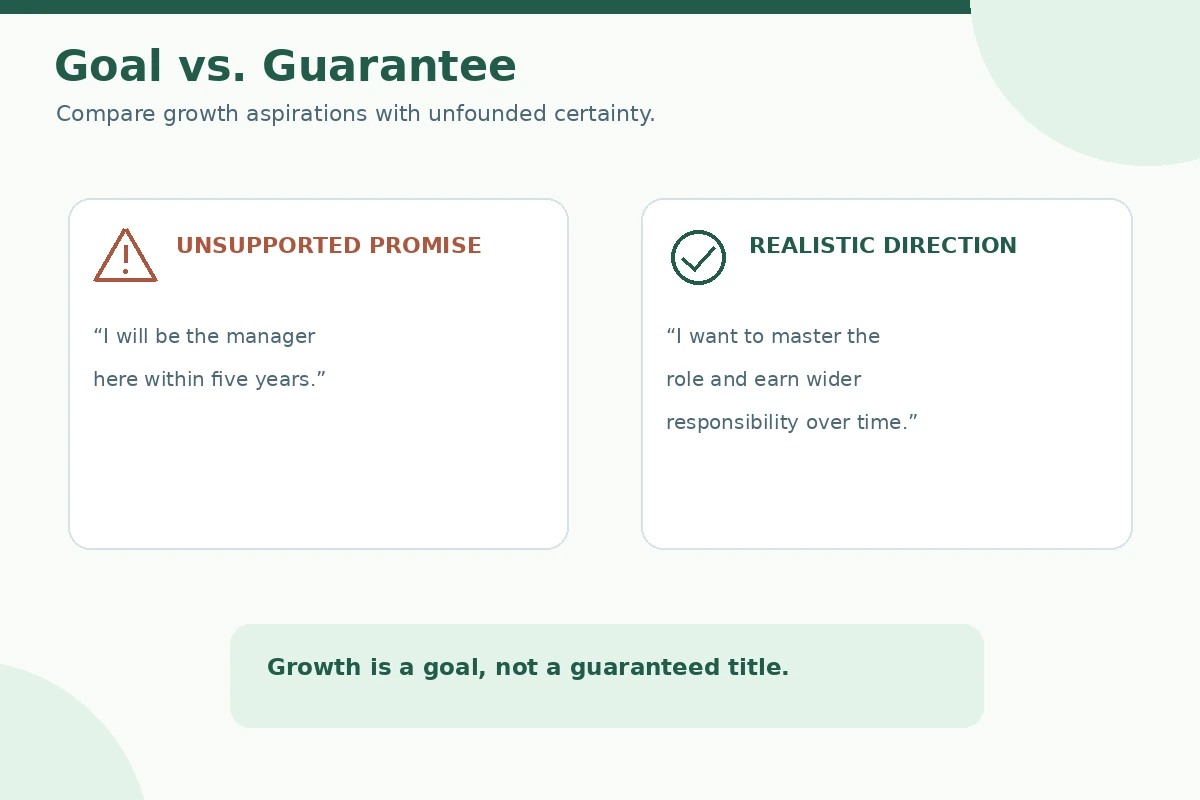
“In five years I will have your manager’s job” can sound presumptuous and may have little connection to the role. “I will work here forever” is not verifiable. Equally, announcing that the position is only a temporary platform to an unrelated career may leave the interviewer unsure why this job interests you. Be respectful without misrepresenting your goals.
If you genuinely do not know your five-year title, say, “I am still learning which specialty fits me best. My near-term goal is to build strong work habits in this role and become capable of taking on more complex assignments as I earn that trust.” That is more credible than a fictional promotion schedule. Brandeis career guidance includes long-term objectives among questions candidates should prepare for.

Practice With a Three-Horizon Note
Draw three boxes on paper: “Now,” “Next skills,” and “Possible direction.” In the first box list responsibilities in the posting. In the second, name skills you can reasonably work on. In the third, write one possible type of contribution without setting a guaranteed title or date. Use the boxes to rehearse a natural answer.
Revisit your notes if an interviewer describes a different team structure or development route. If the organization has no defined path beyond the current position, you can still value skill mastery and reliable contribution. Ask about training and performance expectations instead of assuming a ladder exists. The question should support honest mutual understanding.
How We Research These Interview Answers
JobAsk reviewed Bc career guidance, Career career guidance, Brandeis career guidance on October 27, 2026. We used these sources for the purpose of common interview questions, evidence-based answers, and candid role-fit discussions. The practical diagrams are our original teaching aids, not employer policy. All sample wording is hypothetical and must be adapted to actual job descriptions, experience, and the candidate’s circumstances.
JobAsk does not guarantee an interview, an offer, or a particular employer decision. The examples contain no paid referral. For site-wide commercial relationship information, read the affiliate disclosure.
A practical answer begins with doing the job well, continues with skills you would like to develop, and ends with a plausible kind of contribution. Keep your timeline conditional and your interest genuine.
More Interview Preparation Guides
- Tell Me About Yourself for a Career Change: Build a Credible Bridge
- Tell Me About Yourself in an Accounting Interview: Records and Judgment
- Tell Me About Yourself in an Interview: Build an Honest, Focused Answer
- Tell Me About Yourself for a Warehouse Interview: Accuracy and Safety
- Tell Me About Yourself in a Marketing Interview: Audience and Evidence
No. A realistic set of capabilities and possible responsibilities can be more honest than a precise title.
No. You can show genuine interest in contributing without making a tenure promise you cannot guarantee.
State your current learning priorities and how the offered role helps you explore a relevant direction.
Yes, if that is an authentic goal. Connect it to skills and experience you still need to earn.
Discuss mastering the actual job and ask about available learning paths instead of inventing a promotion route.