
To apply for a warehouse associate job by email, name the exact opening and work location, add one verifiable example of receiving, picking, packing or handling materials, and state shift availability only if the posting asks for it. Attach the requested files and follow the employer’s specified address and subject format. Do not claim forklift certification, overnight availability or experience with warehouse systems you have not used.
The best message is brief but operationally precise. O*NET describes freight and stock work that includes reading work orders, identifying materials and recording movement. Those are occupation-wide examples, not a license to copy duties into your own history. The goal is to show one action you performed, any necessary supervision and the next step the hiring team can verify.
Identify the Exact Warehouse Opening and Its Submission Route
Read the posting for the role name, facility, schedule, application channel and document requirements before composing anything. “Warehouse associate” can refer to inbound receiving, outbound packing, inventory support or seasonal loading. A short email should identify the actual work area when the employer does. If the announcement requires a portal application, submit through that portal first; do not assume a random warehouse email address can replace it. A reference code is useful only if it is shown in the real posting.
Use a subject such as “Application: Warehouse Associate – Evening Shift – [Your Name]” only when the vacancy identifies that shift. If a recruiter asks for a precise subject line, copy it exactly instead. Confirm the recipient through the employer’s careers page or other independently verified contact. A job-board message that rushes you to share identification, banking details or a payment for equipment before a legitimate hiring process deserves extra scrutiny.
Choose One Verifiable Handling or Inventory Example
Your evidence paragraph should describe work you really completed: matching cartons to a picking list, placing labels on inventory, comparing a shipment with an order, logging a discrepancy or preparing orders under established instructions. If you worked in retail stockrooms or completed a school logistics exercise, name that setting accurately. “I followed picking instructions and recorded a missing item for a lead’s review” says more than “I am extremely hardworking” without inventing throughput statistics.
Avoid statements such as “I cut errors by half” unless you personally have reliable figures and permission to use them. If you are new to warehouse employment, a relevant habit from another job—showing up for a scheduled shift, checking a list carefully or transferring a complete handoff—can be described as transferable evidence. Explain what a supervisor reviewed; completing a pick list does not mean you independently authorized shipment or controlled the inventory system.
| Warehouse evidence | What to say | Do not imply |
|---|---|---|
| Stockroom task | Matched items to a list | System-wide inventory control |
| Handheld scanner | Used if actually trained | Powered equipment certification |
| Shift coverage | Name accurate available hours | Unrestricted availability |
| Exception note | Reported discrepancy to lead | Independent shipment release |

Draft a Short Email That an Operations Manager Can Scan
An effective email has a clear greeting, opening that names the job, one concise evidence sentence and a close that identifies the attachment. A hypothetical example is: “Subject: Warehouse Associate Application – [Your Name]. Dear Hiring Team, I am applying for the Warehouse Associate opening at your [location] facility. In my previous stockroom role, I matched items with pick instructions and noted discrepancies for the shift lead. I have attached my resume and would welcome a discussion of the receiving and packing responsibilities. Thank you for your consideration. [Name] [Contact information].” Adapt every clause to your real history.
If the posting asks why you want that work, connect your example to its workflow: accuracy in order preparation, careful handoffs or consistent shift coverage. Do not add jargon to sound more technical. A hiring manager can explore whether you used a scanner, printed labels, worked at a loading dock or only observed the process. Every named task in your application should survive that follow-up question.
State Shift Availability and Equipment Status Precisely
Some facilities recruit for fixed mornings, evenings, weekends or rotating schedules. Confirm which one the actual opening requires and state availability in plain language, if requested: “Available for the advertised evening schedule, including Saturdays” is meaningful if accurate. Avoid “flexible 24/7” when you have transportation, school or caregiving constraints. If you can start after a notice period, give a truthful date when necessary rather than suggesting immediate availability to win attention.
Forklifts, pallet jacks, conveyors and scanning systems are not interchangeable credentials. If you used a manual pallet jack, do not describe that as licensed powered industrial truck operation. If you completed formal training, state the specific equipment and whether the credential is current, but only if documented. If you have no relevant training, express interest in employer-approved instruction and follow workplace safety procedures. Never promise that you can independently operate restricted equipment on your first shift.

Prepare Attachments Without Leaking Warehouse or Customer Data
A resume attachment should include tasks, dates and achievements you can explain. Avoid internal customer order sheets, shipping labels, facility photographs, production statistics or system screenshots that you are not permitted to share. Publicly disclosing a former employer’s shipment details is not necessary to prove you understand receiving and inventory. A one-line example of an authorized workflow can make the same point without exposing anyone’s business information.
Before attaching, check the file format named in the vacancy and use a readable filename like “First-Last-Resume.pdf.” If there is a requested cover letter, send it in the required format rather than attaching unrequested files. Preview your PDF and inspect that the filename, sender address, subject and attachment all refer to the same candidate and opening. Treat the final email as part of your accuracy demonstration.
Check the Message and Track the Application Without Duplicate Sends
Read the message as the recipient: can they identify the facility, job, evidence and requested documents in seconds? Remove unverified numbers, unexplained acronyms and empty claims. Reopen the job posting to ensure its submission rules have not changed. Do not attach safety certificates that are expired or unrelated, and do not promise to take assignments outside your training. Confirm that the recipient address comes from a real employer-controlled source.
After sending, save the position link, exact title, date, email address and attachment version in a personal tracker. If the employer specified a follow-up process, use it. Otherwise allow a reasonable response period and send at most a concise, purposeful status request rather than repeated reminders. If you later discover a material mistake, contact the verified recruiter with the correction rather than sending duplicate complete applications without context.
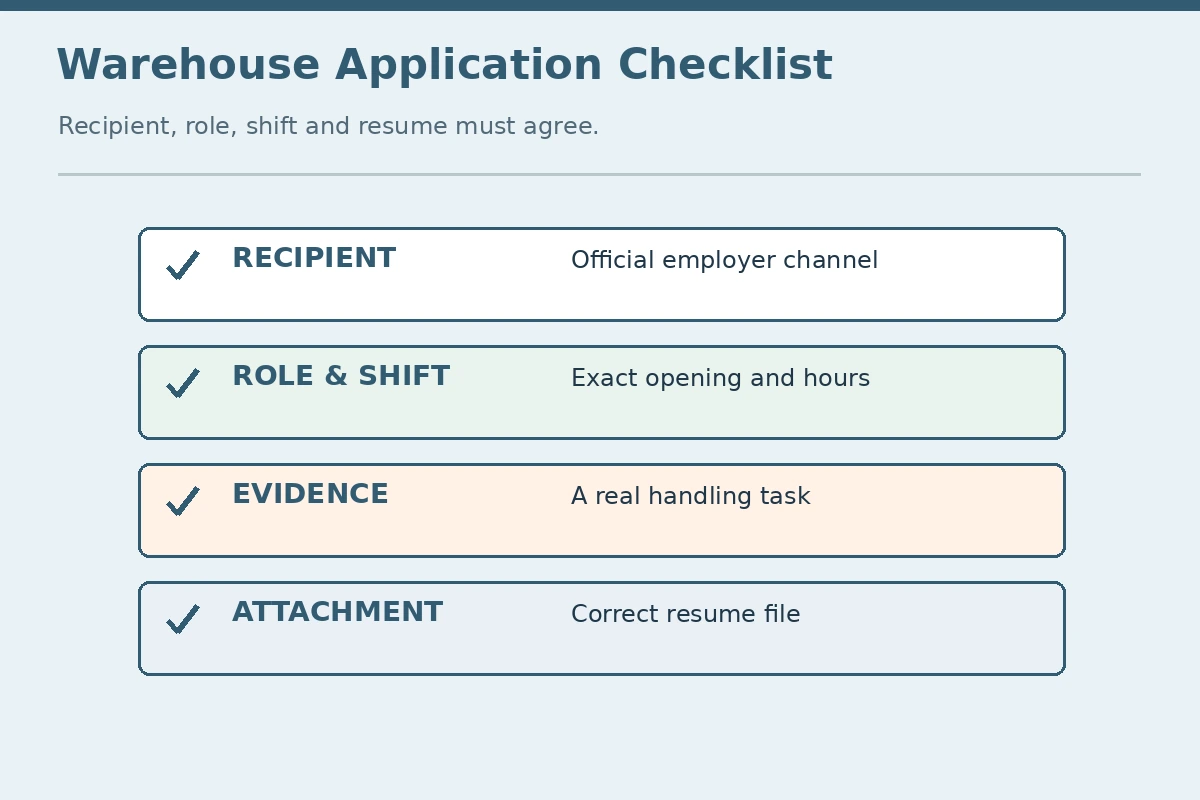
How We Research Application Emails for This Role
Checked on 2026-11-14: O*NET: Freight and Stock Movers — O*NET describes moving and identifying freight, checking assignments, recording units and following work instructions.; Harvard Career Success: Resumes and Cover Letters — Harvard advises applicants to name the position, tailor a short message to the employer and give specific evidence rather than repeating the resume.; FTC: Job Scammers Are Looking to Hire You — FTC describes risks from fake job recruiters requesting money or sensitive data before legitimate hiring steps.; UW Career Listing: Application Instructions — An example listing shows that subject lines, attachments and application routes can be specifically prescribed by the employer.. We compared this role-specific email intent against the supplied JobAsk WordPress title exports and the previous local draft batches. All sample messages and diagrams are hypothetical, not claims about actual applicants or current job openings. Employer-specific submission instructions always take priority over general examples; confirm the posting, credentials and authorized duties yourself. No hiring, response or ATS outcome is guaranteed, and no affiliation with cited organizations is claimed. Read our affiliate disclosure.
Related Job Search Guides
Use the position name and your name, adding shift, facility or reference code only when the employer uses it. Follow any prescribed subject exactly.
Yes where the posting allows it. Give a real stockroom, retail, volunteer or training example and label its context honestly.
Only if you actually have it; identify the specific equipment and training status instead of suggesting automatic permission to operate.
Include the hours or shift requested by the employer. Avoid claiming availability that conflicts with your real commitments.
Do not send customer, shipment or employer-confidential records. Explain your task in words or use a sample you are authorized to disclose.