
A move from a warehouse associate role to logistics coordinator is possible to explore without calling yourself a logistics manager. Your strongest bridge is accurate evidence: receiving records, tracking exceptions, communicating shipment status, and checking an order against a pick list. Begin with jobs whose duties involve documenting and coordinating the flow of goods, then determine which tasks you have actually done and which require training or approval. A resume should not imply you have negotiated carrier contracts or determined freight rates if your role ended at checking labels.
O*NET lists cargo and freight agents among occupations that track deliveries, prepare shipping records, and coordinate shipments; “logistics coordinator” appears among reported job titles. The BLS describes more senior distribution management as often requiring substantial related experience. This guide therefore focuses on the support-level transition and an evidence-led application, not an instant move into warehouse leadership.
Compare Physical Warehouse Tasks With Coordination Work
List the activities from your current shift in order: receiving a delivery, scanning items, checking quantities, locating a discrepancy, asking a lead for instructions, and recording the final status. Next review actual logistics coordinator postings for tracking appointments, updating transport documents, following exceptions, or contacting carriers. The overlap is the movement of reliable information. Moving a carton and authorizing its route are different decisions, even when both happen in one building. Record the decision owner for every handoff.
A job ad might ask for bills of lading or freight scheduling. Those are documents and workflows, not interchangeable with basic stock counts. A warehouse worker who has only used a scanner should say so. A candidate who has verified shipping paperwork under instruction can describe that precisely. Make three columns titled performed, observed, and new to learn; use them to select realistic support vacancies and avoid a mismatch with roles requiring independent shipment planning.
Build a Shipment Evidence Log Without Employer Data
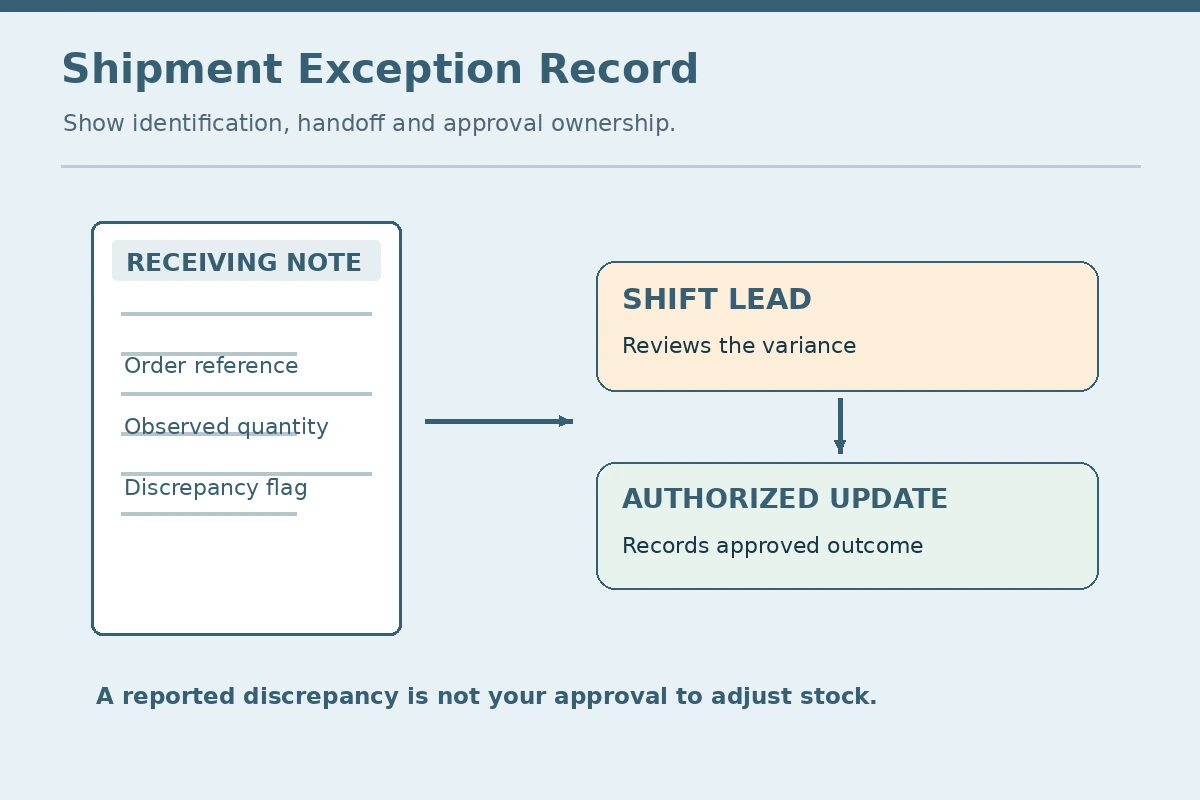
For one genuine work example, reconstruct the safe outline of a routine: what record you checked, what error you noticed, which person reviewed it, and what you updated after approval. Do not copy live customer shipment identifiers, rates, addresses, inventory balances, or screenshots from an internal warehouse management system. You can draw a fictional workflow that illustrates your reasoning while identifying it explicitly as practice rather than employer documentation.
Suppose you actually noticed that an inbound count did not match the receiving note. A truthful bullet might say “Compared inbound item counts with the receiving list and escalated variances to the shift lead for review.” It does not claim that you approved an inventory adjustment or stopped a carrier. If you never completed that task, do not reuse the sample. Retain the difference between an observed problem, the notification you sent, and the final action taken by someone else.
| Warehouse evidence | Coordination use | Do not claim |
|---|---|---|
| Receiving count check | Flag shipment variance | Approve inventory write-off |
| Scanner status updates | Track item movement | Own carrier routing |
| Lead notification | Document exception handoff | Negotiate freight contract |
| Training spreadsheet | Practice status log | Production system proficiency |

Learn What Shipping Records Actually Require
Cargo and freight work can involve transport documents, route information, status messages and carrier coordination. O*NET names tracking goods and preparing shipping documents as example tasks. Read postings to identify the actual systems used: some teams rely on a transport management system, while others work in spreadsheets and a warehouse application. A software acronym is not evidence of mastery. Ask whether the employer trains new coordinators on the platform or expects prior use.
Practice with a fictional shipment ledger containing a reference code, ship date, expected arrival, actual status, exception reason and reviewer. Create one incorrect line, then show how it should be flagged rather than silently replaced. If your sample has a “release” field, mark it pending review. This tiny exercise makes the distinction between entering data, verifying data and authorizing shipment release visible to the person reading your application.
Choose Support Roles Before Management Titles
A dispatch clerk, transportation assistant, freight documentation clerk and logistics coordinator may share some tasks but have different responsibilities. Compare actual postings for contact with carriers, escalation schedules, Excel or database work, shift coverage and document accuracy. Do not assume the word “coordinator” means entry level. Some employers expect experience with cross-border documents or independent supplier negotiation, which goes beyond ordinary receiving work.
Build a shortlist of positions where you can already explain at least two core tasks and can identify a realistic training route for the rest. If a listing asks you to direct forklift operations or make safety calls, check the training requirements and decline to claim any operator authority you have not been given. Consider internal opportunities where supervisors can verify your inventory experience and where controlled exposure to freight workflows is available.
Write Career-Change Resume Bullets With Boundaries
In a career-change summary, link warehouse experience to records and communication rather than replacing your title. A sample profile might read: “Warehouse associate with experience checking received items against order records and reporting discrepancies, seeking a shipment-coordination support role.” Name the system only if you actually operated it. Do not make your scanner experience look like full ownership of a transportation platform or describe an informal handoff as carrier contract management.
For an application, prepare two specific stories. One can show a discrepancy you identified and escalated; the other can show a time you maintained an accurate order or inventory record under a deadline. For each, give the original task, the action you personally performed, the record or person that confirmed it, and an outcome you can truthfully defend. Leave metrics out if you have no reliable count or permitted source.
Plan the Next Skill Without Buying a Promise
Before paying for training, search legitimate vacancies and record which gaps recur. They may include spreadsheet lookups, shipment-status documentation, transport terminology, or professional email updates. You can learn a basic sample workflow using invented data, but do not label a one-hour exercise as a professional certification. Ask prospective employers about training on their actual systems, working hours and who approves exceptions.
Review each submitted resume against the vacancy and remove unfamiliar trade terms that you cannot explain. The goal is not to guarantee a logistics title after a short course; it is to show a carefully documented transition from physical operations into information coordination. Where the target position carries customs, dangerous-goods, licensing or regulated-transport responsibilities, verify employer expectations and the applicable formal requirements rather than guessing from a broad career guide.

How We Research Career Transitions
On 2026-11-14, we reviewed official occupational guidance: O*NET: Cargo and Freight Agents — O*NET lists freight shipment tracking, document verification, recordkeeping and routing as cargo and freight agent tasks.; BLS: Transportation and Distribution Managers — BLS describes warehouse operations, shipment coordination, inventory records and experience required for higher-responsibility roles.. We checked the chosen transition against the supplied WordPress title exports and the available prior article packages. The sample job descriptions, resume bullets and visual exercises are illustrative, not actual open vacancies or proof of a hiring outcome. Your location, credentials, job duties and authorized scope may differ from the occupational summaries. Verify each vacancy and employer independently. Read the affiliate disclosure; no employer partnership or sponsored placement is claimed.
Explore Related Career Guides
Some support vacancies value warehouse knowledge, but requirements vary. Show actual recordkeeping, shipment handoffs and the specific new systems you need to learn.
Only if you used it. State whether you scanned items, reviewed stock, entered data or had wider authorized access.
No. Label it as an independent practice project and keep it separate from paid warehouse employment.
No. Management roles often involve planning and staff oversight; compare actual responsibilities rather than assuming titles are interchangeable.
Do not claim carrier coordination. Use internal status and exception handoffs as transferable evidence and look for training opportunities.