
Web developer jobs from home can involve front-end interfaces, server-side functionality, site maintenance or testing across a team. The first screening task is not choosing a coding buzzword: it is matching the posting’s actual deliverables, collaboration approach and security expectations to work you can demonstrate. A fully remote designation does not tell you whether you own deployments, attend customer meetings, have access to production data or work fixed overlap hours.
The U.S. Bureau of Labor Statistics describes web developers as creating and testing sites and working with others on their design and functionality; education requirements vary by setting. This guide provides an evidence map for applications and interviews, not live job listings or a guaranteed pathway into development. All examples are hypothetical unless they describe the published BLS or FTC guidance explicitly cited below.
Read the Role Beyond the Technology List
A posting may mention HTML, CSS, JavaScript, frameworks, back-end services, testing or content systems. Translate each requirement into an expected output: a responsive page, an accessible form, an API integration, a performance fix or a maintained website. Then identify which of those outcomes you have genuinely produced. Do not claim full-stack responsibility if you only edited a template or fixed styling under supervision.
BLS explains that web development includes code, usability, website functionality and collaboration. Different employers distribute those tasks differently. A developer may focus on front-end components, work with designers, or maintain an existing application. Ask about the codebase, test process, release ownership and who approves changes. Those questions matter more than a checklist of tools you have only read about.
Make Your Portfolio Demonstrate a Reviewable Change
Choose two or three permitted projects that show a user problem, your specific solution, what you tested and what you learned. A private practice project can be valuable if labeled as such. For example, demonstrate a fictional appointment form with validation and an explanation of keyboard behavior. Do not fabricate client use, performance improvements or positive testing results that you have not actually measured.
If a repository is public, check it for tokens, secrets, personal data, unlicensed assets and proprietary code before linking it. You can write a short case study instead of publishing an employer repository. Make the contribution visible through screenshots, code snippets you own, test notes or a pull-request explanation. State whether you were the sole creator or one member of a team.
| Developer claim | Best evidence | Important boundary |
|---|---|---|
| Front-end implementation | Owned component and tests | Do not invent user adoption |
| Team code review | Your PR or review notes | Not automatic merge authority |
| Production maintenance | Permitted bug-fix story | No sharing logs with personal data |
| Remote collaboration | Documented issue handoff | Check core hours and access rules |

Distinguish Code Contribution From Release Approval
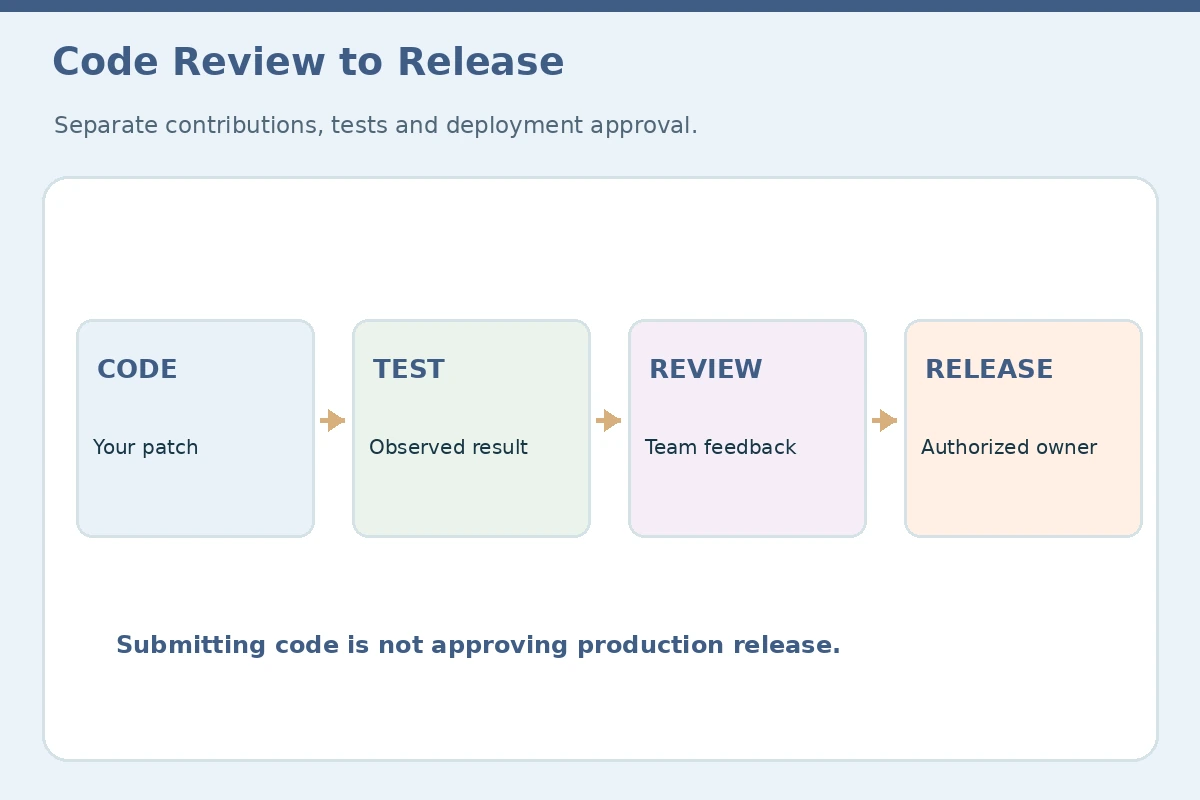
In many teams, a developer proposes changes, reviewers examine them, automated tests run and an authorized owner controls release. This is a useful example of one possible workflow, not a universal deployment policy. A job description that says “own features” may still have approvals for security or production changes. Ask who reviews code, which checks block merging and what happens when an issue is found after deployment.
When describing previous work, say “submitted a change for review,” “tested a component locally,” or “helped investigate a production bug” if those are true. Avoid “managed the production release” if another engineer performed that step. Clear ownership builds trust in a remote team where decisions are often recorded in issues, tickets and code reviews.
Treat Credentials and Production Access as Controlled
No legitimate portfolio needs live customer passwords or internal configuration files. Separate public demo content from private environments, and use placeholders only in your own learning project where they cannot be mistaken for real secret values. A remote employer may require approved devices, access policies and authentication. Follow the actual employer’s rules; do not copy private repositories or customer data into personal services to show your abilities.
If asked to complete a hiring exercise, clarify the permitted environment, the expected deliverable and whether your code will be used commercially. Do not install unknown tools or run scripts from an unverified recruiter. Use a safe local project and clearly explain any security assumption. If an assignment requires production access before legitimate onboarding, treat that as a serious verification concern.
Evaluate Time-Zone and Team Collaboration Requirements
Remote development is not necessarily independent solo coding. Some roles have daily standups, scheduled pairing sessions, urgent incident coverage or customer demonstrations. Check the posting for core hours, geography, support rotations and required communication tools. Do not assume the employer permits work from any location or that a fully asynchronous team has no deadlines or meetings.
Prepare examples of a clear issue report: observed behavior, reproducible steps, expected result, test environment and the person who reviewed the fix. Be specific about what you measured rather than claiming a universal speed gain. An employer may value understandable documentation and review feedback as much as speed. Describe how you handle uncertainty and ask questions before modifying sensitive components.
Apply Through a Verified Employer and Tailor Evidence
Use a vacancy on the employer’s official career page or a reliably linked application system. The FTC warns of remote-job scams where fake recruiters use text messages and payment requests. Verify email domains and hiring steps independently before sharing identification documents or installing tools. A promised senior developer position after a short anonymous chat should not override these safeguards.
Tailor your project description to the vacancy: front-end accessibility, API work, maintenance, testing or interface design, as applicable. Keep tool names, project dates and ownership accurate. Save an employer-specific list of technical questions about review, deployment, data access and on-call expectations. A thoughtful application demonstrates dependable engineering boundaries, not just a long stack of keywords.

How We Research Work-From-Home Jobs
On 2026-11-14, we checked these sources: BLS: Web Developers and Digital Designers — BLS describes website creation, testing, code, collaboration and varied educational expectations for web developers.; FTC: How to Avoid Work-from-Home Job Scams — FTC advises independent employer checks, no up-front payment for a promised remote job, and caution about fake checks.; FTC: That Job Offer Text Is Probably a Scam — FTC warns that unexpected remote-job texts and job offers with no specific duties may be scams.. We reviewed search results and compared topics with the supplied WordPress export and the preceding packages, distinguishing role-specific facts from our original application frameworks. All sample statements are hypothetical and should be replaced with true experience. This guide does not verify open vacancies, employer promises, individual eligibility, hiring outcomes or compensation. Always check the employer and current posting independently. Read our affiliate disclosure. No sponsored placement or affiliate approval is claimed here.
Related Job Search Guides
Some employers consider junior remote developers, but requirements vary. Show reviewable projects and read the specific vacancy.
Not universally. A permitted portfolio, case study or code sample may be appropriate depending on the employer.
Only with authorization. Do not share proprietary repositories, credentials, customer data or protected material.
No. Check time-zone overlap, live meetings, on-call duties and release windows in the actual job description.
Describe your contribution accurately, such as implementing and testing a feature that another authorized person deployed.