
When asked “Why did you leave your last job?” state the accurate reason in plain language, give only context needed to understand the transition, and explain what you are looking for next. You do not need to disclose every personal detail or attack a former manager. You also must not disguise a dismissal as a voluntary resignation or claim a contract ended if it did not.
The wording below is hypothetical and should be adapted to actual facts. Employment records, reference practices, and verification processes vary; this is interview communication guidance, not a legal conclusion about what any employer can ask or discover.
Identify the Actual Type of Departure
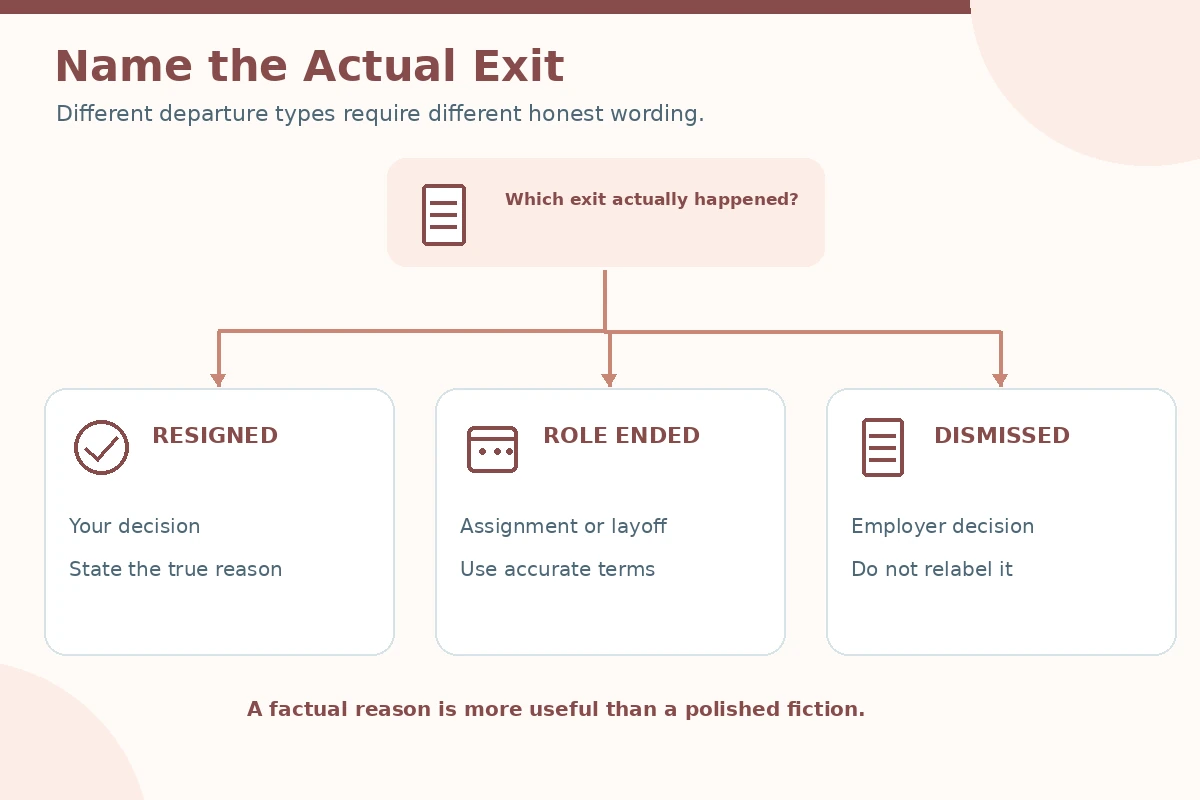
Before practicing, write down which event actually happened: you resigned, the assignment reached its stated end, the employer eliminated the role, the employer dismissed you, or you stepped away for another honest reason. These are not interchangeable labels. A voluntary resignation to pursue new work should not be described as a layoff; an employer-initiated separation should not be described as your personal decision.
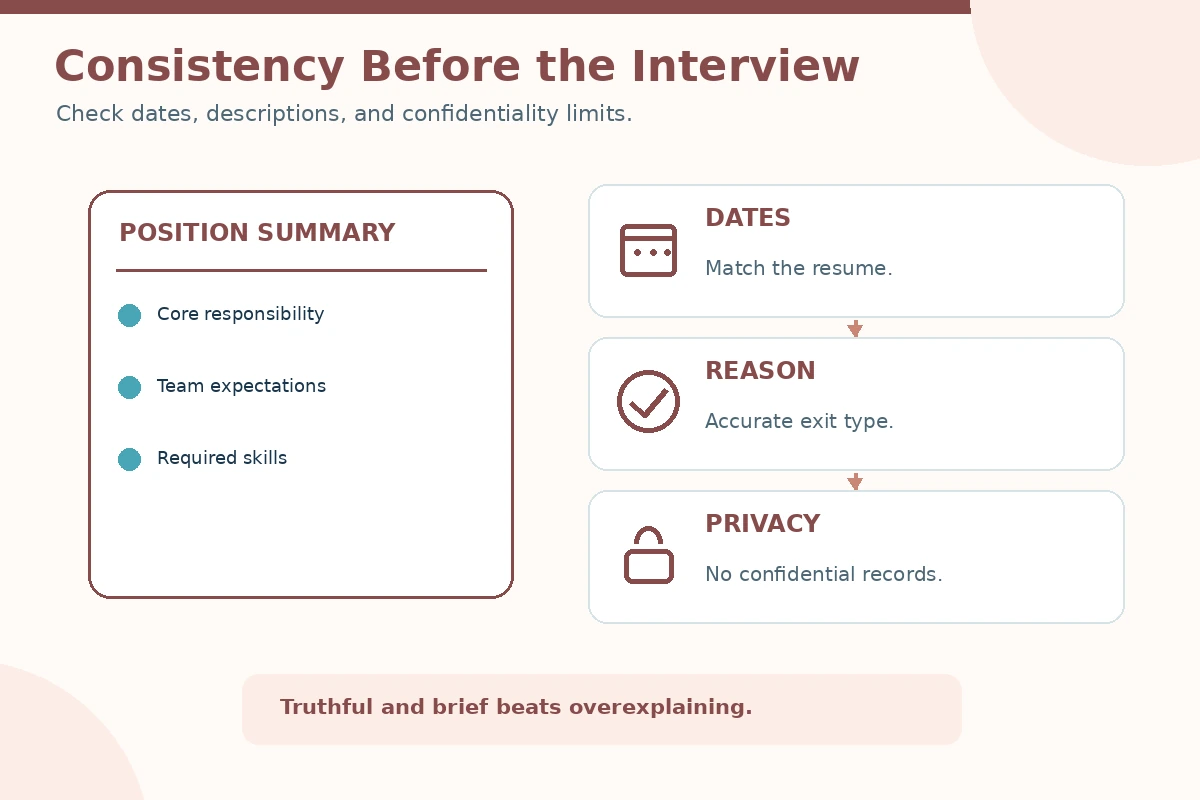
Check that your explanation is consistent with your resume dates and any forms you complete. A gap after the final date does not create a duty to volunteer sensitive family or medical information. But if you are asked about the chronology, answer truthfully and avoid adding details that you cannot confirm.
Give the Reason Without a Long Defense
For an ordinary planned change, a one- or two-sentence answer may be enough: “I left after completing a period of customer-facing scheduling work because I wanted to focus on operations coordination. I am now looking for a role involving accurate schedules and team handoffs.” The candidate is explaining a professional direction, not making unsupported claims about the former workplace.
If you still work in the role, correct the question gently: “I am currently employed and exploring roles with more direct responsibility for inventory records.” Avoid exaggerating frustration about what the present job lacks. UMass Dartmouth Career Center includes questions about reasons for leaving among the common interview questions to prepare.
Explain Layoffs and Assignment Endings Precisely
If a position was eliminated as part of a staff reduction, state that it was an employer decision, provided that is true. Do not imply that every layoff reflects company-wide financial distress. An honest illustration: “My position ended when our department reduced the number of support roles. I completed the handoff of my assigned records and am looking for comparable scheduling work.” Only use the handoff sentence if you actually did it.
If a seasonal assignment ended on its scheduled date, say so. An internship, a temporary agency assignment, and a regular role can all have different end conditions. Interviewers may ask what you learned; point to tasks you handled or a project you can discuss. Do not promise a favorable reference from a former supervisor without their permission.
Address an Involuntary Separation Without Inventing a Story
If you were dismissed, prepare a factual description that does not evade direct questions. You can keep the context short, acknowledge an identified performance or conduct issue if it is accurate, and explain a specific change you have made since. A hypothetical response: “My employment ended after repeated scheduling errors. I took responsibility for improving how I verify changes, and I now use a written confirmation step when I coordinate dates.” Do not use that story unless it is yours.
If the circumstances are disputed or involve legal, discrimination, or confidentiality questions, get advice appropriate to your situation before assuming a universal script applies. A Penn Career Services article discusses explaining difficult departures diplomatically; diplomacy should not turn into a false statement of what happened.

Avoid Blame and Protect Sensitive Information
It is possible to report a difficult environment without describing former coworkers as incompetent or sharing internal records. Instead of “My boss never knew what was happening,” you could truthfully say, “I was seeking a role with clearer ownership of scheduling decisions.” Only give that explanation if it reflects your real reason and the roles you are pursuing.
Keep private data private: customer names, confidential health details, internal pricing, and coworkers’ performance notes do not belong in an interview example. It is also acceptable to say a personal circumstance is resolved or that you are available for the required schedule without giving a detailed personal history, as long as the statement is true.
Bridge From Your Departure to This Role
After you have accurately answered the reason question, connect the move to one responsibility in the new posting. This changes the conversation from explaining the past to evaluating a real opportunity. “That is why the documented scheduling and cross-team handoff duties in this posting interest me” is useful only if those duties are actually included in the role description.
If your reason for leaving was unrelated to career advancement, do not manufacture an ambitious plan. You can say that the earlier assignment ended and that you are seeking steady work with responsibilities you are qualified to handle. The forward-looking sentence does not erase the past; it simply helps the interviewer understand your present search.
Rehearse Difficult Follow-Up Questions
Practice three follow-ups: “Was this your decision?”, “Would your previous employer describe it the same way?”, and “What would you do differently?” A clear answer should be consistent across those questions. Write down factual dates, your last role title, and any role-ending notice you actually received, while keeping confidential documents out of the interview.
If you cannot recall an exact date or label, say you will verify rather than guessing. Likewise, do not declare that background checks can or cannot reveal a separation reason: procedures and permissible information differ. The safe principle is to be accurate and brief, not to wager on what an employer might find.
How We Research These Interview Answers
JobAsk reviewed Umassd career guidance, Careerservices career guidance, Bc career guidance on October 27, 2026. We used these sources for the purpose of common interview questions, evidence-based answers, and candid role-fit discussions. The practical diagrams are our original teaching aids, not employer policy. All sample wording is hypothetical and must be adapted to actual job descriptions, experience, and the candidate’s circumstances.
JobAsk does not guarantee an interview, an offer, or a particular employer decision. The examples contain no paid referral. For site-wide commercial relationship information, read the affiliate disclosure.
Write an accurate one-sentence reason, add only essential context, and state what you seek in the next role. Test it against your work history and real documents. If a truthful answer requires individual legal advice, do not substitute a generic interview script.
More Interview Preparation Guides
- Why Should We Hire You? Match Job Requirements to Evidence
- What Is Your Greatest Weakness? Give an Honest Interview Answer
- Went Above and Beyond Interview Answer: Show Extra Value Without Overclaiming
- Greatest Achievement Interview Answer: Choose a Story You Can Prove
- Conflict With a Coworker Interview Answer: Show a Fair Resolution
No. Use an accurate description of the departure and provide concise context if asked.
No. Explain relevant facts and your next-step goals without sharing confidential or personal attacks.
Yes, if the assignment genuinely ended at that time. Do not relabel an unrelated separation as a scheduled contract end.
You can usually describe the transition briefly without volunteering sensitive details, while remaining truthful about your availability and work history.
Only if that accurately describes the employer’s decision. Use verified circumstances instead of adding assumptions about the organization.