
To answer “Why do you want to work here?” name a verifiable reason this employer interests you, connect that reason to a responsibility in this particular position, and briefly show how your real skills apply. A credible answer does not need to praise a company as the best in its industry. It needs to demonstrate a deliberate choice rather than a copied statement.
This guide is for a U.S. job seeker preparing for a screening or hiring-manager interview. All sample wording below is hypothetical and must be changed to match what you actually know. If an employer has little trustworthy public information, be open about the specific job duties you can verify instead of inventing a company mission.
Separate Employer Interest From Role Interest
“I like your company” and “I can perform this job” are different claims. The first should point to a real practice, product, customer group, public project, or service the employer describes. The second should point to a posted responsibility you want to perform. An answer that includes both tells the interviewer why this opportunity, rather than any opening with the same title, merits your attention.
For example, a hypothetical candidate applying for an operations assistant role might note that the employer publishes a clear description of how it serves several branches, then connect that coordination work to their own experience scheduling volunteers. The volunteer work does not prove they already know the employer’s software, but it gives an honest starting point for a discussion of scheduling and handoffs.
Research One Fact You Can Defend
Read the current job posting first. Then check the employer’s own about, services, products, customer support, or careers pages. If you mention a public initiative, use a page or announcement you can name. An employer review, an unverified social post, or an old news item can provide questions for further research, but it should not be stated as confirmed company policy.
Write down the fact in plain language and ask whether it changes your interest in the work. “Your careers page describes cross-team dispatch coordination” is stronger than “You are famous for an amazing culture.” The first is checkable. The second may claim inside knowledge you do not have. Career guidance from Harvard FAS likewise emphasizes researching the employer and position before the conversation.

Build a Three-Link Answer From Evidence
Use a concise structure: employer fact → role task → relevant experience. First, say what you learned. Second, name the work you hope to do. Third, describe one real action you have taken that suggests you can contribute. The experience could come from a paid role, a documented class project, supervised volunteer work, or another genuine setting. Avoid making the final link a prediction of guaranteed success.
Hypothetical wording: “I noticed the position involves answering service requests and keeping accurate handoff notes across shifts. In my campus event role, I maintained a shared request log and confirmed changes with the next volunteer team. I would like to apply that careful follow-through in a role where records help coworkers respond consistently.” Replace every detail with your actual experience and the real posting.
Adjust the Answer for Limited Experience
A first-job applicant does not need to imitate a seasoned manager. Identify the part of the role you understand, then discuss how you have learned or practiced a closely related task. If the job requires direct customer contact and you have only class-group experience, call it group communication rather than customer service experience. A genuine difference in scope is better than overstating your readiness.
Try: “I applied because the posting highlights greeting visitors and directing questions clearly. I have practiced listening, checking instructions, and recording requests in a school club, though I have not worked at a front desk. I am interested in learning the location’s actual procedures and handling the parts of the role I am trained to do.” This demonstrates interest without pretending to have held that job.

Handle Mission and Culture Claims Carefully
Values can be relevant, but slogans are not proof of how people work. If the organization publishes a mission, mention the particular activity behind it. “Your annual report describes supporting community training programs” can be checked; “everyone here is supportive” cannot be known from outside. If the interviewer mentions a process, ask a thoughtful follow-up rather than assuming the process is universal across all teams.
You may also have ordinary motivations such as schedule compatibility, pay, a shorter commute, or seeking stable work. These are valid reasons to evaluate an offer, but an interview answer can focus on the job duties you intend to perform. There is no requirement to pretend a personal calling or repeat a company slogan you do not believe.
Practice a Natural Answer, Not a Script
Write three note cards: one employer fact, one required duty, and one experience example. Practice saying the connection out loud in roughly a short paragraph. Do not memorize a speech so closely that a changed question derails you. If asked specifically “Why this role?” spend less time talking about the company and more time on the work itself.
After rehearsing, remove generic filler such as “innovative leader,” “dream workplace,” or “perfect match.” Replace it with an observed fact and a modest contribution you can explain if challenged. Penn Career Services recommends using employer research rather than relying on empty excitement; your own voice should still be apparent.
Use a Final Fact-Check Before the Interview
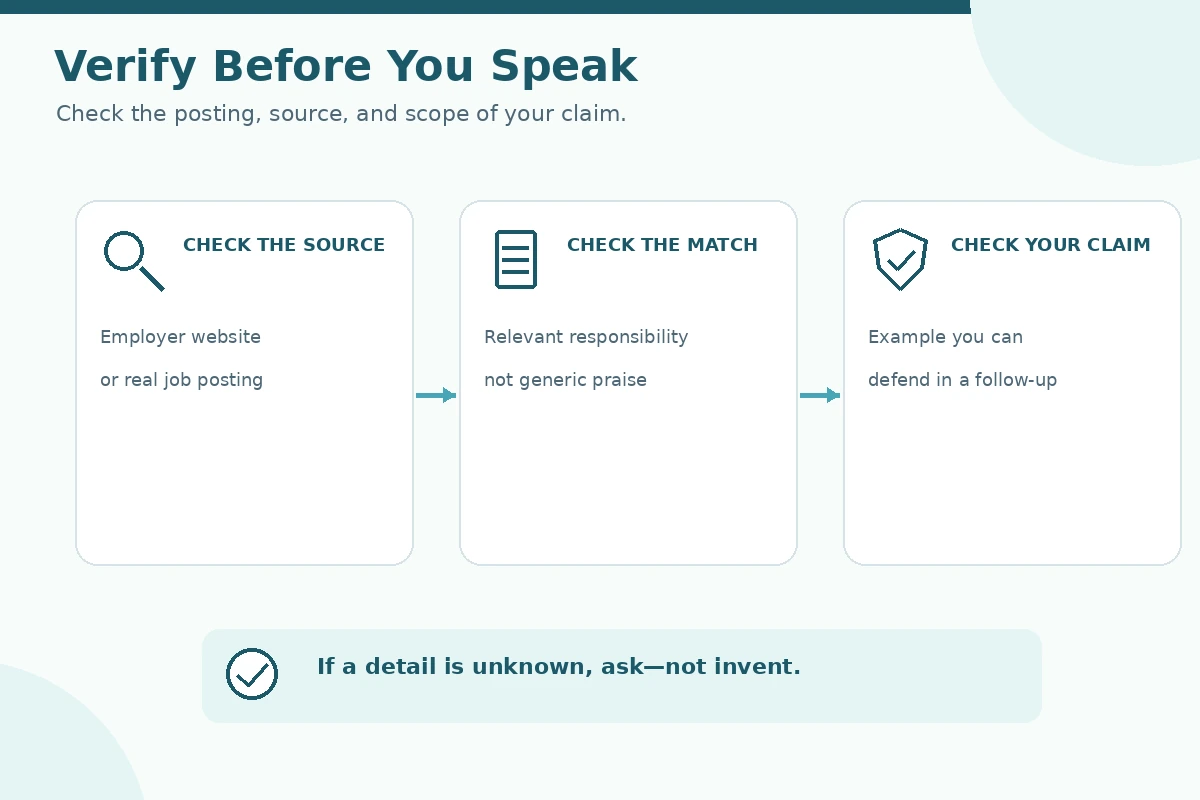
Check that the posting is for the right location, team, and title. Companies can have similarly named positions with very different responsibilities. Confirm whether a claim came from the employer, the job description, or an opinion. Remove details that are not current or that you cannot trace to a reliable source.
If the interviewer explains that the day-to-day work differs from the posting, acknowledge the clarification and adapt honestly. You can say, “That helps me understand the emphasis on customer follow-up; I have more direct experience with records and would want to learn your support process.” The goal is mutual fit, not a flawless performance that conceals important gaps.
How We Research These Interview Answers
JobAsk reviewed Careerservices career guidance, Careerservices career guidance, Unh career guidance on October 27, 2026. We used these sources for the purpose of common interview questions, evidence-based answers, and candid role-fit discussions. The practical diagrams are our original teaching aids, not employer policy. All sample wording is hypothetical and must be adapted to actual job descriptions, experience, and the candidate’s circumstances.
JobAsk does not guarantee an interview, an offer, or a particular employer decision. The examples contain no paid referral. For site-wide commercial relationship information, read the affiliate disclosure.
Before your interview, prepare one employer fact you can cite, one duty taken from the job description, and one experience example that is true. If any link is missing, ask for clarification rather than improvising a company claim.
More Interview Preparation Guides
- What Motivates You at Work? Explain the Fit Without Pretending
- Tell Me About a Mistake at Work: Explain the Fix and Prevention Check
- Work Under Pressure Interview Answer: Show Calm, Safe Choices
- Career Goals Interview Answer: Explain Your Next Step and Plan
- Teamwork Interview Answer: Show Your Part in a Shared Result
Pay and stability are legitimate considerations. For this specific question, connect your answer to verifiable duties and what you can contribute without making up enthusiasm.
Use the actual posting, a verified service description, and questions for the interviewer; do not invent a mission or culture.
Usually no. Refer to a real activity connected to the mission and explain your own relevant interest.
Yes, if the example is real and described at its actual scope rather than represented as paid professional experience.
Specific enough to name a real employer detail, an actual job responsibility, and one truthful skill or example you can explain.