
A useful 3D artist resume summary tells a reviewer what you create, how you work, and where your work can be inspected. Start with the role you can support—prop modeler, environment artist, character artist, or generalist—then select two relevant technical strengths and a specific portfolio reference. Do not present class exercises as studio commissions or a team project as your solo achievement. The short paragraph should lead to proof, not replace the portfolio.
Choose the exact type of 3D work first
Read the posting for the deliverable rather than collecting every animation keyword. Environment models, stylized character meshes, product visualization, and rigged animation demand different evidence. A junior asset-modeling opening may emphasize clean topology and texture files while a character position asks for anatomy, deformation, or sculpting. Write down which examples you can actually show. If your portfolio consists of product renders, do not call yourself a character animator just because both jobs involve three-dimensional software. Your first phrase should narrow the work rather than make a sweeping claim about all of 3D production.

Link one portfolio asset to each important claim
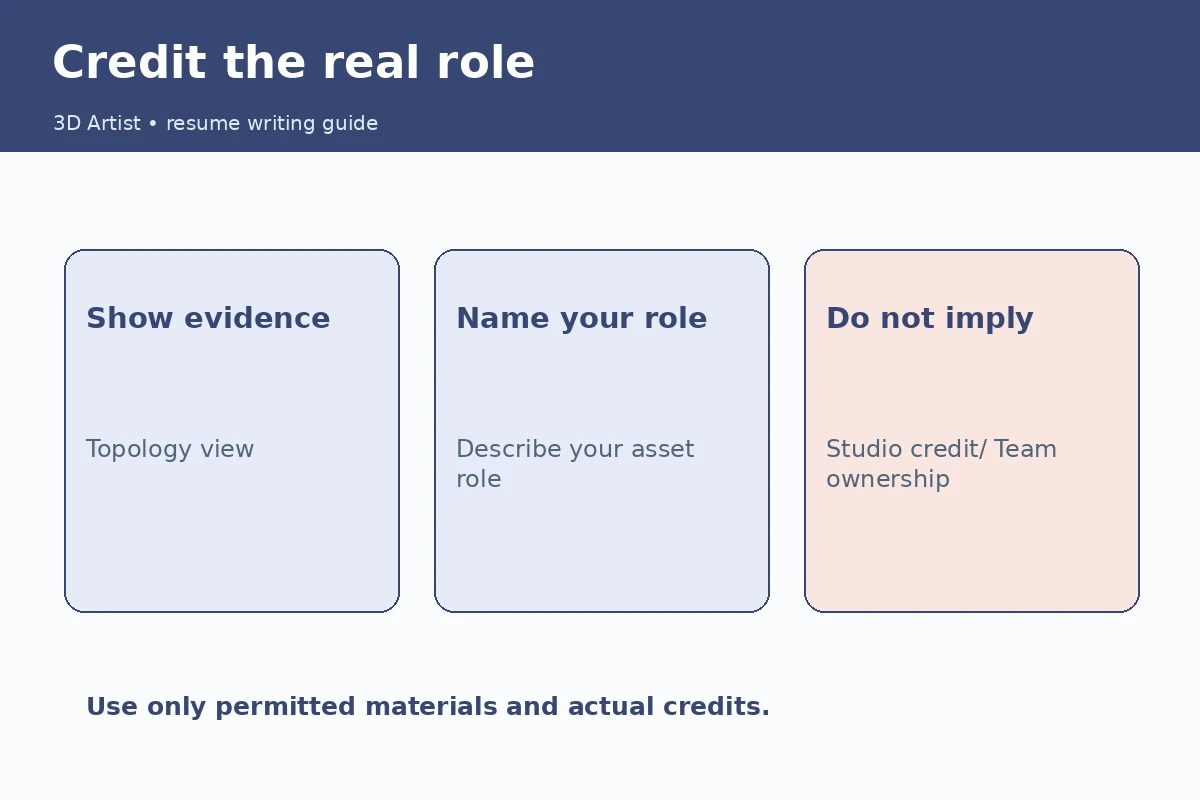
A summary is credible when its nouns point to inspectable artifacts. For modeling, show at least one wireframe or viewport image; for texturing, a material breakdown; for an animation claim, a clip with your precise contribution identified. If the portfolio is a single reel, give the reviewer a visible project title and your role on that project. A self-directed asset is legitimate work to discuss if clearly labeled as self-directed. A portfolio does not need a fictional client, an invented shipped title, or an unverified performance gain to demonstrate technical decisions.
Write a two-sentence version with real scope
A fictional beginner might write: “3D artist creating original environment props and textured assets in Blender. Portfolio documents modeling steps, UV layouts, and changes made after peer critique.” This example describes process and evidence without claiming employment. A practitioner with real studio work can substitute an actual specialty, production context, and approved credits. Keep the final version short enough to scan and put software names only where you used them independently. Your experience bullets should supply the project details that the introduction intentionally leaves out.
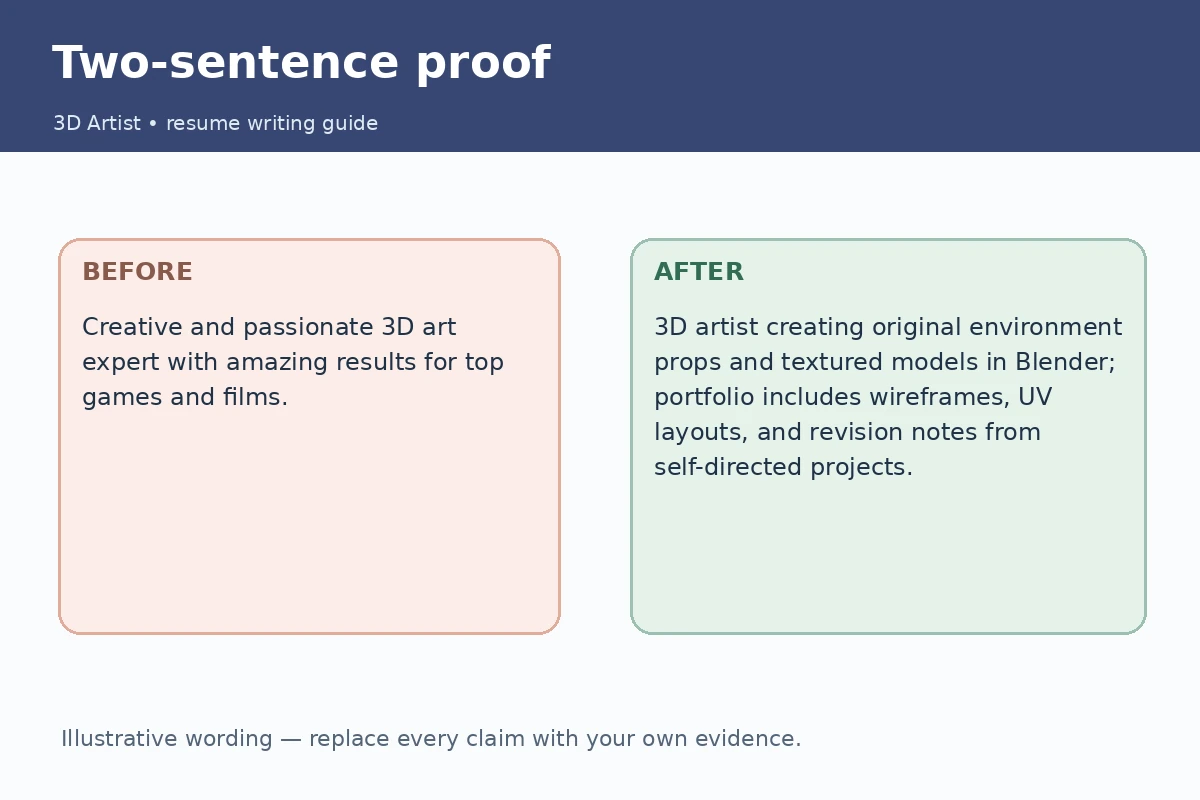
To audit the example, locate its three claims in the actual portfolio: original environment props, use of Blender, and a documented revision process. A render without a wireframe may not show the specific modeling technique asserted. If a file was assembled with teammates, its caption should separate their work. For a texture-only contribution, replace the word ‘modeling’ with the exact material or surface work you performed. This is why a narrow, linkable example gives a reviewer more information than adjectives such as versatile or world-class. The sample is illustrative; substitute your documented work and tools before using it.
Separate a team credit from a solo asset
If a shared game prototype contains your models but someone else designed the level, explain the split. “Modeled three environment props for a student game team” is materially different from “Designed the full game environment.” Specify whether you built meshes, authored textures, optimized assets, or only gave feedback. Ask collaborators before showing work that includes their unreleased material. This caution protects your credibility and avoids exposing assets you do not have permission to distribute. The small summary should not imply ownership broader than the supporting bullet, portfolio caption, or credits page.
Match tools to the work you can demonstrate
A job description may name Blender, Maya, Substance tools, Unreal, or another pipeline. Add only software you have used for the relevant action: modeling, UV preparation, texturing, rigging, or scene assembly. A tutorial watched once is not production experience. For a beginner, “Blender modeling and UV unwrapping in original projects” is clearer than “expert in all 3D pipelines.” Do not claim a proprietary studio workflow unless you actually worked within it. If you learned a tool in coursework, say so where appropriate and show the finished educational exercise in the project section.
Avoid invented render speeds and optimization scores
Claims about reduced polygon counts, saved hours, improved frame rates, or increased engagement need records and a defensible measurement method. You may know that you cleaned a mesh, corrected normals, or resolved texture seams without having a verified percentage improvement. State the action accurately: “Rebuilt UV islands to remove visible texture stretching in a practice scene.” That communicates a real decision without borrowing a business outcome. When you do have a documented performance comparison, explain the baseline and testing context in the project description rather than squeezing an unexplained statistic into the summary.
Make feedback and iteration visible
Art employers may value a candidate who can interpret critique and revise a deliverable. Choose a project where your before-and-after views demonstrate a specific improvement, such as readable silhouette, lighting adjustment, or a corrected edge flow. State whether the comment came from a class critique, peer, supervisor, or your own review; do not invent client signoff. Your summary can mention “iterative asset development,” but only if the work demonstrates multiple states. For collaborative work, a concise caption can show who reviewed the version and what exactly you changed.
Run a final summary-to-portfolio audit
Read every phrase in the opening and point to its evidence. Does the linked portfolio open without sign-in? Can a viewer tell which assets are yours? Does the summary match the actual medium and software versions without overpromising? If the answers are unclear, replace a broad adjective with a concrete task or remove the claim. Keep links short, working, and relevant to the application. A plain, readable resume matters more than decorative fonts, and an accurate project record will hold up better in an interview than an impressive but unsupported label.
How We Research Professional Resume Summaries
We reviewed BLS occupational guidance; Penn Career Services resume guidance; Berkeley Career Engagement resume guidance to separate the tasks typical of this field from what any particular applicant actually did. Occupational descriptions inform which terms to explain, but they are not proof that a named person has the listed credentials. The resume resources emphasize targeted, specific evidence. Examples on this page are hypothetical; they must be rewritten to match your records, permissions, and the job posting. We do not invent employment, project outcomes, certifications, test scores, salary, or hiring assurances. Check your current employer requirements and refer to our affiliate disclosure before relying on any linked recommendations.
More Resume and Cover Letter Guides
Yes. Describe it as student or self-directed work and identify your own modeling, texture, or animation contribution.
No. Prioritize tools you used for the opening’s main tasks and place the rest in a truthful skills section.
Only when it actually shipped and you have permission to describe your specific contribution. A prototype is not a released commercial title.
Include accessible project views, your exact role, and process evidence such as topology, texture, or revision notes.
No. Use a metric only when recorded and attributable; otherwise describe the actual technical improvement.