
A mechanical engineer resume summary is most useful when it links a design domain to tangible engineering work: modeling, analysis, drawings, prototyping, testing, or manufacturing collaboration. Put the equipment or product area and the part you personally contributed near the top. A long list of CAD and simulation acronyms without project evidence makes it hard to judge your level.
The Bureau of Labor Statistics describes mechanical engineers designing, developing and testing mechanical devices, often alongside other specialists. A summary should distinguish your calculations and test work from an approved design release, which may require review or licensed authority depending on the work and jurisdiction.
Name the design discipline and product context
Start with the kind of work you actually performed: machine components, thermal systems, fixtures, automotive subsystems, building equipment or test tooling. These areas differ in calculation methods, documentation and validation. “Mechanical engineer with prototype and fixture-design experience” is more meaningful than “passionate engineering innovator.”
If the role is entry level, describe capstone or internship contributions as projects rather than professional product launches. If the posting is about thermal analysis, prioritize relevant heat-transfer work instead of unrelated manufacturing keywords. A narrow true claim is stronger than a broad unsupported one.
Make CAD and drawing contributions verifiable
Name the software you used and the output you created: 3D parts, assemblies, controlled drawings, bills of materials or revision changes. Do not equate opening a model with releasing a design to production. Technical reviewers may ask about constraints, tolerances, material choices and how changes were reviewed.
A defensible statement might be “Prepared CAD assemblies and updated controlled drawings for design review.” If you checked geometries but an engineer approved them, state that division of responsibility. Avoid claiming ownership of intellectual property, customer designs or restricted product details.

Distinguish simulation assumptions from validated results
Simulation is an input to engineering decisions, not automatic proof of field performance. If you performed stress, vibration, thermal or fluid analysis, explain what loads, boundary conditions and comparison method you used at an appropriate level. Do not say a design was “fully validated” unless a defined testing or review process supports that conclusion.
For a student project, “compared modeled deflection with bench measurements” can be useful when true. For an employee, “supported load-case review and documented changes for engineer approval” may be more accurate than “certified structural safety” if you lacked the designated sign-off authority.
Describe test work and manufacturing handoffs
Testing can include preparing fixtures, recording observations, comparing results to acceptance criteria, investigating deviations and documenting retests. Manufacturing support can mean clarifying drawing notes, evaluating fit issues or discussing assembly constraints. Name what you measured and whom you informed.
Avoid an invented “zero defects” claim or company-wide savings based on one isolated improvement. A summary is stronger when it describes an actual closed feedback loop: problem, controlled change, verification and approved next step. If a test failed, explaining responsible follow-up is still evidence of engineering judgment.
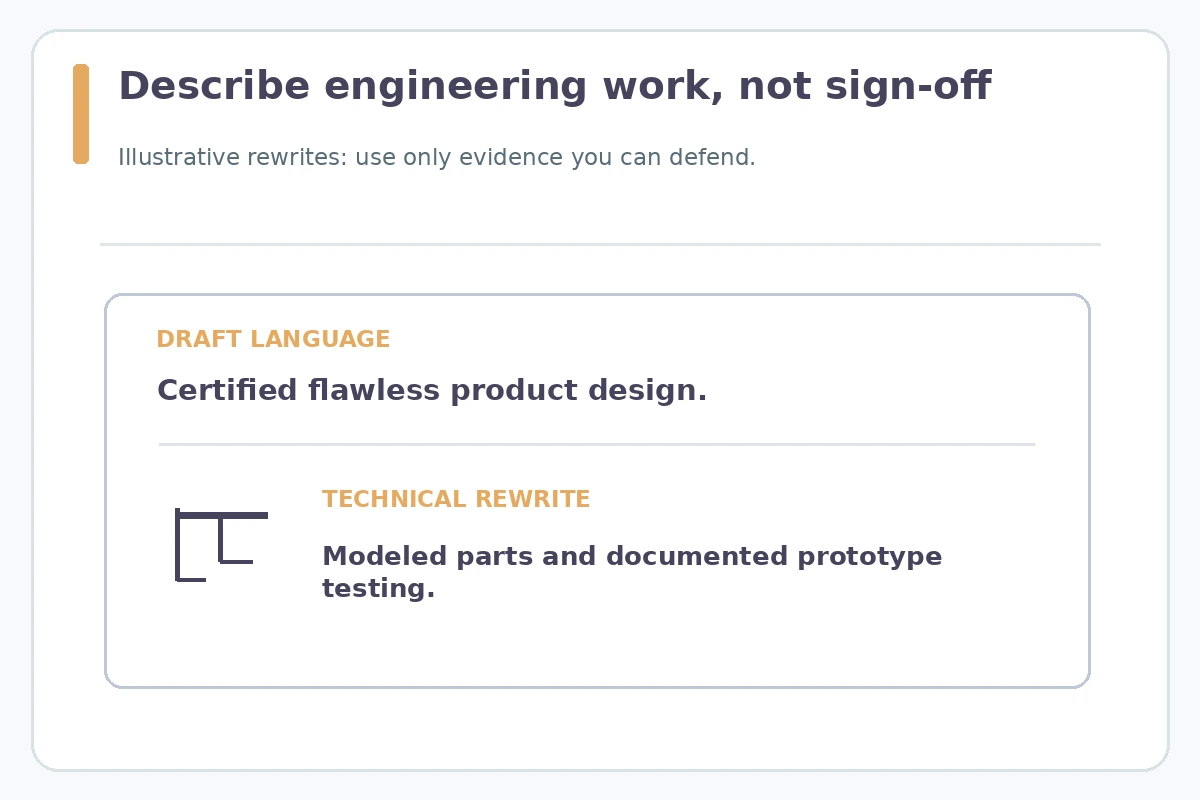
Turn a buzzword-heavy profile into a technical summary
Weak sample: “Visionary engineer who guarantees flawless designs and saves millions with expert tools.” This offers no traceable work and asserts guarantees the candidate cannot substantiate. It may also confuse engineer contributions with management and certification authority.
Illustrative revision: “Mechanical engineering professional with experience building CAD assemblies, preparing drawings for design review, and documenting prototype test observations. Collaborates with manufacturing and senior engineers to resolve fit and verification questions.” Replace “professional” with a truthful status if your experience is only academic.
Tailor the summary to the design-validation stage
Different employers need conceptual design, detailed design, manufacturing support, qualification testing or maintenance analysis. A design-heavy role may value geometric dimensioning and tolerancing; a test-focused role may prioritize instrumentation, repeatability and documentation. Select only the skills and methods you used.
A CAD course alone is not evidence that you controlled a production release. If you completed a team project, distinguish your assigned components from the whole system. The supporting Projects and Experience sections should make those boundaries unmistakable.
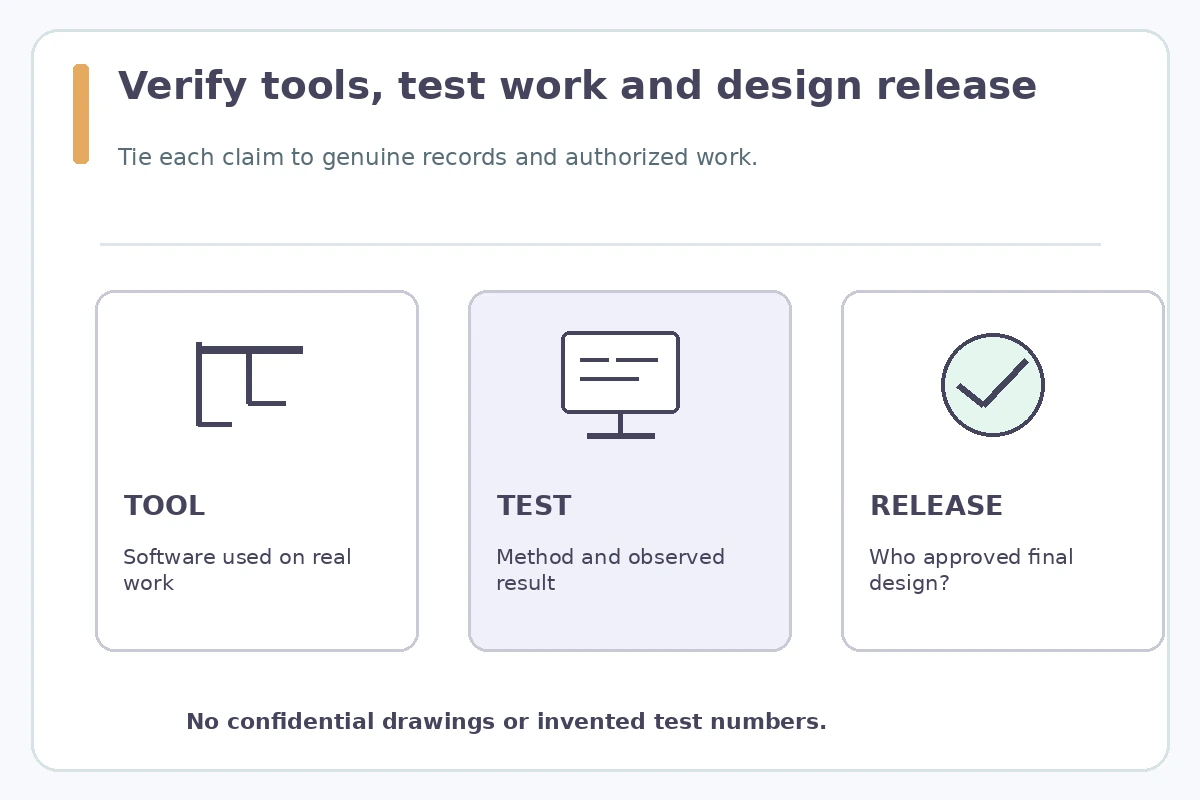
Review confidentiality, approval and credentials
Do not disclose restricted client drawings, unpublished dimensions, proprietary materials, failure modes or test data without explicit permission. You can describe types of analysis and high-level contributions without revealing trade secrets. Any numeric achievement should have a verifiable baseline and clear ownership.
Engineering licensure requirements vary with the work performed and jurisdiction. Do not write “licensed engineer” or use a professional designation without earning it. Before sending the file, check that the summary aligns with the specific tools, project evidence and professional title elsewhere on the resume.
Worked Example: A Summary You Can Defend
Illustrative scenario: A junior mechanical engineer modeled a mounting bracket, revised drawings after team review, and helped record fit-test results. A senior engineer approved the final design. The draft “Led all product engineering and certified the design” exaggerates both project scope and approval authority. A defensible summary is: “Mechanical engineering professional contributing CAD part models, drawing revisions, and prototype fit-test documentation. Works with senior engineers and manufacturing colleagues to review changes before release.” The project section should identify the bracket and the exact tests the candidate personally supported.
This example is hypothetical, not a genuine employer testimonial or a measured hiring outcome. Keep the sentence structure if helpful, but replace every noun, title, tool, credential and claimed contribution with your own verified information. A useful test is whether you could explain the sentence to a hiring manager without adding a qualification that is missing from your resume.
Final Resume Summary Audit Before You Apply
Read the first three lines as a hiring manager would. Can you tell the occupation and work setting? Are the skills tied to observable tasks? Is an employer likely to mistake training for paid tenure, team participation for individual ownership, or a recommended action for final approval? Verify every date, credential, product name and numerical claim against your records.
Compare the summary with the target job advertisement and the evidence in your work-history or projects sections. Do not fabricate percentages, promote yourself to a higher title, or include confidential organizational details to sound impressive. Read the exported resume on a phone and computer so the summary does not become a clipped block of jargon.
How We Research This Guide
We checked official CareerOneStop resume guidance and the applicable Bureau of Labor Statistics occupation description on November 2, 2026, then compared the proposed topic with the supplied JobAsk WordPress list and previous local article batches. Occupational descriptions summarize typical duties; they do not certify any applicant’s skills or guarantee that every employer uses the same responsibilities. All example sentences in this guide are hypothetical. See our affiliate disclosure for site policies.
CareerOneStop resume guide: CareerOneStop explains when a brief 3–4-sentence professional summary helps and recommends relevant accomplishments rather than inflated claims. Reviewed November 2, 2026.
BLS occupational reference: BLS describes mechanical design, analysis, testing and collaboration, including licensure considerations for public services. Reviewed November 2, 2026.
More Resume and Cover Letter Guides
No. Prioritize tools directly relevant to the job and back them with actual project outputs. Put additional tools in a skills section.
Yes, if clearly identified as academic work. Name your own design, modeling and test contributions rather than presenting a class project as a commercial release.
Only with a clear comparison method, genuine measurements or documented model assumptions. Do not treat a simulated result as a verified field outcome.
No. Say you prepared, reviewed, tested or recommended the design change according to your actual responsibility.
No. Licensure depends on applicable jurisdictional rules and individual qualifications; represent any credential accurately.