
If you have not held a paid job, a volunteer supervisor may still be a credible professional reference because they observed how you followed instructions, completed tasks, communicated, and responded to feedback. Ask someone who supervised genuine responsibilities rather than a person who only knows you socially. Identify the relationship as volunteer supervision; do not present an unpaid position as salaried employment. The right choice also depends on whether the employer requests a particular type of reference. This guide uses illustrative tasks, not claims about any applicant’s work history or employer.
Find a supervisor who watched specific responsibilities
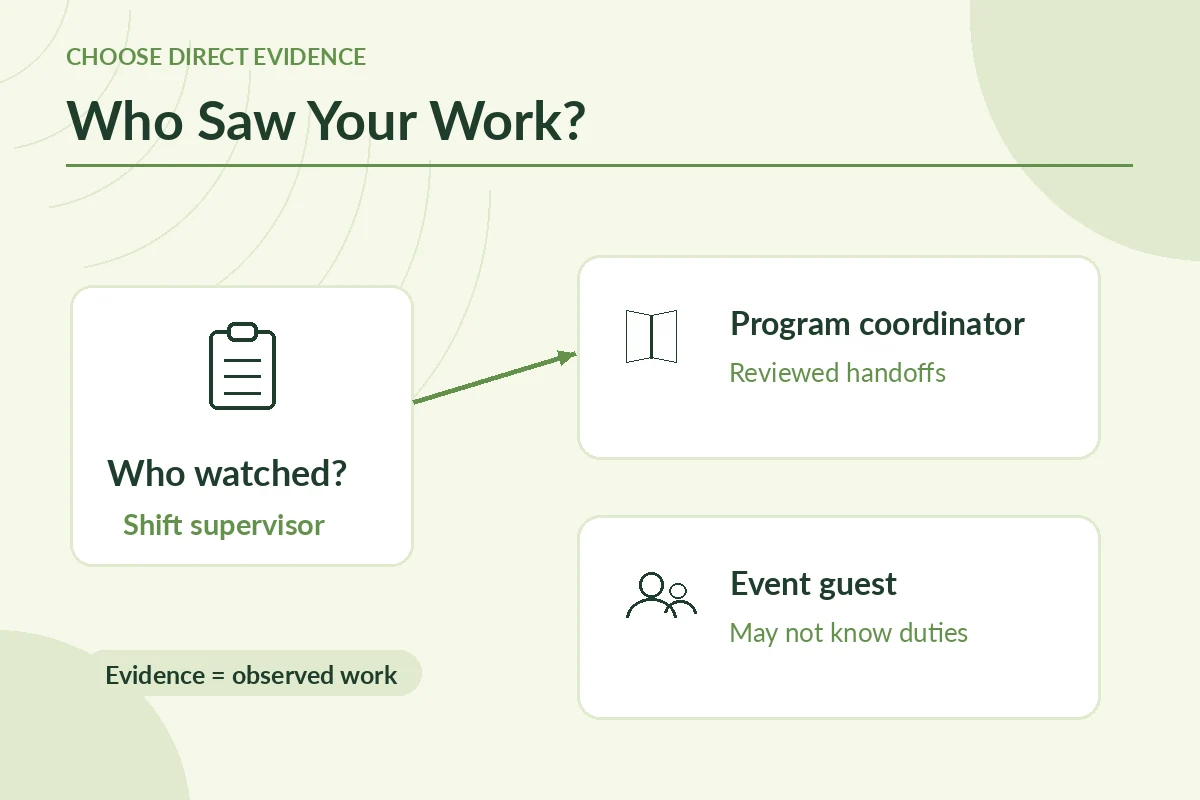
A coordinator who assigned volunteer shifts and reviewed your completed work can often say more than the head of an organization who greeted you once. Consider a library program organizer, a food-pantry shift lead, a tutoring coordinator, or an event volunteer manager. Choose a person who could accurately describe your attendance, work procedures, cooperation, and willingness to ask when instructions were unclear. A person with a prestigious title but no first-hand observations cannot reliably validate those details.
Write down three examples the supervisor personally saw: the dates or period you volunteered, what task was assigned, and a concrete action that shows care or initiative. Do not invent attendance figures, outcomes, or responsibility for confidential records. If you worked with children, patients, or financial transactions, discuss only permitted general work practices and keep protected information out of job-search materials.
Translate volunteer duties into job-relevant evidence
For a first retail role, a volunteer shift might demonstrate greeting visitors, organizing supplies, or following safety instructions. For a clerical role, scheduling appointments or checking a sign-in list may be relevant if those duties were actually permitted and performed. Match the job description to what you did; a strong reference is not a substitute for a required skill or credential. The reference may describe how carefully you learned a process, not claim that you were qualified to run it independently.
A useful three-column note reads ‘Role need: accurate handoffs; Volunteer task: prepared event supply checklist; Observed behavior: flagged missing items to the shift leader.’ This is a hypothetical pattern, not a testimonial. Share the underlying facts with the supervisor and let them decide whether their experience supports them. If the posting asks for paid supervisory experience, do not relabel basic volunteering as management to satisfy the wording.
Ask permission with a modest, specific request
Write: ‘I volunteered with your team during [actual period], helping with [actual task]. I am applying for an entry-level [job title] and wondered whether you would feel comfortable discussing my reliability and communication as a reference. I would only share your contact details if you agree.’ The reference should have the option to decline, especially if the organization has a policy about volunteer references or the supervisor has changed positions.
After agreement, confirm their preferred contact information and professional title. If they can speak only to dates and attendance, that may be useful for verification but may not meet a hiring manager’s request for a performance reference. Ask what scope they feel comfortable discussing; you should not direct them to describe imaginary achievements or say they managed duties they never supervised.

Label unpaid service honestly on the reference sheet
Use an entry such as ‘Volunteer Program Coordinator — supervised my community event shifts at [organization], [period].’ Their current job title may differ. If so, state both the present position and historical relationship without suggesting the supervisor is still with that charity. Include only contact details the person authorized you to share, and store the list outside your public resume. Follow the employer’s format and requested number of references when submitting it.
Do not use ‘former employer’ if this person supervised an unpaid volunteer role; use ‘volunteer supervisor.’ That description is not weaker—it helps the recruiter understand what the person actually observed. An employer can weigh different references appropriately when the relationships are stated plainly.
Combine references from distinct settings when needed
An internship mentor, professor, lab instructor, paid-work supervisor, or volunteer manager may each see a different side of a new applicant. If an employer asks for several references, prioritize people who can independently discuss relevant skills rather than three friends repeating the same character assessment. Check whether the form demands a prior employer; when you have never had one, say so honestly and ask whether a supervisor of unpaid work may be substituted.
A sample mix could include a volunteer coordinator who saw shift reliability, a course instructor who evaluated project accuracy, and a club adviser who supervised group work. This combination is only suitable if those people really know your work and agree to be contacted. Do not add a person merely to fill a third line or create fake organizational email addresses.
Prepare a short, accurate briefing for the referee
Send a copy of the posting and your relevant resume or application description. Highlight the kind of evidence the employer is likely to request—punctuality, communication, learning, or record accuracy—without composing a reference in the other person’s name. For instance, you could say: ‘You saw me use the shift checklist; that is a relevant example if you feel it reflects my work.’ The referee still decides what they can honestly confirm.
If the organization serves vulnerable people, avoid passing along participant details, internal schedules, security processes, or restricted documents. A general description of duties and conduct is enough to support a legitimate first-job discussion. Give the person reasonable notice and tell them when their details have been sent to a recruiter.

Handle a short or old volunteer assignment
A one-day event helper may have little evidence beyond participation. Ask whether the supervisor actually remembers your work before treating them as a strong reference. If they cannot, consider a longer project, a class assignment with assessed work, or a part-time supervisor. A recent reference with substantial observation may be more useful than an impressive-sounding organization with no personal connection.
If volunteering happened years ago, help the person recall the date range and task, then ask if they feel qualified to comment. Don’t send them a polished claim and seek a signature. A brief truthful reference can be better than a long letter containing uncertain details. Where the application explicitly requires employment verification, ask the hiring team what evidence of volunteer service it accepts instead of implying that it is paid work.
Check the list before a recruiter receives it
Run a final verification: did the person opt in, is the relationship clearly marked as unpaid work, can they discuss behavior directly, and are their contact details current? Check that your resume and reference list use compatible dates and role names. Send the list privately only when the process requests it, not as an attachment to every unsolicited message.
After a recruiter contacts your supervisor, send a thank-you and a brief result update when appropriate. Even if this reference does not lead to an offer, keeping the relationship respectful can help you build a genuine professional network over time without exaggeration or transactional pressure.
How We Research Professional Reference Advice
We checked guidance from careercenter.ucdavis.edu; sc.edu; careercenter.umich.edu; careers.bu.edu about selecting people who observed real work, requesting permission, describing professional relationships accurately, and limiting claims to what a reference can genuinely know. The sources describe general career practices rather than rules at every employer. Example names and events here are hypothetical and do not represent an actual reference check, legal conclusion, or hiring outcome. Follow the instructions of the specific hiring organization and use only approved contact information. For commercial relationships and links, review our affiliate disclosure.
More Resume and Cover Letter Guides
It often can when a supervisor observed specific responsibilities. Check the employer’s instructions and label the relationship as volunteer supervision.
Ask whether they can comment on your actual work. If not, use a professor, project supervisor, or other person with better first-hand knowledge.
Do not mislabel unpaid service as paid employment. Identify the person accurately as your volunteer supervisor.
No. Keep examples general and protect confidential or sensitive participant information.
Prefer a person who evaluated or directly supervised your duties when the employer asks for a professional performance reference.