
If a job reference becomes unavailable after you have submitted a list, do not invent an explanation or silently substitute another person’s contact details. First identify what happened: a mistyped email address, an outdated phone number, a busy contact who has not responded, or someone who has withdrawn permission. Correct the fact you can verify. If you need a replacement, ask the new person for consent, confirm their relationship to your work, and notify the employer using the hiring team’s preferred channel. A missing response does not automatically mean the employer has rejected you or that the original reference gave a negative assessment.
University career centers advise confirming contact details and notifying referees before employer outreach. The purpose is to give the hiring team a reliable route to people who can accurately describe your work. When an old employer changes systems or a reference leaves the company, you might need to distinguish an individual professional reference from formal employment verification; those are not identical services. Do not assume a closed business or departed manager means your whole work history is invalid. Identify who still has legitimate firsthand knowledge and what the application actually requires.
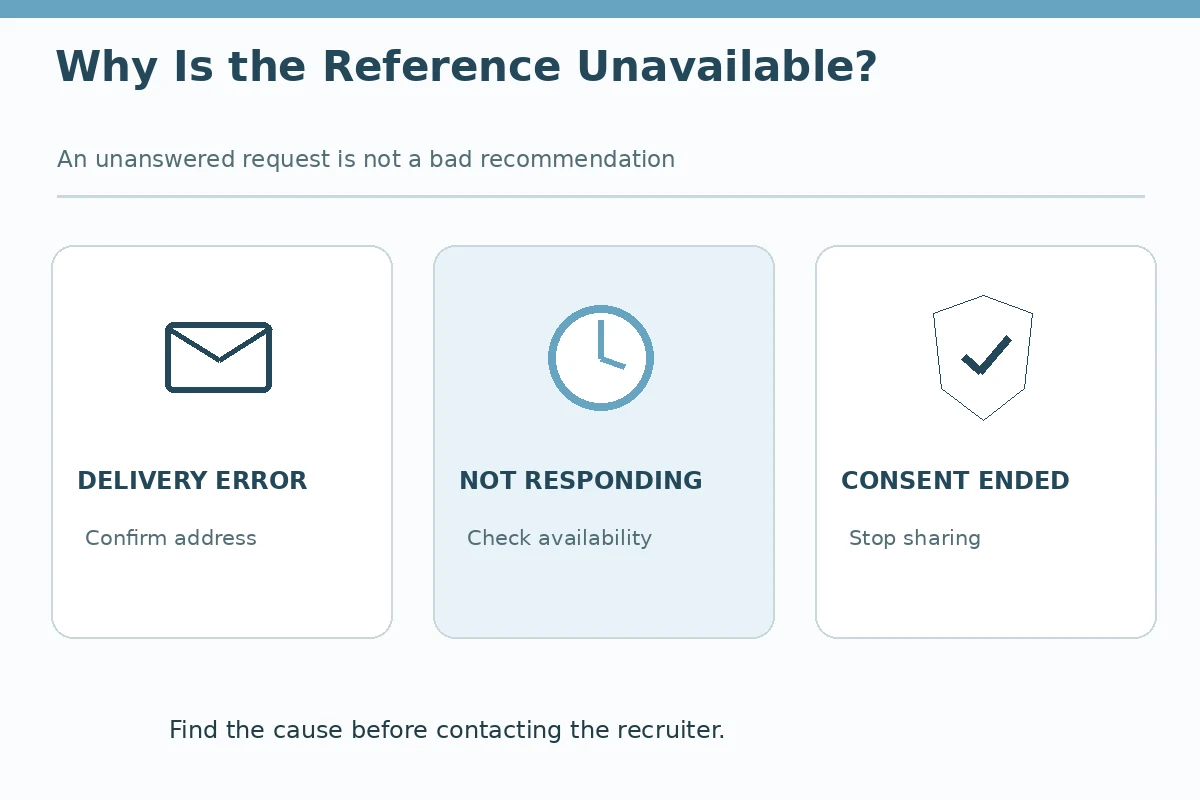
Identify the Reason a Reference Is Missing
Classify the issue before acting. If the name is spelled incorrectly, confirm the correct version with the reference. If the preferred email changed, request the new one directly. If the person has limited availability, ask whether another approved time or channel would work. If permission is withdrawn, stop listing them and tell the employer that a replacement is available, without sharing personal reasons. If the employer requires a former direct supervisor, verify that the new person meets the requirement or ask the recruiter about acceptable alternatives.
Four Steps to Correct a Submitted Reference
Step 1: Determine what is actually wrong
Check the information you submitted against the person’s last confirmed details. A bounced email indicates delivery trouble, not a bad opinion. A missing answer from a busy manager does not prove withdrawal. Contact the person courteously through a previously agreed channel and ask whether they remain willing and reachable. Respect their schedule and privacy; repeated calls to a personal phone may be intrusive.
Important boundary: Do not tell the employer that a reference declined if all you know is that a message has not been returned.
Step 2: Repair the contact details when consent remains
If the reference confirms a new preferred email or number and still agrees, ask how to update the hiring team. Some applicant portals allow edits; others require a brief message to recruiting. State the affected name and the corrected contact method without adding unnecessary personal explanation. Verify the information before sending, because multiple successive corrections can create confusion.
Important boundary: Do not search for a private number online or copy unverified contact information from an old directory.

Step 3: Get an appropriate substitute when necessary
Choose someone who directly observed work relevant to the job and meets the requested relationship requirements. Ask permission and explain the likely timing before disclosing their contact details. A former project lead may be suitable where the employer accepts work collaborators, but not if the form explicitly requires a direct manager and the employer refuses alternatives. Be straightforward about your relationship and avoid inventing supervision.
Important boundary: Do not replace a former supervisor with a friend labeled as a manager or submit a new person before they agree.
Step 4: Update the recruiter without inventing a story
A short message might say that one listed contact is unavailable and that you can provide a confirmed substitute. Include the new reference only through the employer’s requested secure channel and with that person’s consent. If the reference is temporarily unavailable, ask whether the recruiter can wait, try a verified alternate method, or accept another observer. Keep the tone neutral; you do not owe the hiring team private medical or family details about the referee.
Important boundary: Do not claim that the reference was contacted or that a check failed unless the hiring team has confirmed it.
Choose the Right Replacement Route
| Situation | Appropriate action | What to verify |
|---|---|---|
| Incorrect email | Confirm replacement address with referee | Send corrected details |
| Contact temporarily busy | Ask about timing and employer flexibility | Do not infer a negative assessment |
| Permission withdrawn | Stop sharing and request a substitute | Notify recruiter discreetly |
Write a Brief Update to the Hiring Team
Illustrative recruiter message: “Hello Hiring Team, I wanted to correct the reference information I submitted for the operations assistant role. One contact is no longer available to serve as a reference. I have confirmed another former project supervisor who can speak about my scheduling and documentation work. Could you let me know the preferred secure method for updating the reference list? Thank you.” This example does not assert a reason for unavailability or promise that the alternative will be accepted; both must reflect the real situation.

If you learn that the employer already attempted contact, ask what information needs correcting. Sometimes the person never received an automated message or the spam folder blocked a request. The University of Kansas recommends briefing referees when a check is imminent, including the employer’s expected contact channel. You can pass along official sender details if known, but you should not ask the referee to share account credentials or impersonate them. When the issue is technical, an accurate resend may be enough.
An unavailable reference is not a reason to rewrite employment history. Maintain truthful titles, dates and supervisors across the application, résumé and any background form. Employment verification may be processed by HR records while a personal professional reference provides a firsthand account of performance. If the employer needs one type rather than the other, provide the correct route and ask how to meet the requirement. Do not assume a substitute automatically resolves every formal check; the employer decides what it needs.
Confirm the Revised List Before Resending
Before you finish, verify the current permission status of every contact on the revised list, the accuracy of job titles and relationships, and the employer’s instructions for changes. Update only the relevant fields instead of sending a public spreadsheet of everyone’s personal numbers. If the recruiter replies with a new deadline or secure upload location, keep that instruction with your application records. Thank the new referee and, where appropriate, the original referee for considering the request. A factual correction is better than silence or speculation.
How We Research and Verify Reference Advice
This guide was researched against university career guidance checked on 2026-11-14. careers.bu.edu explains boston University explains when to submit a reference list, how to update contacts, and how to describe former relationships. ecc.ku.edu explains university of Kansas recommends confirming references again when the employer signals an imminent check and explaining the employer’s contact channel. myusf.usfca.edu explains university of San Francisco recommends obtaining permission, sharing job context and protecting references’ contact details. All message examples are fictional and must be adapted to real work, relationships, consent and employer instructions. The sources explain common university career-advising practice rather than a universal hiring rule. See our affiliate disclosure.
More Resume and Cover Letter Guides
Not necessarily. Employers control their own process, but an unanswered message or invalid address does not by itself prove a negative reference or rejection.
Often you can request a correction or replacement. Ask the hiring team which secure route and reference type it accepts.
Stop sharing their details, respect that decision, find a suitable consenting alternative and tell the employer accurately that a replacement is available.
Only provide factual, relevant information you know and are comfortable sharing. Do not speculate about private reasons or invent a story.
Yes, if delivery failed, you can ask whether a resend or corrected approved address is possible. The referee must complete their own response.