
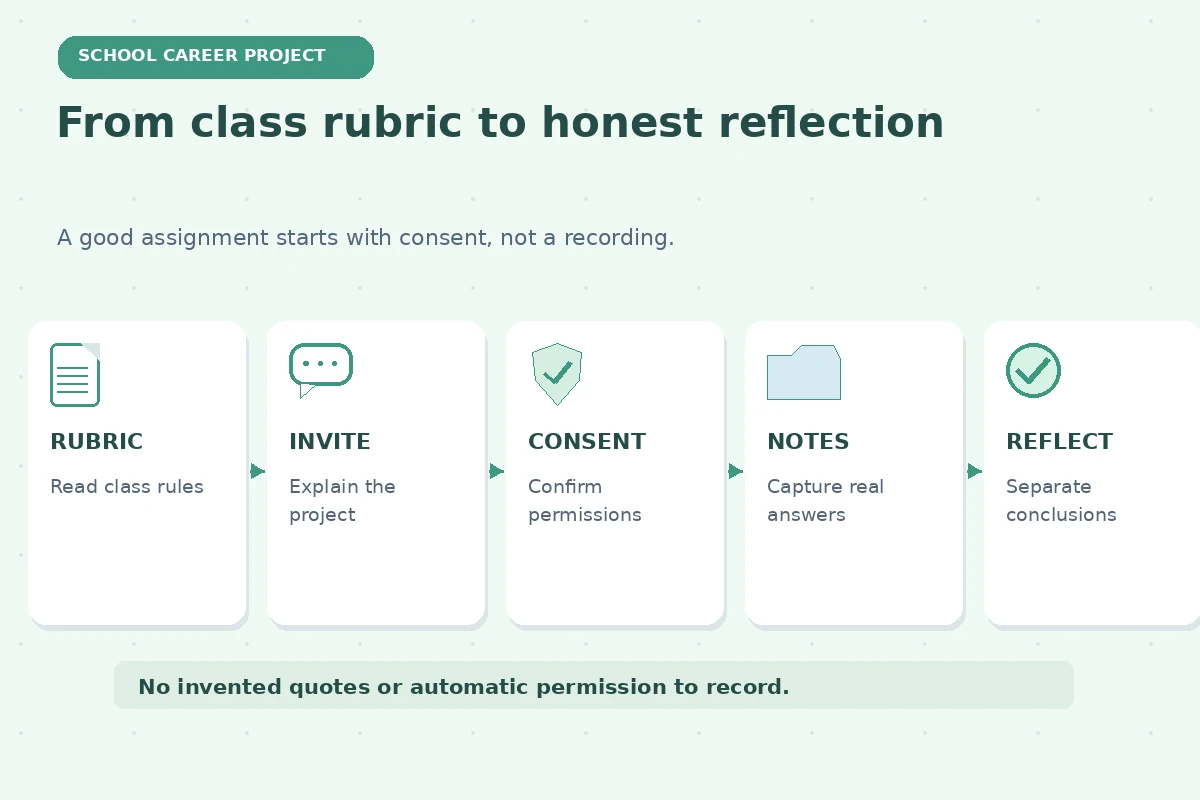
A career interview assignment asks you to learn about a person’s occupation through a short, permission-based conversation and then report what you learned. It does not require the professional to share confidential employer information or agree to a recording. Start by reading your instructor’s rubric, confirm the person is willing to speak, ask open questions, and distinguish actual answers from your interpretations. The example below is fictional so you can practice the structure without inventing a source.
Read the classroom rubric before contacting anyone
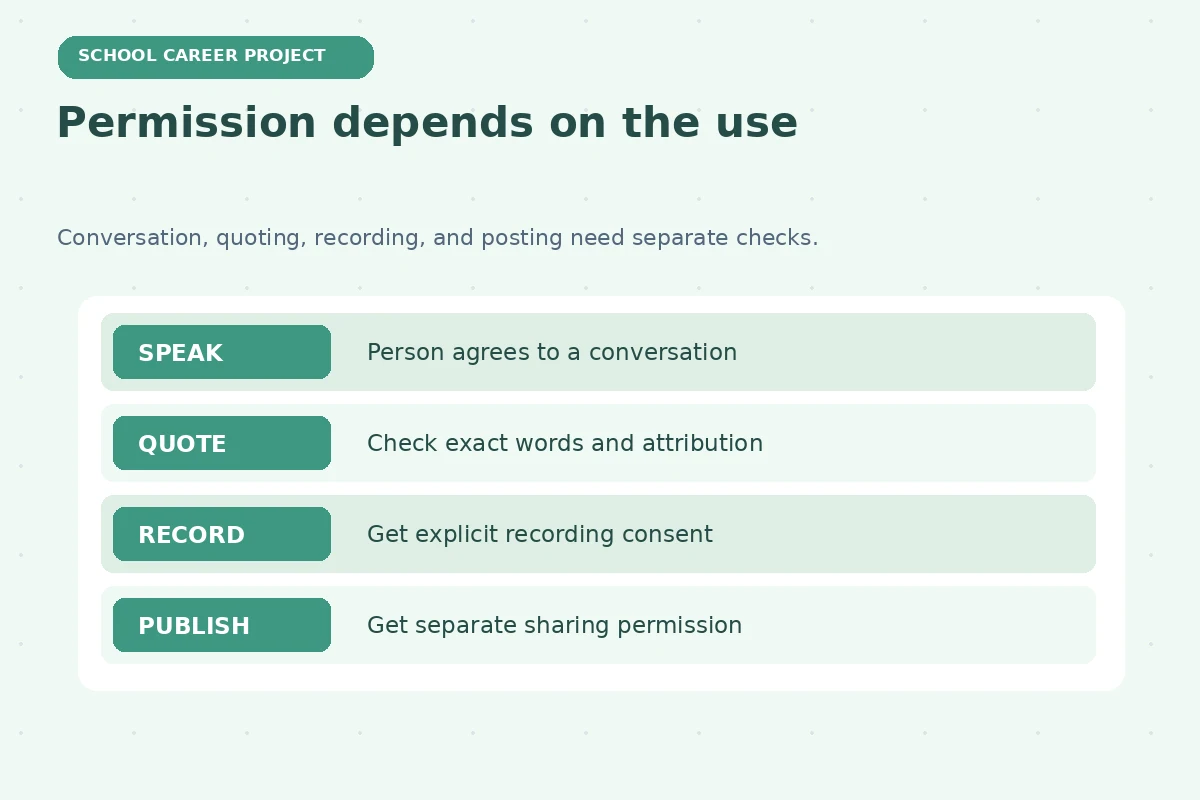
Look for the requested format, required number of questions, deadline, word count, and any school rules about interviews with adults, parental permission, accessibility, or remote meetings. A class assignment could ask for a transcript, a reflection, a slide, or a summary; these are not interchangeable. If the teacher requires a recording, learn the school’s procedure and applicable consent rules before asking a potential interviewee. Do not assume you may capture audio automatically.
Identify a professional whose actual job aligns with the research question. A relative may be appropriate if the rubric allows it, but say how you know the person. Do not create a fictitious interviewee simply because your schedule is tight. If someone cannot participate, ask the instructor about an alternate contact or an approved secondary-source option rather than inventing responses.
Send a clear, consent-first request
Explain that the conversation is for coursework, name the general topic, give an estimated duration, and state how the information will be used. A sample note could say: “I am preparing a school career exploration project about facilities operations. Would you be willing to answer a few questions in a 15-minute call? I plan to write a summary for my class; I will not record unless you agree and the class rules permit it.” This is hypothetical wording; adapt it to your actual school’s requirements.
Ask whether the interviewee is comfortable being named or would prefer a general role description if your rubric permits anonymity. They may agree to speak but not to be quoted publicly. Respect that distinction. Schedule through an appropriate channel, choose a safe public or supervised environment when necessary, and do not share personal phone numbers or home addresses more widely than required.
Ask questions that reveal decisions rather than secrets
A short set can cover entry route, main duties, tools or skills, collaboration, challenges, and advice for someone at your education level. Examples include: “Which part of your work requires the most judgment?” “How did you learn the tasks that were not taught in a class?” “What does a new colleague need to practice first?” and “What is one misconception about this occupation?” Avoid questions about confidential patients, pupils, clients, security controls, private compensation, or individual employee discipline.
Let the answer guide a follow-up. If the person explains that a technician must verify a record before acting, ask “What does verification look like in a typical nonconfidential example?” If they cannot discuss it, move on. Your assignment is stronger when it captures real responsibilities and boundaries, not when it forces the speaker to reveal something sensitive.
Build notes that separate answers and interpretations
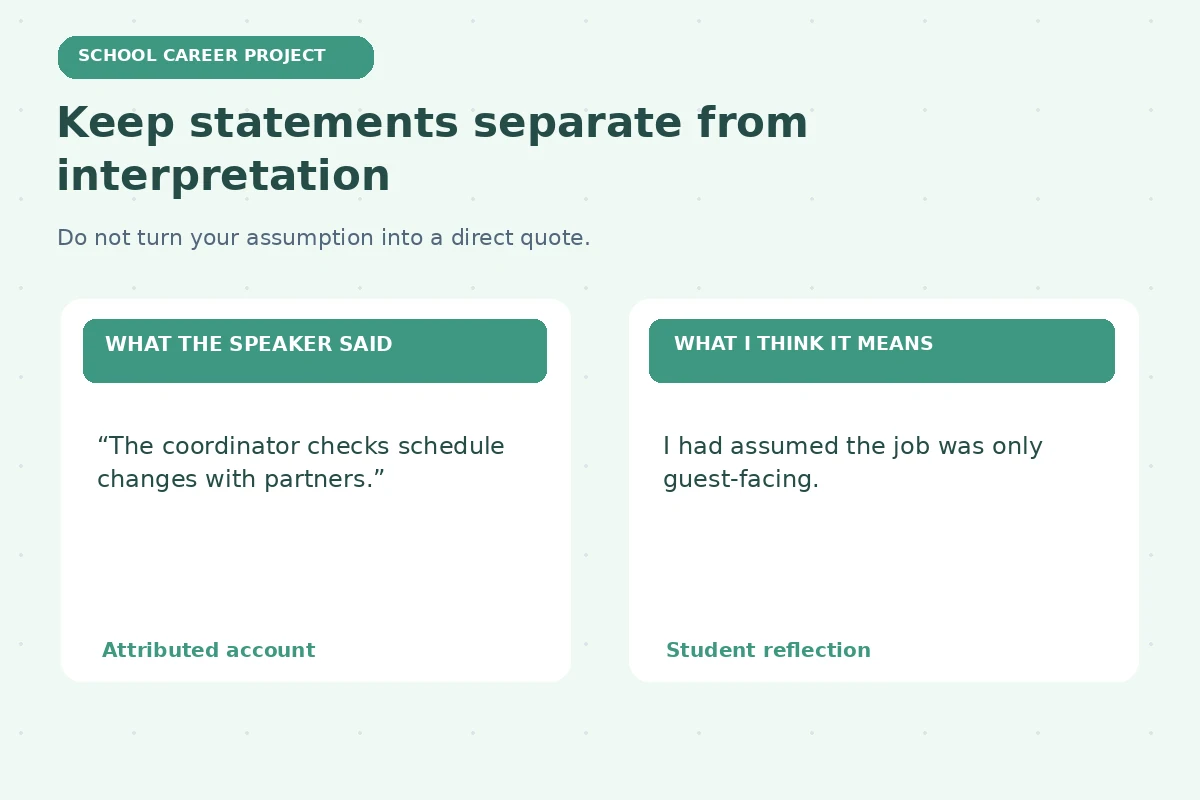
Use two note columns: “What the person said or clearly confirmed” and “My interpretation or question to verify.” Record key words, not fabricated full quotations. If you need an exact quotation for a report, capture it accurately and obtain any required consent. Do not reconstruct a sentence from memory and present it inside quotation marks as if it were verbatim. The person’s experience may describe only one workplace and time period.
A fictional example: the interviewee explains that an event coordinator checks venue changes with several teams. Your note could state, “Speaker described checking schedule changes with the venue and organizer before notifying guests.” Your own reflection could add, “This surprised me because I assumed the role was mainly customer-facing.” The two statements serve different purposes and should not be blended.
Turn the conversation into an evidence-based reflection
A useful structure is purpose, contact/context, two or three verified insights, an expectation that changed, and one action you will take. Cite the interview as your teacher requires, but include only the name and contact information the person agreed you may use. If you used public occupational pages to verify a claim, identify those sources separately instead of attributing them to the interviewee.
Do not inflate one person’s advice into an industry rule. A professional might have entered a career through a particular major or apprenticeship, but another employer may use a different hiring route. Use an official occupation description or additional conversation to check how representative the path is. Your final paragraph should explain a decision or research next step—not simply repeat that the conversation was “interesting.”
Submit respectfully and keep records minimal
Thank the person for their time, check any quote or name permissions that remain uncertain, and submit only what the assignment requires. If a voice recording was legitimately made, follow school instructions for storage, restricted sharing, retention, and deletion. Do not upload it to public social networks or share a link outside the permitted classroom audience. If a teacher requests evidence of the conversation, clarify what nonintrusive proof is acceptable.
Before submitting, review questions for leading language, check that factual details came from the actual conversation, and label your own conclusions. If the professional declined to answer something, do not fill the gap with a guess. A well-documented assignment respects the interviewee while showing that you can investigate a career carefully and reflect on what you learned.
How We Research Career Conversations
We compared published U.S. university career-center guidance on informational interviews, outreach, preparation, note-taking, and follow-up. Where this article discusses occupational duties, we checked the cited occupational description separately. The question scripts and dialogues are hypothetical teaching examples, not actual interviews, employer policies, or guarantees that a professional will respond. Guidance from one organization may not reflect every profession, employer, or school assignment.
Sources reviewed November 13, 2026: careerhub.ufl.edu — University of Florida career guidance advises taking notes and asking permission before recording an informational interview.; career.ku.edu — University of Kansas describes informational interviews as a way to learn about career paths, typical duties, training, and field challenges.; capd.mit.edu — MIT recommends preparation, thoughtful questions, a thank-you, and evaluation of information gathered across multiple contacts..
This is general U.S. career guidance, not professional hiring or legal advice. Ask permission for sensitive notes or recording and follow applicable institutional policies. Review the JobAsk affiliate disclosure. The navigation links here are informational, not evidence of employer endorsement, a job placement, or an affiliate agreement.
Related Job Search Guides
Only if your instructor permits it. Identify the relationship honestly and focus on the person’s actual occupation.
Yes, seek clear permission and follow the applicable law, school policy, and platform rules. Notes can often substitute when recording is not required.
Follow the assignment rules and any agreement with the person. Only use exact, accurately captured wording as a direct quote.
Respect the boundary, note that the topic was not discussed if relevant, and do not fabricate an answer.
Identify a specific revised assumption and one appropriate next research or preparation step that follows from what you learned.