
An accounting internship resume should show that you can check figures, trace a number to its source, document exceptions, and ask for review when authorization is required. If you have not worked in an accounting office, a clearly labeled class reconciliation or bookkeeping simulation can still prove a relevant method. Do not describe a classroom ledger as a real company account or claim that you approved payments you only prepared for review. The worked examples below are fictional: adapt the structure only to tasks you can verify.
Choose the accounting experience you can document
Start by making three columns headed “Experience,” “Evidence,” and “Permission.” A course spreadsheet where you matched fictional invoices to purchase orders belongs under Projects. A supervised office assignment belongs under Experience only when the organization, role, and dates are accurate. A student club treasurer role can be listed as Leadership or Finance Experience, but do not recast it as a corporate accounting internship. For each item, save an assignment description, grade feedback, an approved redacted work sample, or your own task notes. Never upload client data to a portfolio.
Match your proof to the internship posting rather than dumping every accounting class. A posting about accounts payable may value invoice coding, document matching, discrepancy logs, and Excel verification. An audit-support posting may emphasize tracing documents and maintaining an audit trail. O*NET describes these as functions found in accounting clerk work; it does not mean interns perform all of them or have independent authority. If a task needs a reviewer, say who reviewed the work in general terms and keep private names or transactions out.
Build an honest education and skills section
Place your actual degree program, institution, and expected completion date near the top when you are pursuing a student internship. Course titles such as Financial Accounting, Managerial Accounting, or Spreadsheet Modeling are useful only when completed or genuinely in progress and relevant to the role. List software by real experience level: using spreadsheet filters and formulas in a class is different from having access to a company accounting system. You do not need to claim proficiency in a product because it appeared in the job ad.
Use specific skills that can be tested in conversation: compare source documents, investigate a balance difference, label a reconciliation status, document assumptions, and hand unresolved items to a reviewer. If you used formulas, name the functions you actually used rather than implying automation you never built. “Prepared a class reconciliation worksheet in Excel and flagged unmatched entries for instructor review” is stronger and safer than “Managed complex financial operations.” The former tells the reader how you worked and makes the origin of the example transparent.
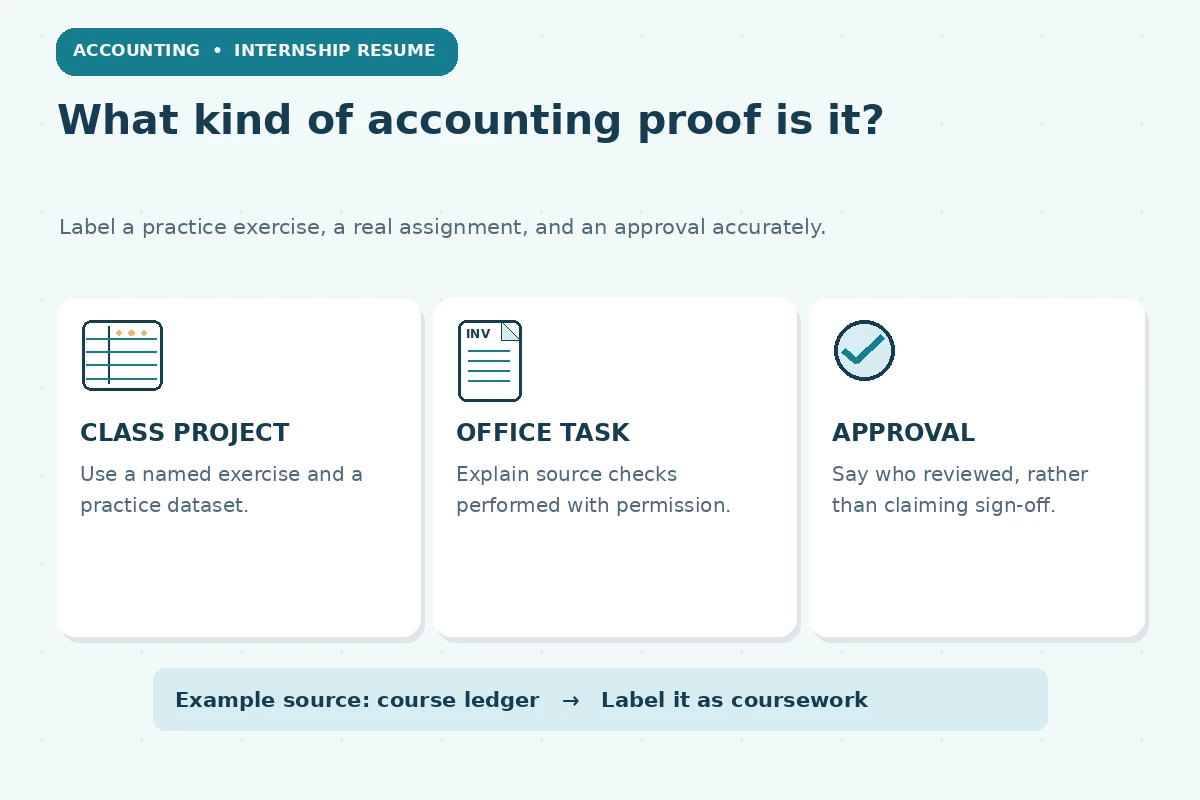
Turn a course reconciliation into a credible bullet
Consider this hypothetical student example: “Compared a simulated cash ledger with a provided bank statement; marked unmatched entries and documented the adjustments proposed in a reconciliation worksheet.” This sentence names the source, comparison, output, and review status. It does not pretend the student could post real correcting entries. When rewriting your own version, identify the data that were provided, the comparison you personally performed, and the record you produced. Only add a count if you can reproduce it from your worksheet.
Do not change “prepared” to “approved,” or “flagged” to “resolved,” merely to make the line sound senior. Approval is a real responsibility, not a stronger synonym. A well-written internship bullet can end with “for supervisor review,” “as a class exercise,” or “with discrepancies escalated” when those details explain the work. If your contribution was one part of a larger team project, name your part instead of claiming the complete group result. Keep institutional data and financial identifiers out of shared samples.
Separate invoice matching from payment authority
Imagine a practice assignment with a purchase order, receiving record, and vendor invoice. The purpose is to identify mismatched quantities, dates, codes, or totals before a reviewer decides the next step. A truthful sample bullet could read: “Checked sample invoice fields against purchase-order and receiving records; logged exceptions for instructor review.” Do not say that you authorized payment or released funds unless you really had that responsibility. The documentation itself is often the strongest evidence of careful work.
If you held an office internship, ask what you may disclose about the workflow. You may be able to describe a generic task such as validating required fields, but the ledger, client, vendor, price, and payment details could be confidential. Use anonymized descriptions only with permission. If you cannot share a work sample, describe your method in interview-ready terms: what you compared, how you labeled inconsistencies, when you stopped, and what you handed off. That is enough to show judgment without revealing transactions.

Write three bullets with defensible verbs
Build each statement around the action you really controlled. “Prepared” fits a draft schedule or worksheet; “checked” fits comparison against a source; “documented” fits a discrepancy log; “assisted” fits support under direction. Avoid a flat list of weak verbs, but also avoid inflating responsibility. A fictional coursework line might be: “Created a labeled spreadsheet for an assigned mock ledger, cross-checked transaction dates, and identified entries needing instructor clarification.” The point is the check process, not a fabricated financial impact.
A different hypothetical club example would be: “Recorded approved reimbursements for a student organization and maintained receipt references for an officer’s review.” Only a student who actually did that work could use the wording. Keep approval boundaries visible; if the officer approved reimbursements, do not present it as your decision. A third example for an internship may describe summarizing a batch of anomalies for a supervisor, but must not invent speed gains, dollar savings, or an audit result. Interviewers may ask where each number came from.
Order sections for the intended accounting internship
A student without accounting employment can use Education, Relevant Coursework, Projects, Experience, and Skills. Another student with a genuine bookkeeping position may put Relevant Experience above Projects. Choose based on evidence and the posting, not a universal section order. The university resume guides emphasize tailoring and meaningful project descriptions, and an accounting employer needs to know what was class-based versus performed in a workplace. Distinct headings make that difference obvious.
Keep descriptions concise and readable: the reader should quickly find the method, tool, result, and level of supervision. Use the employer’s terminology only when it accurately matches your work. A class “journal entry exercise” should not be renamed “financial close” without good reason. If you attended a tax workshop, it does not make you a tax preparer. If you have not passed a credential exam, do not list the credential as earned. Check the resume and the attached PDF for consistent dates and project titles.

Check numbers, confidentiality, and audit-trail claims
Before including a count or claim, ask whether your records support it and whether sharing it is permitted. “Matched 25 mock invoices” is acceptable only if you actually counted 25 practice records. “Reduced accounting errors by 40%” needs a defined baseline, measurement method, your attributable contribution, and permission to disclose the result; otherwise leave the number out. Percentages are not mandatory. Evidence of precise documentation often matters more than an invented impact statement.
Use a final redaction and accuracy pass: verify dates, tense, course names, software, and which person approved each action. Remove financial account numbers, vendor names, and private data. Read each bullet aloud and ask whether you could explain the underlying worksheet or procedure if interviewed. If you cannot, replace it with something you truly did. The resume’s purpose is to prepare a credible conversation, not to simulate a job history.
Compare the final draft with the specific posting
Circle three duties in the real internship posting and map each to one defensible piece of evidence. If the posting asks for reconciliation, use the class or work comparison you completed. If it requests documentation, show how you organized records and exceptions. If it emphasizes accuracy, describe a verification step, not a vague self-rating. Leave out unrelated software and jargon. A hiring manager should not have to infer that a group project involved financial records when your role was only a presentation slide.
Open the exported resume as the employer will see it. Check text order, dates, link destinations, and document name. A genuine student profile may be short; do not fill space with fictitious internships. If your evidence does not cover a required job criterion, treat it as a preparation gap to investigate rather than pretending the resume proves it. Source-backed methods and transparent scope produce a stronger application than inflated impact lines.
How We Research Internship Resume Guidance
We checked U.S. university career-center recommendations for student resumes and projects, plus O*NET descriptions of related occupational duties. The profession-specific tasks illustrate possible evidence, not what every internship permits or requires. All resumes, projects, figures, and dialogue examples here are hypothetical demonstrations; copy the reasoning pattern, never an invented accomplishment. We did not interview employers or test claims about applicant-tracking systems.
Sources reviewed November 13, 2026: www.onetonline.org — O*NET describes record verification, invoice matching, reconciliation, and discrepancy reporting among accounting-clerk tasks.; careers.ucsd.edu — UC San Diego advises resume writers to name their actions, context and outcomes, and distinguish significant coursework and projects.; capd.mit.edu — MIT recognizes relevant paid and unpaid experience, projects, and project-action-result statements on a resume..
This educational article is not legal, certification, professional-practice, or hiring advice. Check individual employer instructions, institutional confidentiality policies and supervisor permissions. Read the JobAsk affiliate disclosure. The links in this article are informational; no employer partnership, placement, or affiliate approval is implied.
More Resume and Cover Letter Guides
Yes. Label it as a course or independent project, describe the records you worked with and your personal contribution, and never imply the figures came from an employer.
Describe the activity as a simulated reconciliation or class worksheet. Reserve descriptions of actual employer-account work for work you really performed.
Yes, if you can explain the features you used. Name tested tasks or functions rather than asserting an advanced level without evidence.
Do not include the data. Describe the general checking method and approval path; share a redacted sample only with permission.
No. Use numbers only when accurate, attributable, and shareable. Source checking, discrepancy documentation, and review boundaries can be useful evidence without amounts.