
A research internship resume should state exactly which part of a study or class project you handled: gathering approved information, checking data, documenting a method, preparing a figure, or summarizing a finding. Scientific credibility comes from precise scope and transparent limitations, not from calling every class exercise “published research.” If participants, patient records, or unpublished findings are involved, obtain permission and follow institutional rules before sharing. All sample bullets below are fictional and must be adapted only to verified work.
State the research setting before the technique
A research internship reader needs to know whether your example came from a class simulation, independent literature review, supervised undergraduate lab, community survey, or actual employer project. Place the role, institution or project, and accurate dates together. If a professor supplied the study design, do not claim you developed the research question. If you worked with fictional data, name it as a practice dataset. A clear label does not diminish the value of careful methods.
Compare the target posting with your record of tasks. Some internships seek participant scheduling, others spreadsheet checks, field observations, laboratory preparation, or a literature summary. O*NET’s description of social science research assistants includes data verification, report preparation, and support for studies, but it does not define universal student permissions. Select two or three tasks relevant to the real role. Avoid implying a credential, lab authorization, human-subjects approval, or technical proficiency you have not actually earned.
Distinguish study design, execution, and review
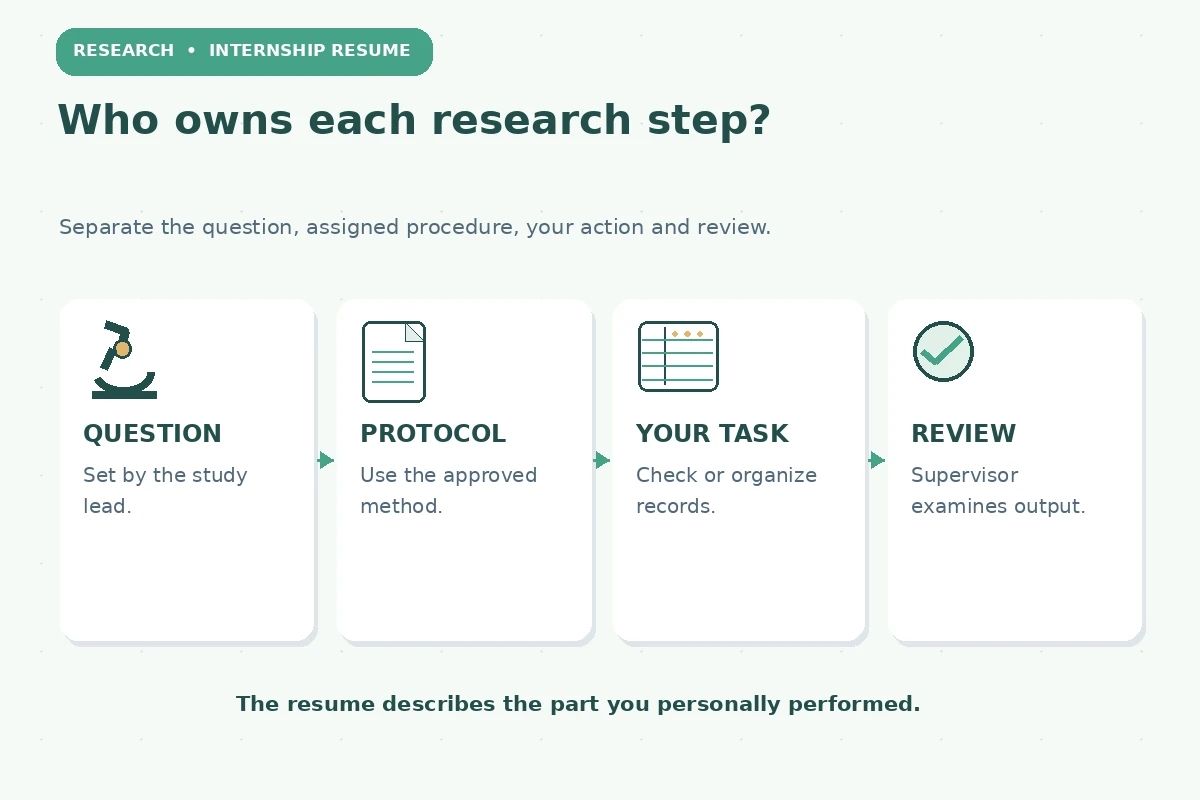
Draw a four-column study map: question, approved procedure, your action, and reviewer. The same project may involve several students with different responsibilities. If the instructor wrote the survey and you cleaned a practice spreadsheet, the resume should say you checked data, not that you designed the study. If a supervisor interpreted the findings, do not present the interpretation as solely yours. Those distinctions help an interviewer understand how you work as part of a research team.
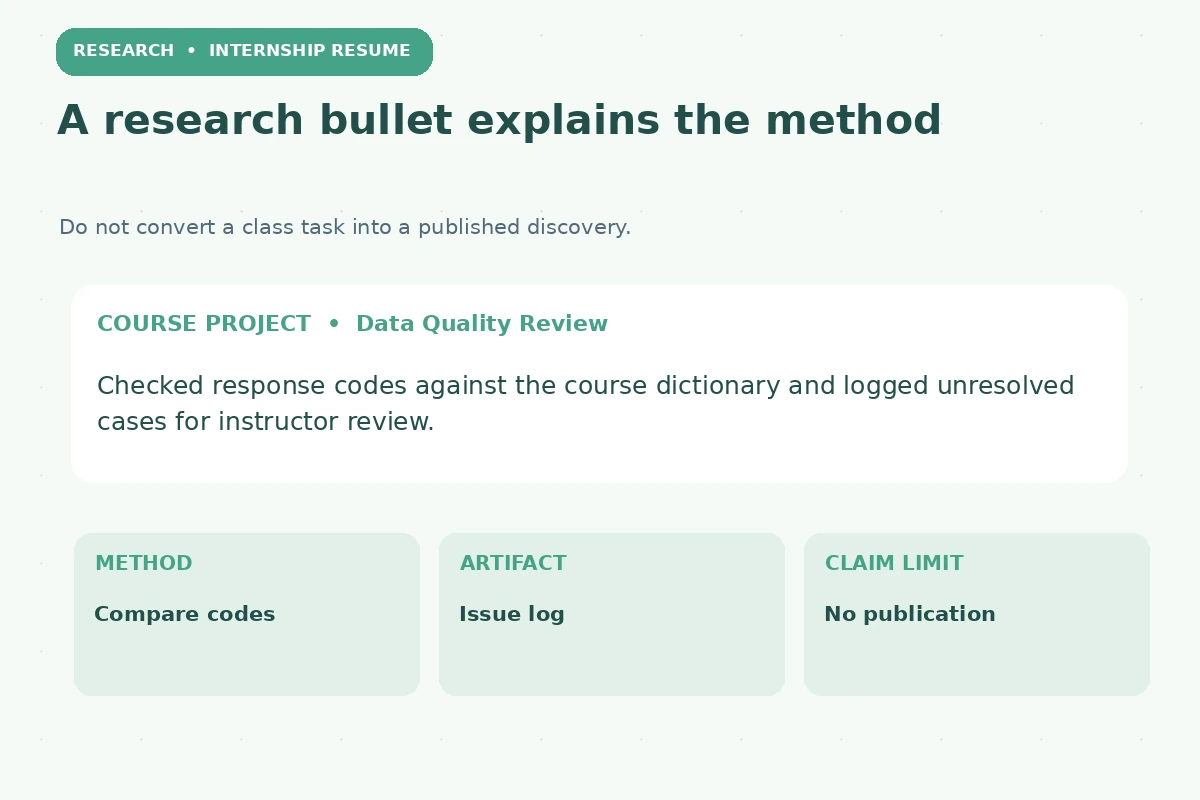
In a hypothetical survey course, a student might verify missing-value codes against a class data dictionary and produce a short issues log. That is a concrete contribution even if they did not analyze the final results. An honest line might say “Reviewed a supplied teaching dataset for inconsistent response codes and documented questions for instructor review.” Do not borrow the word “validated” if you did not have defined criteria, and never claim regulatory approval merely because a class discussed ethics.
Show a method through reproducible work products
The most useful research evidence is often a record someone else could follow: a codebook, search strategy, observation sheet, cleaned practice table, figure with units, or dated lab notebook entry. Name the method and the resulting artifact. A fictional example is “Used a documented source-screening rubric to organize class literature references and recorded the inclusion decisions.” If you did that, you could explain the criteria, tools, and uncertainties in an interview. Without a record, an expansive claim about analysis is difficult to substantiate.
Avoid presenting a software name as a complete method. “Used R” or “used Excel” says less than “checked duplicate practice records in a spreadsheet and retained the original data for comparison.” Also be careful with statistical claims. Do not say an effect was significant unless you performed an appropriate analysis and understand what was tested. Research work is not automatically successful when it produces a positive result; accurate notes about inconclusive findings can demonstrate stronger judgment.
Respect participants, confidential data, and consent
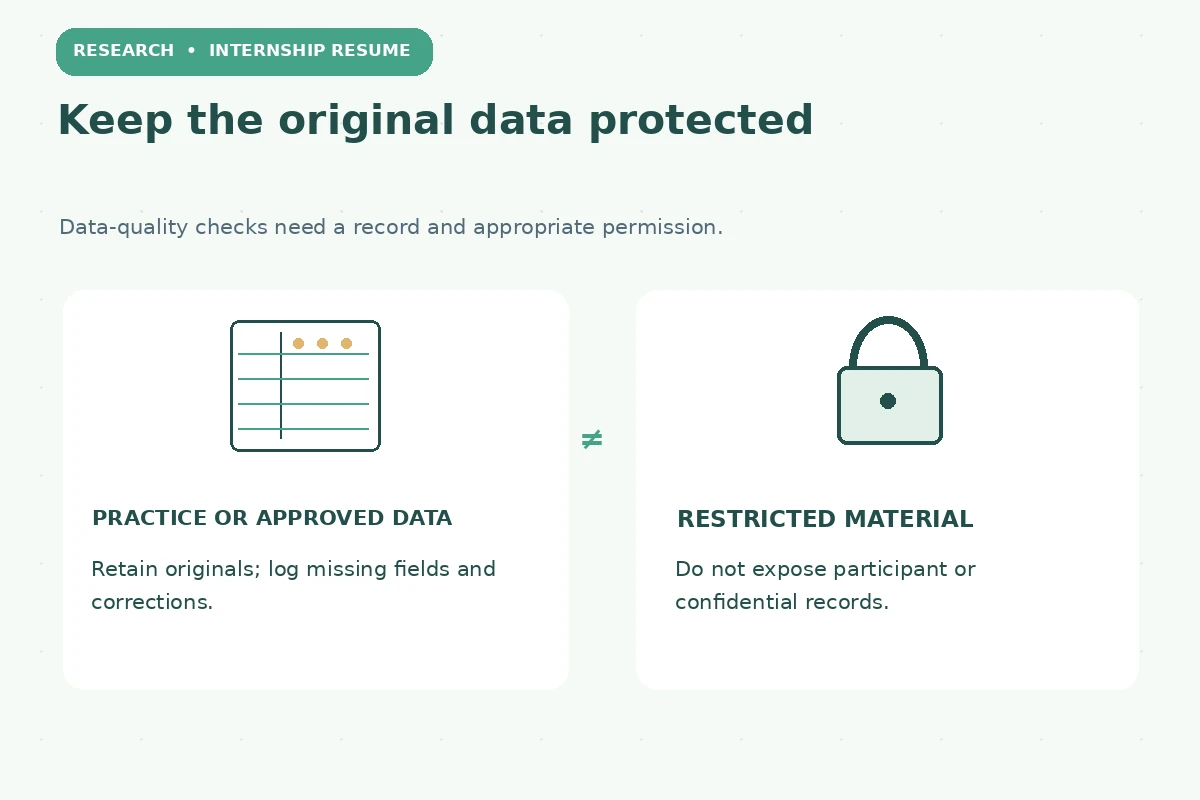
A resume is a public-facing document relative to a private research workspace. Do not add participants’ names, responses, recruitment lists, unpublished figures, or identifiable lab records. A course project involving real participants may have special permission and ethics requirements. If you do not know what is shareable, ask the supervising instructor or research office. Avoid assuming that anonymization is automatic: a combination of details can still identify someone.
An internship applicant can describe a general permitted process without reproducing data. For example: “Prepared an instructor-approved checklist for entering de-identified practice records and flagged missing fields for review.” Use that sentence only if every element is true. “Managed confidential research databases independently” is an inappropriate upgrade if you only observed the workflow. The best resume shows both precision and respect for the boundary between a learning task and an approved study operation.
Write methods-based bullets instead of inflated discoveries
A bullet can follow method, action, output, review. For a fictional ecology class: “Recorded assigned plant observations using the course field sheet, checked unit consistency, and prepared a summary table for the project team.” This does not imply publication, original discovery, or unsupervised field decisions. For a fictional social research course: “Categorized provided interview excerpts using instructor-defined codes and documented disagreements for discussion.” Replace the subject, tool, and criteria with what you really did.
Do not convert a poster assignment into “authored a peer-reviewed publication.” If you presented a student poster, say so and name the venue accurately. If several people collaborated, identify the part you handled. Report sample sizes only when recorded and permissible, and avoid attaching someone else’s data to a personal website. A strong small task is often the basis for a good interview discussion about reliability, unexpected exceptions, and the care required to preserve source records.
Decide where research belongs in your resume
For an undergraduate seeking a first placement, Education, Relevant Coursework, Research or Projects, Experience, and Skills may be a clear order. If you already held a formal lab assistant position, Research Experience might precede class projects. A research-focused academic CV can be longer and differently organized than an industry internship resume; do not call your document a CV merely to imply credentials. Read the actual application instructions before deciding on format.
Use headings that distinguish real research employment, paid or volunteer assistance, and course projects. A class poster can go under Projects; a verified presentation can appear under Presentations if appropriate and accurately identified. Do not create a Publications section if you have none. Include course methods or tools only when you can discuss the procedure. Berkeley’s resume resources support presenting research contributions, but the key is telling the reader what the student personally accomplished.
Check claims about independence and results
Ask five questions of each bullet. Who chose the protocol? Who collected or supplied the material? Who performed quality checks? Who interpreted the output? Who approved dissemination? Your phrasing should reflect those answers. Verbs such as “assisted,” “coded,” “recorded,” “screened,” “compiled,” and “drafted” can be more accurate than “led,” “proved,” or “discovered.” Do not claim an overall project outcome if you contributed only one input.
Numbers can help when they are reproducible, not when they look impressive. A count of coded practice documents may be useful if it is in your records. A claimed improvement in study validity requires support far beyond a tidy spreadsheet. Be prepared to discuss how you handled a mismatch, how you retained the original material, and what you would do differently with more time. This interview story often matters more than asserting that research was flawless.
Prepare an interview explanation that matches the resume
For the strongest project, write a short story: the research question, the assigned part, the method, the uncertainty you noticed, the reviewer, and the usable output. Do not rehearse a heroic conclusion. Suppose a lab sheet revealed inconsistent date formats: the responsible response might be to mark the records and ask whether a conversion rule was approved. That demonstrates attention to repeatability without granting yourself authority over the dataset.
Before sending the resume, confirm supervisors’ names and project titles can be disclosed, verify all dates, and open the final PDF. Keep an approved public abstract or your own sanitized workflow diagram ready if relevant. Where documents are private, describe the process verbally instead. A credible research internship resume should invite careful questions, not depend on impressive claims that cannot be independently explained.
How We Research Internship Resume Guidance
We checked U.S. university career-center recommendations for student resumes and projects, plus O*NET descriptions of related occupational duties. The profession-specific tasks illustrate possible evidence, not what every internship permits or requires. All resumes, projects, figures, and dialogue examples here are hypothetical demonstrations; copy the reasoning pattern, never an invented accomplishment. We did not interview employers or test claims about applicant-tracking systems.
Sources reviewed November 13, 2026: www.onetonline.org — O*NET describes social science research assistants supporting data quality, reporting, tabulation, and research documentation.; career.berkeley.edu — UC Berkeley advises student applicants to describe undergraduate research roles, projects and actual contributions.; careers.ucsd.edu — UC San Diego advises candidates to explain project goals, individual methods and outcomes rather than only naming a course..
This educational article is not legal, certification, professional-practice, or hiring advice. Check individual employer instructions, institutional confidentiality policies and supervisor permissions. Read the JobAsk affiliate disclosure. The links in this article are informational; no employer partnership, placement, or affiliate approval is implied.
More Resume and Cover Letter Guides
Yes. Identify it as coursework and explain the method, your role and output rather than describing it as formal employment.
You may list an accurately labeled course paper or project; do not call it a peer-reviewed publication.
Follow your institution’s rules and get appropriate permission. Do not put identifying or protected information in the resume or portfolio.
Choose relevant tools you actually used and can explain, with a specific task showing how you applied each.
Describe the portion you completed, such as organizing records or checking codes, and attribute interpretation or approval to the appropriate person.