
For a restaurant interview, start with the actual job: server, host, bar support, line cook, prep worker, or office staff. A clean, neat business-casual outfit is a useful default for many conversations, but venue standards differ. The restaurant’s instructions should decide whether you need a more formal appearance, safe work clothing for an approved practical assessment, or simply polished interview attire.
A fine-dining host, casual dining server, and kitchen trainee may all meet the same manager while facing different tasks. The Bureau of Labor Statistics notes that servers greet guests, take orders, coordinate with kitchens, and sometimes follow uniforms or specific dress codes. That is why the best outfit helps you move comfortably and discuss the role; it does not imitate a uniform or pretend you have food-safety approval.
Separate Guest-Facing Roles From Back-of-House Roles
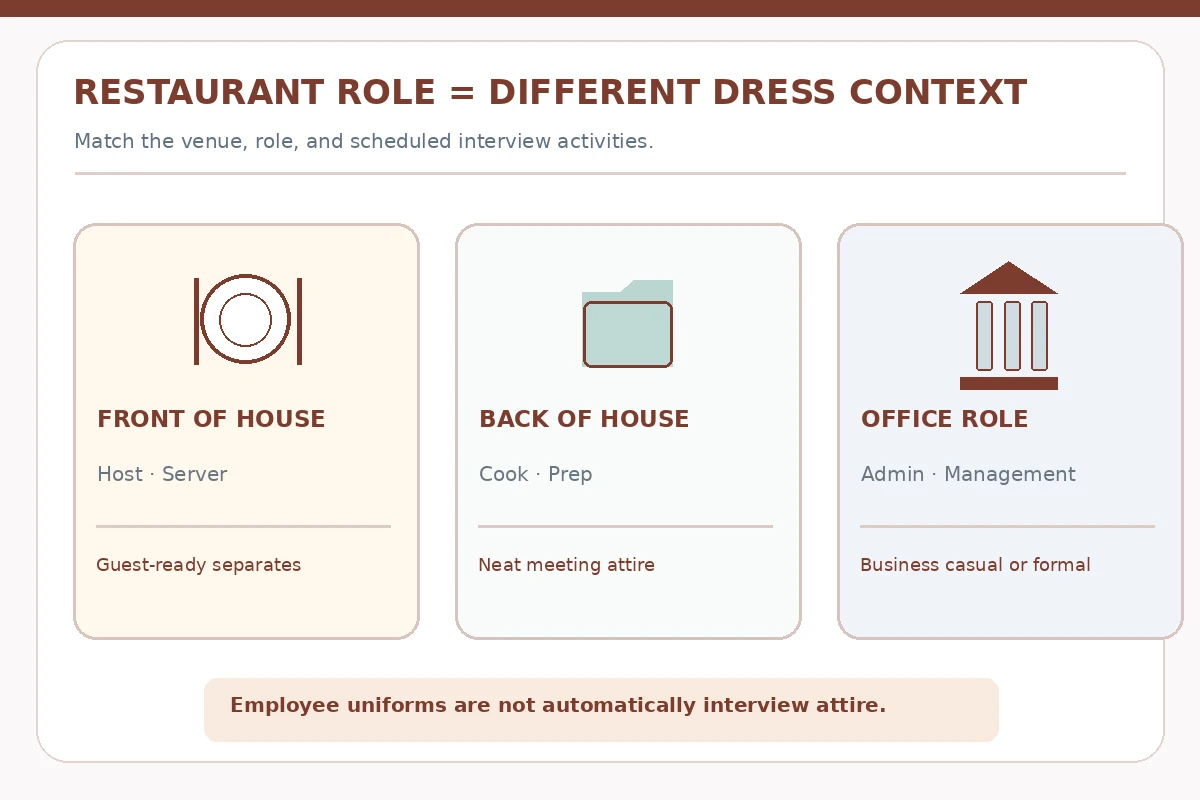
A host or server may be expected to interact with guests throughout a shift. For a front-of-house interview, consider clean trousers, a collared shirt or blouse, a simple sweater, or similarly neat separates that fit the restaurant’s formality. At a formal dining venue, the interviewer may prefer more tailored clothes; at a neighborhood café, polished casual clothing may be appropriate. Look at the official restaurant site and ask your contact when the standard is uncertain.
For a kitchen or prep role, wearing chef whites to a first interview is not automatically required. Select tidy, comfortable clothes suitable for a professional meeting. If the employer has explicitly scheduled a kitchen tour or a paid or unpaid practical assessment, ask about clothing, safety, food handling, and any necessary protective equipment beforehand. Never assume an interview means you are authorized to start preparing food or operating equipment.
Read the Venue Without Copying a Uniform
Restaurant uniforms belong to employees and may include items the employer provides. You can observe whether the restaurant presents itself as formal, fast-casual, or casual, but do not buy a branded shirt or an entire uniform before an offer. Use the venue as context for your degree of formality, not as a secret checklist. Some employers use multiple uniforms for hosts, servers, and kitchen staff; the role description is more reliable than a photograph of one employee.
If the restaurant’s online photos show jeans or aprons, do not assume jeans are appropriate for the interview. A clean, well-fitting shirt and slacks are often a lower-risk choice when the invitation gives no direction. Ask a short practical question if you are unsure: “Should I dress for a conversation only, or is there a kitchen or service-floor assessment?” The answer determines whether additional practical clothing is relevant.

Make Footwear and Movement Part of the Check
Service jobs frequently require walking and standing, so shoes that fit and are clean matter. For a first conversation, prioritize comfort and a tidy appearance. If you expect a supervised work demonstration or kitchen access, ask about slip-resistant footwear or other site-specific requirements; do not present a generic internet suggestion as a universal workplace safety rule. An office-only interview might not require the same practical equipment.
Practice walking, sitting, and reaching for your resume without adjusting clothes repeatedly. Avoid dangling accessories that distract you or create a problem around active food areas if those will be visited. Check the actual location: an interview may occur before opening, in a separate office, or by video. A full service-floor tour is not guaranteed. Travel time and a calm greeting are more useful than arriving in clothing suited to a different workplace.
| Interview setting | Outfit direction | Important question |
|---|---|---|
| Host or server interview | Polished, guest-ready separates | Is a service-floor tour included? |
| Kitchen or prep interview | Neat meeting attire | Any work demonstration or safety requirement? |
| Restaurant office role | Business casual or formal as stated | Where will the meeting take place? |
Prepare to Describe Service and Safety Honestly
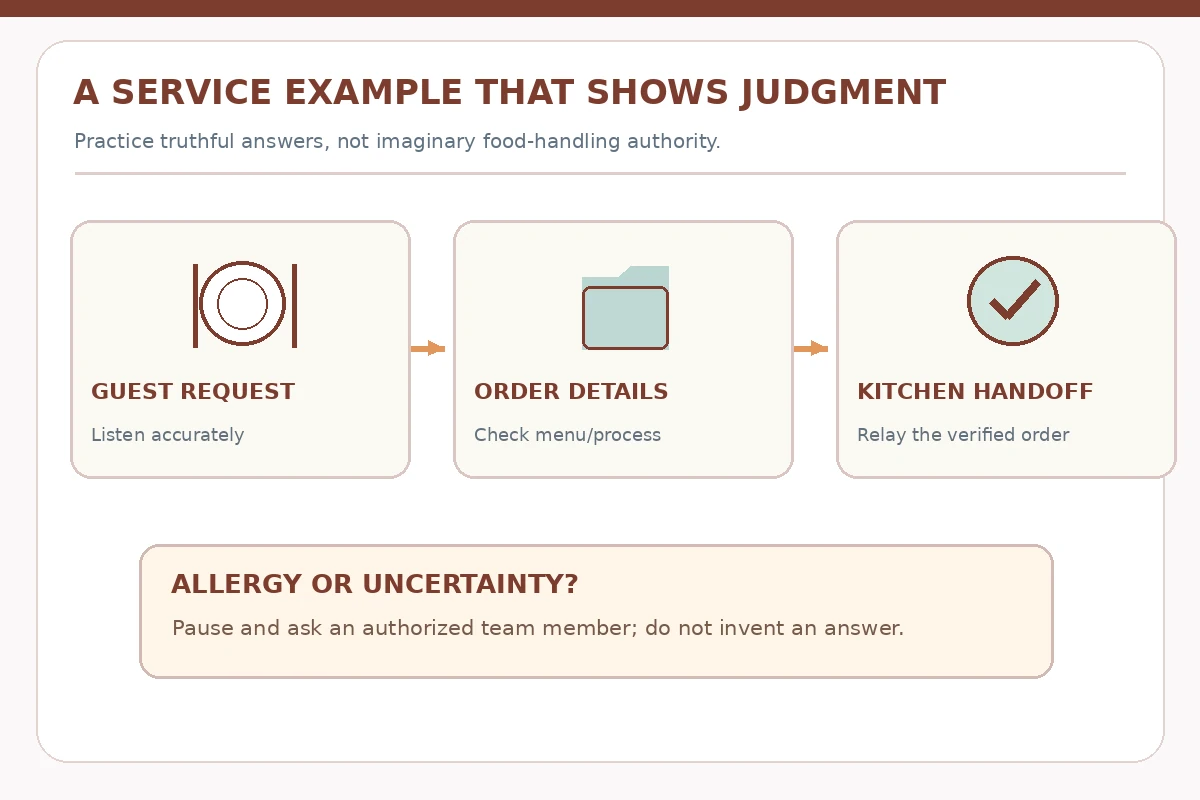
An outfit can communicate that you prepared, but it does not show whether you accurately take orders or recognize when to escalate an allergen question. Prepare one truthful example of teamwork, an order correction, respectful guest communication or careful instructions. If you have never worked in food service, say so and use a school, volunteer or retail situation without recasting it as restaurant experience.
If asked about allergens, alcohol service or equipment, do not invent certifications. Explain that you would follow training and the establishment’s process and refer decisions outside your role to a qualified supervisor. This distinction matters more than a perfectly matched shirt color. The interview can also help you learn which tasks are assigned to new employees and how training is provided.
Adjust for a Trial Shift or Unexpected Venue Change
If you are invited to a working interview, confirm its purpose, expected activities, duration, clothing, safety orientation and compensation arrangements with the employer. This article is not a statement that any specific trial shift is lawful or unpaid; rules depend on actual work and location. Do not undertake restricted tasks or handle customer payments without authorization and instruction.
If the meeting moves from the dining room to an office or online call, adjust for that setting. For video, the clothing should still appear professional on camera, but avoid assuming the restaurant expects chef attire on a remote screen. Bring only requested documents and protect personal identifiers. A concise question is better than guessing what the manager wants from a completely different stage of the selection process.
A Server Interview and a Possible Kitchen Tour
Imagine a candidate applying to a casual restaurant as a server. The manager confirms a short office interview and possible dining-room walk-through, but no work trial. The candidate chooses dark clean trousers, a pressed shirt, comfortable professional shoes, and carries copies of the resume in a folder. They do not purchase the restaurant’s branded uniform or wear a kitchen apron. The choice is based on the meeting, not a claim that every restaurant requires identical attire.
During the discussion, the manager asks how the applicant would handle an order that may include an allergen. The candidate does not pretend to know the restaurant’s menu or food safety procedure. They say they would pause, verify details using the approved process, and involve an authorized team member. This fictional example shows how clothing preparation and honest job judgment work together without promising a hiring outcome.
How We Research and Verify Interview Advice
We reviewed these publicly available guidance sources on 2026-11-14: U.S. Bureau of Labor Statistics server profile (BLS outlines server duties, variable workplaces and possible uniforms.) OpenTable hospitality guide (OpenTable compares restaurant interview attire for front-of-house, back-of-house, and office roles.) University of Texas at Dallas Career Center (UT Dallas provides a framework for matching interview attire to formal and casual settings.) The practical scenes and sample wording in this guide are hypothetical illustrations, not real employer instructions, job offers, or claims about how a hiring decision will be made. Employers differ in dress expectations, procedures and assessments; use the verified invitation and direct contact as the controlling instructions. No approved affiliate partnership or guaranteed outcome is implied. Read our affiliate disclosure.
More Interview Preparation Guides
A venue may permit them, but do not assume. If the invitation is silent, neat slacks or similarly polished separates are a reasonable default.
Not unless the employer directs you to bring or wear one for a specific supervised activity.
It depends on the restaurant and meeting type. Choose clean, comfortable footwear; ask about slip-resistant requirements if a work assessment is planned.
Favor polished, relatively formal clothing and follow the venue’s stated instructions. Your outfit need not duplicate the staff uniform.
Clarify the activities, instruction, safety rules, pay arrangement and relevant permissions before participating in tasks.