
Library assistant experience on a resume should make everyday service work visible: processing checkouts, reshelving materials accurately, helping visitors use basic tools and routing specialized questions to qualified staff. Describe the library setting and your assigned tasks, not the professional responsibilities you merely observed. A precise circulation example can demonstrate care, organization and service without overstating your role.
The Bureau of Labor Statistics distinguishes library assistant duties from the wider responsibility of library technicians and librarians. The American Library Association also emphasizes confidentiality of patron-identifying records. These distinctions matter when writing resume bullets: show helpful work at a desk or behind the scenes while keeping a real visitor’s borrowing history out of job applications.
Describe the Library Setting and Service Assignment
Public libraries, school libraries, academic libraries and special collections can assign different duties to assistants. Begin with the institution name, official title, and dates. A context line might say “Part-time circulation and shelving support in a public library branch.” If you volunteered for seasonal reading activities, mark the entry as volunteer experience rather than quietly presenting it as paid employment.
A circulation desk shift may involve checking materials in and out, issuing a card according to policy, guiding a patron to the catalog, and noting a device issue for another employee. A technical services assignment may focus on labeling, material preparation and shelving workflows. Keep the example tied to the work you actually did, and avoid calling yourself a reference librarian or cataloging specialist unless that was your real position.
Turn Circulation and Shelving Into Evidence
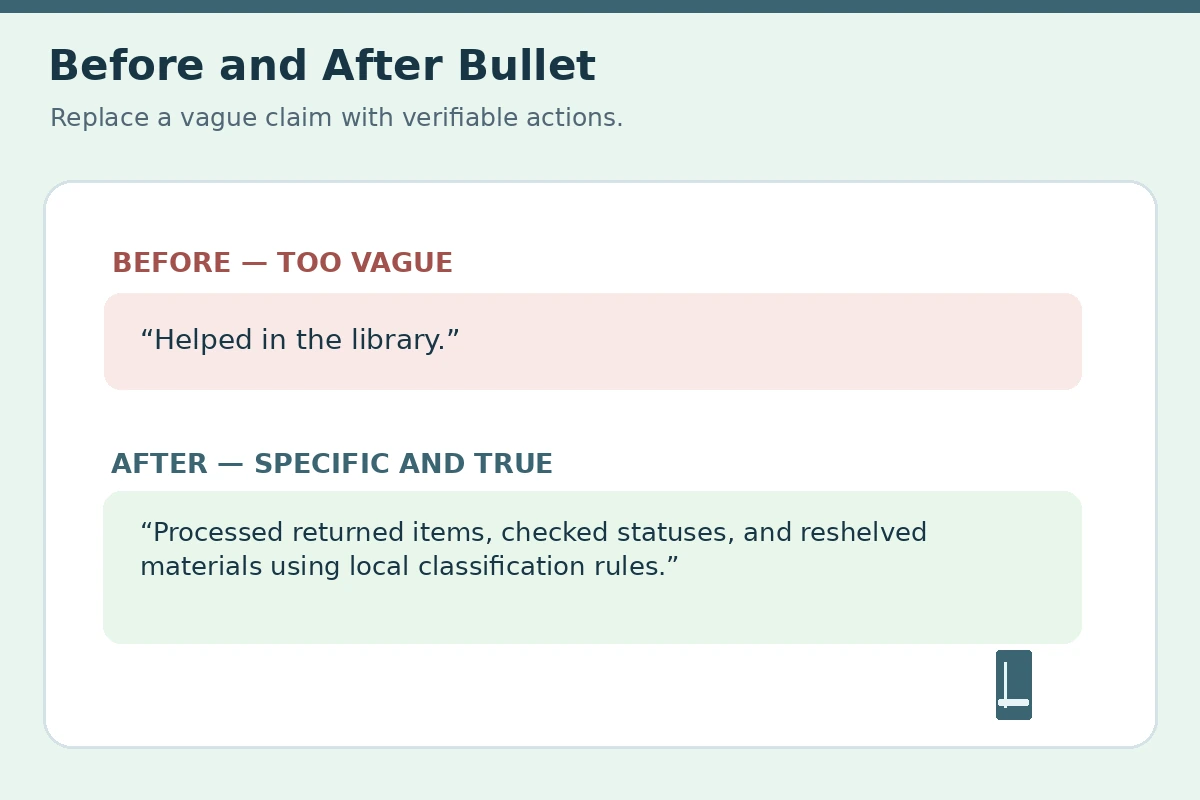
Effective library resume bullets identify the material, procedure and accuracy check. A hypothetical example is: “Processed returned materials, confirmed item status in the circulation system, and reshelved collections using local classification rules.” This makes accuracy visible. If you handled only book carts and shelf-reading, do not describe database permissions or independent cataloging you did not hold.
Quantity can help when it is documented and meaningful, but routine accuracy is valuable without a number. Instead of inventing “hundreds of daily loans,” explain whether you checked call numbers, flagged damaged items or prepared materials for staff review. These small handoffs protect collection access and demonstrate attention to established procedures.
| Library task | Evidence to describe | Boundary to preserve |
|---|---|---|
| Circulation | Checkouts, returns, item status | No patron borrowing details |
| Shelving | Call number and location checks | No unsupported catalog authority |
| Visitor help | Catalog guidance and referrals | No invented specialist credentials |
| Programs | Setup, materials, registrations | Do not claim event leadership |

Show Patron Assistance Without Overclaiming Expertise
Library assistants may teach a visitor basic catalog searches, explain borrowing policies, help with a printer or direct a complex reference question to a librarian. Name the distinction. A sample bullet could read: “Guided visitors through catalog search and device sign-in steps; referred specialized research questions to a librarian.” That signals service judgment rather than pretending to provide professional research instruction.
Different patrons need different explanations. You can discuss providing patient and clear instructions, helping visitors find accessible resources or coordinating with other staff. Do not disclose a specific person’s reading choices, medical inquiry, account balance or program participation. Those details are not necessary to establish your skill and may breach the library’s policies or applicable law.
Differentiate Program Support From Program Leadership
Programs such as story times, author visits, library orientations and community events can create valuable experience. Identify what you prepared: room setup, attendance materials, supply lists, registration desk duties or post-event cleanup. If a librarian selected content and led the session, you can describe assisting that session, not “designed the instructional program.”
A concrete example: “Prepared materials and seating for scheduled reading activities, checked supply readiness, and directed attendee questions to program staff.” If you ran an approved demonstration yourself, state the topic and supervisor arrangements. Put your most relevant responsibilities first when applying for another library, community service or public-facing administrative role.

Protect Patron Records and Explain Systems Honestly
Library circulation systems can contain personally identifiable information. The American Library Association recommends strong confidentiality practices for such records. Your resume may name the catalog or circulation platform you used if that fact is public and appropriate, but it should never include a patron name, account printout, borrowing record or internal screenshot.
If you held limited permissions, such as checking item status but not changing account policy, reflect that. A safe bullet can describe completing allowed transactions and referring unusual account questions to an authorized colleague. Avoid claiming compliance with a specific state statute unless you have checked the relevant rule; privacy rules and institutional policies differ.
Build a Focused Library Experience Section
Group similar duties into two or three bullets: a circulation workflow, a materials workflow, and a patron or program workflow. A candidate applying to a university library might emphasize database search assistance and careful shelving. Someone targeting front-desk roles could highlight accurate records, scheduling and respectful problem routing. The facts remain the same even when the order changes.
Before submitting, inspect title, employer, shift arrangement, dates and software names. If an experience was a course placement, use that label. Remove fabricated collection counts and claims that you independently selected, purchased, classified or preserved materials when you only prepared them for another staff member. Clear boundaries can make a library resume more credible.
How We Research and Protect Resume Accuracy
This guide was checked on 2026-11-14 against original primary occupational and resume references: BLS library technicians and assistants (BLS describes shelving, circulation, patron assistance and routine library database or clerical duties, with role differences between assistants and technicians.); ALA confidentiality policy (The American Library Association recommends safeguarding circulation and other patron-identifying records.); CareerOneStop work experience guide (CareerOneStop recommends listing accurate roles, employers and dates, then emphasizing responsibilities and accomplishments relevant to the next job.). We compared the provided WordPress title inventory, the original JobAsk production plan and immediately previous batches for overlap; content is not a claim that private WordPress drafts are publicly indexed. All example bullets are hypothetical and must be adapted to real work. Job requirements and state or institutional rules may vary. Review the JobAsk affiliate disclosure; no paid affiliation is asserted.
More Resume and Cover Letter Guides
Yes. Label the role as volunteer work and list specific duties and dates. Do not imply it was paid employment.
Explain the classification method, accuracy checks, organization and handoffs you actually performed. Shelving is legitimate library operations work.
Only if you used it and may identify it appropriately. Explain what actions you performed instead of merely listing a platform name.
Describe initial guidance and referrals accurately. Do not claim professional reference services unless those were assigned to you.
Borrowing and account information may be confidential. Generalize the workflow; do not expose real patrons or account details.