
A museum internship resume is strongest when it shows what you cataloged, documented, observed, or helped prepare—and clearly states who had authority over collections decisions. Use your exact internship title and dates, then write specific bullets about supervised database entries, inventory checks, object photography, exhibit preparation, or visitor-facing research. Do not say you accessioned, conserved, authenticated, or approved a collection item unless your role really included that decision.
The National Park Service Museum Handbook describes collection documentation, cataloging, inventory, photographs, and accountability as distinct museum functions. A student may assist a small portion of that workflow, with training and permissions set by the host institution. The examples below are invented illustrations; replace them with your own recorded responsibilities and never expose restricted catalog data or photographs without permission.
Name the Collection and Your Authorized Task
Begin with the kind of material if the institution permits it: paper archives, photographs, teaching objects, natural history specimens, or collections records. Then identify the exact step you performed. “Entered approved object descriptions into a supervised catalog queue” is more precise than “managed an art collection.” If you only watched a conservator work, say you observed the procedure and note what you learned; do not convert observation into a treatment credential.
If an internship title was “Collections Assistant Intern,” use that title as provided. Do not silently rename yourself curator or conservator because those roles appear in future jobs. For an unpaid placement, there is no need to hide the experience; a truthful internship entry can be useful. Confirm whether object names, collection numbers, and institutional software are permitted in public-facing resumes.
| Internship activity | Honest resume evidence | Claim to avoid |
|---|---|---|
| Catalog fields | Checked descriptions and flagged missing data | Claiming final curator approval |
| Collections photography | Prepared approved photo setup with staff | Posting restricted object photos |
| Exhibit assistance | Drafted labels for curator review | Claiming sole exhibit design |
Describe Catalog Records With Traceable Quality Checks
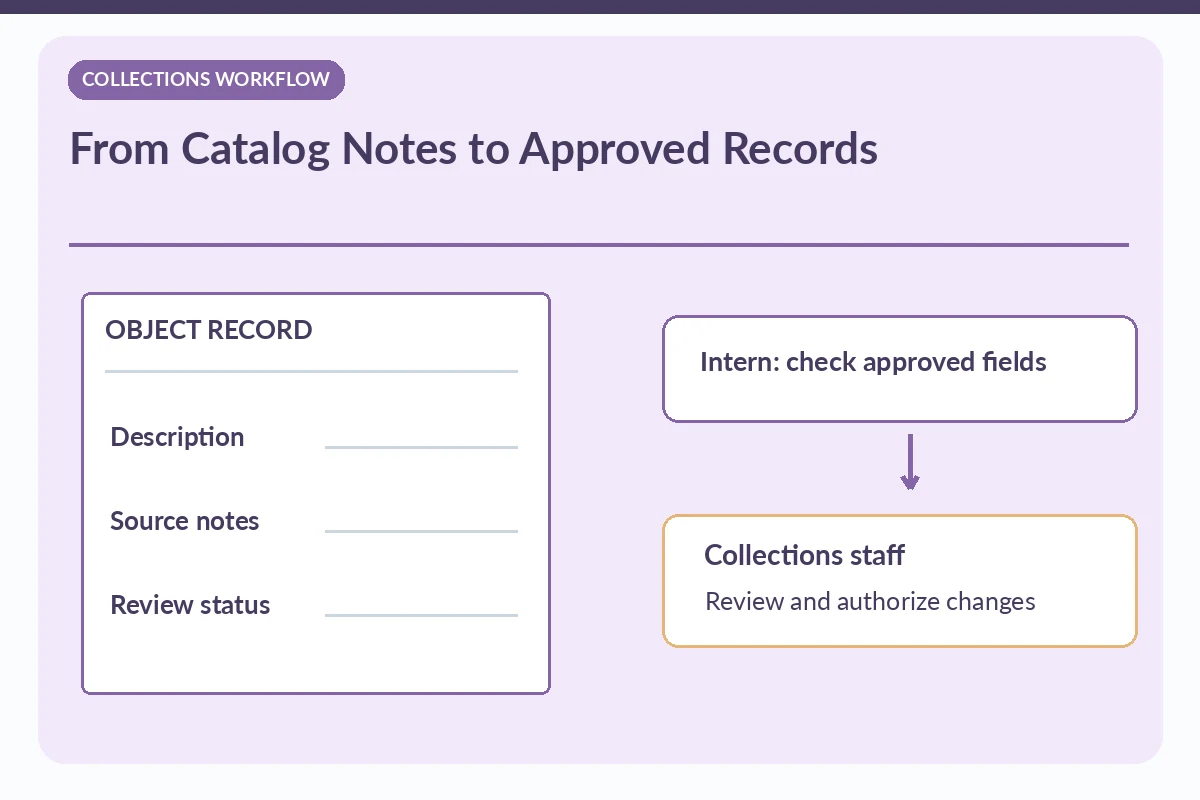
Catalog work might involve comparing a label with an existing inventory entry, checking missing descriptive fields, entering staff-approved terminology, or saving photographs under a naming convention. A hypothetical bullet: “Compared approved object labels with catalog entries, noted mismatches, and sent unresolved fields to a collections supervisor.” That sentence names a check, work product, and handoff without implying the intern finalized identification or ownership.
The value is in the method. Write whether you used a controlled vocabulary, an established data-entry checklist, or a versioned records process—only if true. Avoid invented volume claims such as “cataloged thousands of artifacts” or misleading completeness percentages. If you performed an actual count, verify it with your work log and ask whether the institution permits public disclosure. Quality can also be shown by identifying what you flagged for review.
Separate Object Handling From Curatorial Authority
Moving, cleaning, measuring, photographing, and labeling objects can require special handling instructions and institutional authorization. Do not imply that every intern may handle collections. If your supervisor approved a specific task, name the task and the oversight: “Assisted staff with condition-photo setup using the approved handling plan.” If you used replicas rather than original collection items, state that rather than writing “handled museum artifacts.”
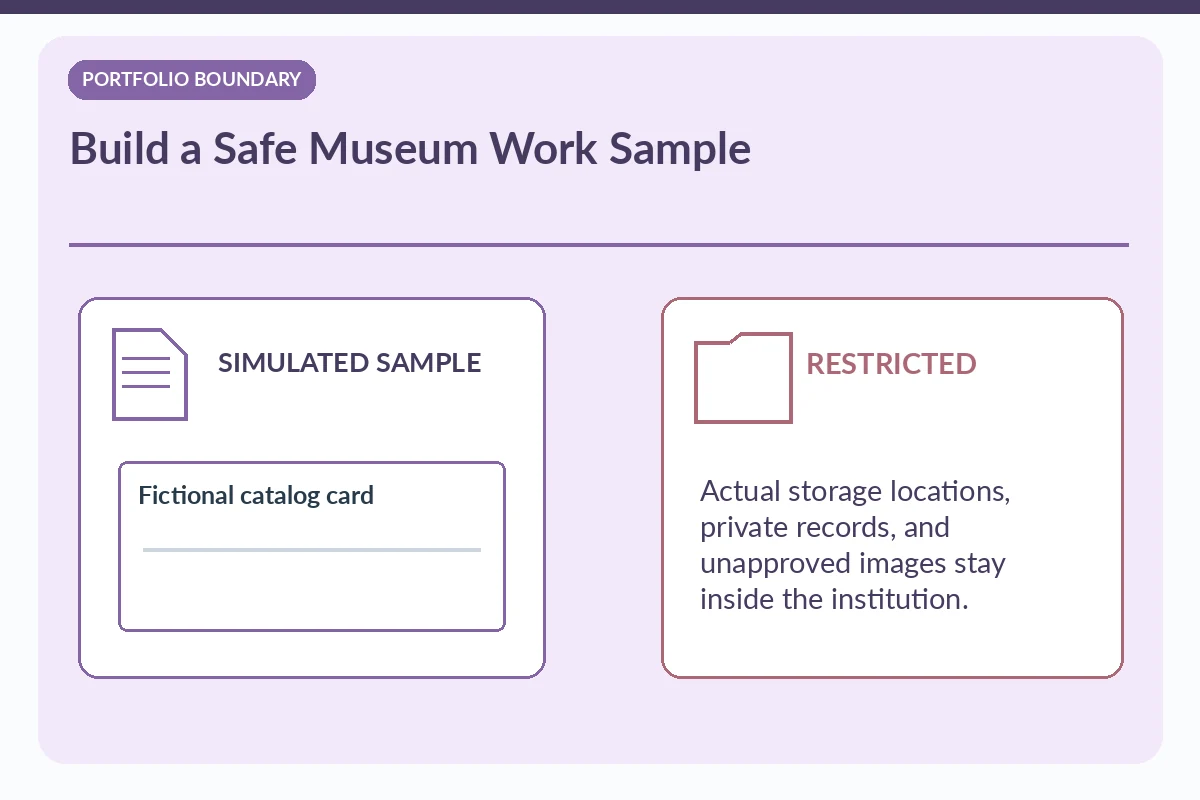
An object photograph may be owned or restricted even when you took the picture. A portfolio should use only approved images or public educational examples; never upload conservation notes, accession documents, security details, donor restrictions, or private location records without explicit permission. You can design a fictional catalog card to demonstrate careful field labeling and mark it as a simulation instead of reproducing a real internal record.

Write Results Without Inventing Museum Impact
Before: “Preserved collections and modernized museum management.” This is too broad to check and may claim professional conservation authority. After, if true: “Reviewed selected catalog entries for missing location or description fields and routed exceptions to collections staff.” You might also describe preparing safe exhibit labels for curator review. This shows what the institution received from your work, even when there is no publishable numerical result.
If you contributed to an exhibition, distinguish drafting a small label or arranging approved supplies from designing or curating the entire show. You can mention a public exhibit title if it is correct and authorized, but avoid suggesting that every public exhibition outcome was yours. Resume reviewers can appreciate reliable documentation, respectful handling procedures, and careful collaboration without a made-up increase in attendance.
Use Coursework and Portfolio Samples With Labels
Art history, archival methods, metadata, museum studies, history, or biology coursework may connect directly to the collection. Put an academic cataloging assignment under Projects, not the institution’s work record. Explain your method: selected source, consistent field names, comparison against a public reference, and uncertainty notes. When a source image is public domain or properly licensed, confirm the actual permissions before including it.
A practical sample might be a one-page fictional catalog record with fields such as object description, source, review status, and notes. Label the item “Simulated collection record—no institution data.” This demonstrates that you understand records discipline without disclosing a real object’s protected storage location or donor history. If you have a permitted public portfolio piece, add a direct link that works without a restricted login.
Audit Dates, Verbs, and Restricted Details
Check each line with your internship diary or supervisor feedback. “Observed,” “assisted,” “prepared,” “checked,” and “drafted” are different levels of involvement; select the one that matches what actually happened. Confirm whether you created a record or only reviewed an existing one. If the collection’s status is uncertain, avoid calling it authenticated, conserved, or accessioned by you. Accuracy is especially important where museum records carry provenance and custody implications.
Before submitting, compare the job description with your evidence. A collections role may prioritize catalog fields and inventory checks; an education role may value approved interpretive content. Keep relevant tasks first, your dates in the same style as other entries, and formatting readable on a one-page student resume when appropriate. Remove staff-only codes, sensitive location data, and private images from any linked sample.
How We Research Internship Resume Examples
Sources checked on 2026-11-15: www.nps.gov (National Park Service museum records guidance covers accessioning, cataloging, inventory, and collection accountability.); career.ucsd.edu (Relevant experience can include unpaid or internship work when dates and personal contributions are described accurately.); careercenter.umich.edu (Strong experience bullets connect an action to a specific object, workflow, or result that can be discussed.). We distinguish documented occupational tasks from work a particular intern was actually authorized to perform. All sample sentences above are invented examples; verify your own dates, duties, records, permissions, and outcomes. This informational guide has no verified paid recommendation. See the JobAsk affiliate disclosure for site-wide transparency.
More Resume and Cover Letter Guides
Yes. Use the genuine position title, organization, dates, and duties, whether the placement was paid or unpaid.
No. Collection documentation functions differ; describe only the fields, records, or steps you actually handled.
Only if the institution permits the specific images and disclosure does not reveal restricted collection information.
Describe supervised observation or training, not independent conservation or restoration work.
Use a clearly marked fictional record or a permitted public educational example that shows your documentation method.