
Job seekers may have several active roles and several rounds for one role. A recruiter phone screen, hiring-manager conversation, practical exercise, and panel meeting are not interchangeable events. Use one parent application record for each verified position and an interview-event log beneath it. Every event should show the employer, job ID if available, date, confirmed time zone, format, interviewer role, verified contact channel, and the next step actually communicated. This makes it easier to prepare without mixing up employers. The record shows what has happened and what is scheduled; it should not predict that any stage guarantees an offer.
Build a stage timeline from actual invitations
Start with the invitation email or candidate portal appointment rather than guessing a standard process. Some employers interview candidates once; others use several rounds. A title such as “final interview” can be used informally and still be followed by additional hiring steps. Log “phone interview scheduled,” “hiring manager conversation completed,” and “panel requested” only when the relevant communication exists. Save the scheduled and rescheduled times as separate dated events. If an interviewer mentioned a possible later discussion but no invitation came, record that as a possibility, not a confirmed calendar booking.
Check names, links, formats, and time zones
For each meeting, record the date and the explicitly stated local time and time zone, the conferencing method or physical location, any accessibility or check-in instructions, and a verified contact for joining problems. Do not put private meeting links in a public spreadsheet or unprotected shared document. If a scheduling link is unfamiliar, compare it with a verified employer invitation before signing in. A virtual conversation is not inherently fraudulent, but the FTC warns that scammers can send official-looking interview invitations. Independently locate the employer if the message is unexpected or requests money or account credentials.
Prepare using the subject of each real round
A first conversation may clarify qualifications and availability, while another may explore past work or team collaboration. Those are examples, not a fixed hierarchy. Record the topics the employer actually mentioned and map each to one truthful example you can explain. If you spoke with two interviewers, write their names only if the invitation or introduction confirmed them; otherwise use a role description such as “operations manager.” Keep notes respectful and job-related. Never store proprietary questions, protected test content, or confidential employee information simply because you want a detailed transcript.

Use a hypothetical timeline to practice accuracy
Suppose a candidate applied for a scheduling assistant position on October 30, had a verified recruiter call on November 5, and received a confirmed panel invitation for November 18. The tracker should show “recruiter call completed” and “panel scheduled.” It should not show “passed second round” unless the employer explicitly gave that result, nor “offer pending” because a manager sounded positive. If the panel is moved to November 20, preserve the original invitation as a past event and add the reschedule. These dates and roles are fictional examples intended to show the record structure.
| Interview event | Record now | Leave unknown |
|---|---|---|
| Phone screen scheduled | Verified date and format | Selection result |
| Panel completed | Actual attendees and follow-up | Offer likelihood |
| Round rescheduled | Original and updated appointments | Cause unless stated |
| Employer says role closed | Exact date and reported outcome | Private interviewer judgments |
Separate meeting events from employer decisions
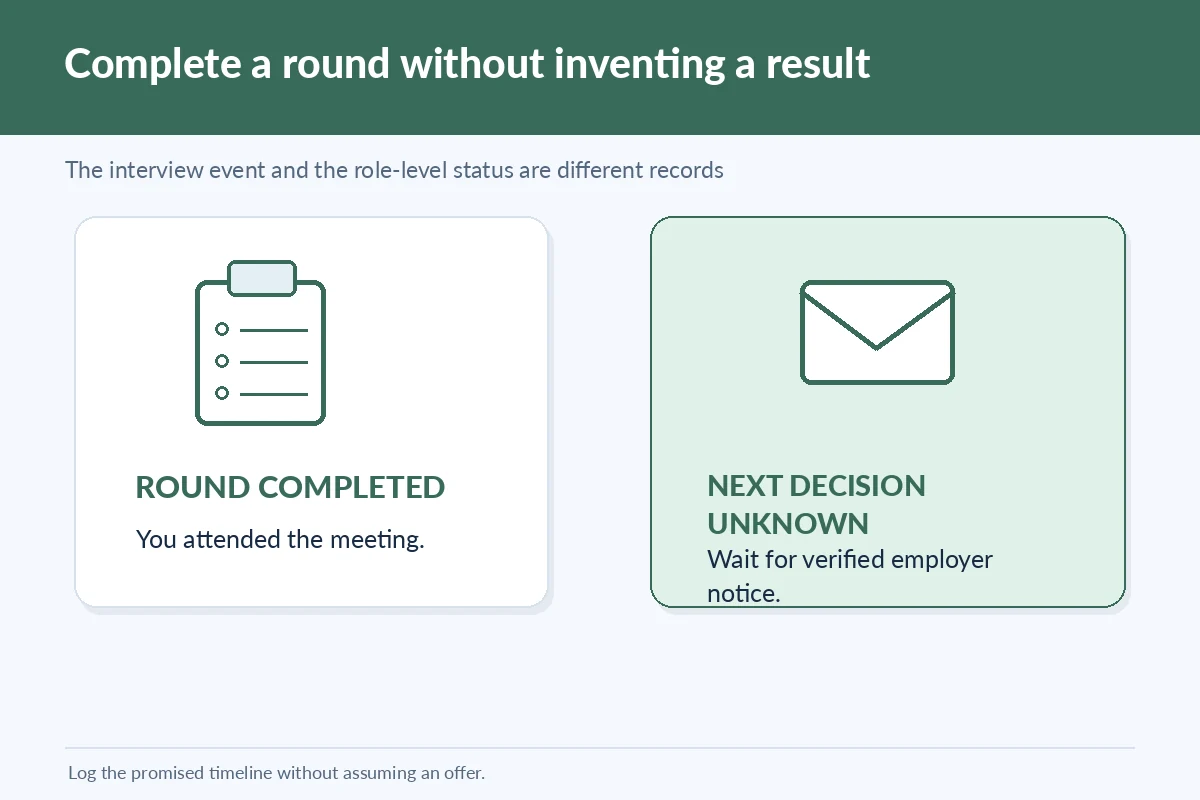
A simple interview table contains meeting stage, scheduled date, confirmation source, format, completed date, next promised communication date, and your follow-up action. Another column can hold the exact employer-reported application status. “Interview completed” describes your activity; “selected for next round” describes an employer decision only if confirmed. Similarly, silence after a panel is not a rejection or offer. Updating one field at a time prevents a note like “good conversation” from accidentally becoming an official outcome. It also makes it clear when you have enough information to send a concise follow-up.

Choose the right follow-up for each stage
Tufts career guidance recommends recording key facts promptly after an interview and asking about next steps. Write a thank-you note only through an appropriate verified channel and avoid asking separate panel members for conflicting timelines. If the recruiter said that updates would arrive by a given date, save that promise with the date and wait until an appropriate later point before asking once for the current status. If you have another genuine offer deadline, share it factually when necessary. Do not claim a competing offer to force a response. Your log should preserve who you contacted and when, reducing duplicate messages.
Protect your calendar and private records
Keep interview invitations and private notes in an account you control. Avoid forwarding meeting URLs to unrelated people. Do not save employer portal credentials, identity documents, confidential interviewer evaluations, or personal contact details beyond what is necessary. For on-site interviews, log the verified check-in location and any stated identification requirement without storing photographs of IDs in the tracker. Verify any sudden request to switch from a regular interview to an unfamiliar paid assessment. A tracking system is useful only if it makes you more organized without creating a new privacy problem.
Close each round and the overall application separately
At the end of each week, review upcoming confirmed meetings first and completed meetings with unanswered next-step questions second. Mark an interview event finished when it happened, even if the broader application remains under consideration. The role-level record stays active until the employer communicates an outcome, you withdraw, or the opening is otherwise reliably closed. If the position was declined, keep that decision distinct from the completed panel interview. When another role at the same company starts, create a separate parent record with its own job ID and stage list. This prevents interviews with similar teams from getting mixed together.
How We Research Application Tracking Decisions
This article compares published career-center guidance with employer or staffing-firm process documents relevant to multi-round interview tracker. The employer-specific examples are not universal policies; the hypotheticals illustrate how to record evidence without claiming an outcome. Source pages and URLs were checked on November 15, 2026. Policies, interfaces, and deadlines can change. Always verify a particular employer’s current instructions before sending information or making a time-sensitive decision.
Sources consulted: Interview and career guidance — 1; Interview and career guidance — 2; Interview and career guidance — 3; Interview and career guidance — 4. The linked materials support tracking and role-specific caveats, not a guarantee of hiring results.
For site relationships, advertising policies, and reader disclosures, review the JobAsk affiliate disclosure.
Related Job Search Guides
No. Log it as completed; only an employer confirmation supports advancement.
Keep the old booking as history and add the new confirmed date and format; do not count two interviews if one occurred.
Use a separate parent application for each requisition, then link its own meetings underneath.
Only necessary professional roles and verified contact details, not private information or speculative evaluations.
Use the timeline the recruiter communicated and contact the appropriate verified person when a reasonable interval has passed.