
A staffing agency can maintain a candidate profile even when no particular client has asked to interview you. Some firms offer a general registration or Quick Apply option, while others ask you to apply to a visible opening first. An agency may later propose a temporary assignment, a temp-to-hire role, or a direct-hire opportunity. These are different events. When you track only “applied to staffing agency,” it becomes impossible to tell which job is available, which recruiter was contacted, or whether the client has even received your information. Separate agency relationship records from employer-specific opportunities from the beginning.
Create a parent record for the agency relationship
The parent record includes the verified agency name, official site, local office or relevant branch, date you registered, type of work you seek, and a contact channel you independently verified. Note your availability as a description you provided, not a promise by the agency. Save whether the profile was received, an introductory conversation occurred, and whether the recruiter requested new documents. Some companies put applicants in a general pool for future openings; that status is not the same as an employer application. You should not label the profile “hired” or “approved for assignment” merely because you have completed an online form.
Create one child row for each concrete opportunity
When an agency offers to discuss a specific position, create a linked child row with a role title, client name only when legitimately disclosed, shift or location, job order reference if given, recruiter, and the date of discussion. Record what you agreed to: interested, requested details, permitted submission, declined, or awaiting interview. Avoid filling the client name from rumors or guessing that two agencies represent the same opening. You may need to ask about representation for the particular position before sending permission to submit. Maintain the exact words of any required agreement rather than assuming all agencies use the same authorization process.
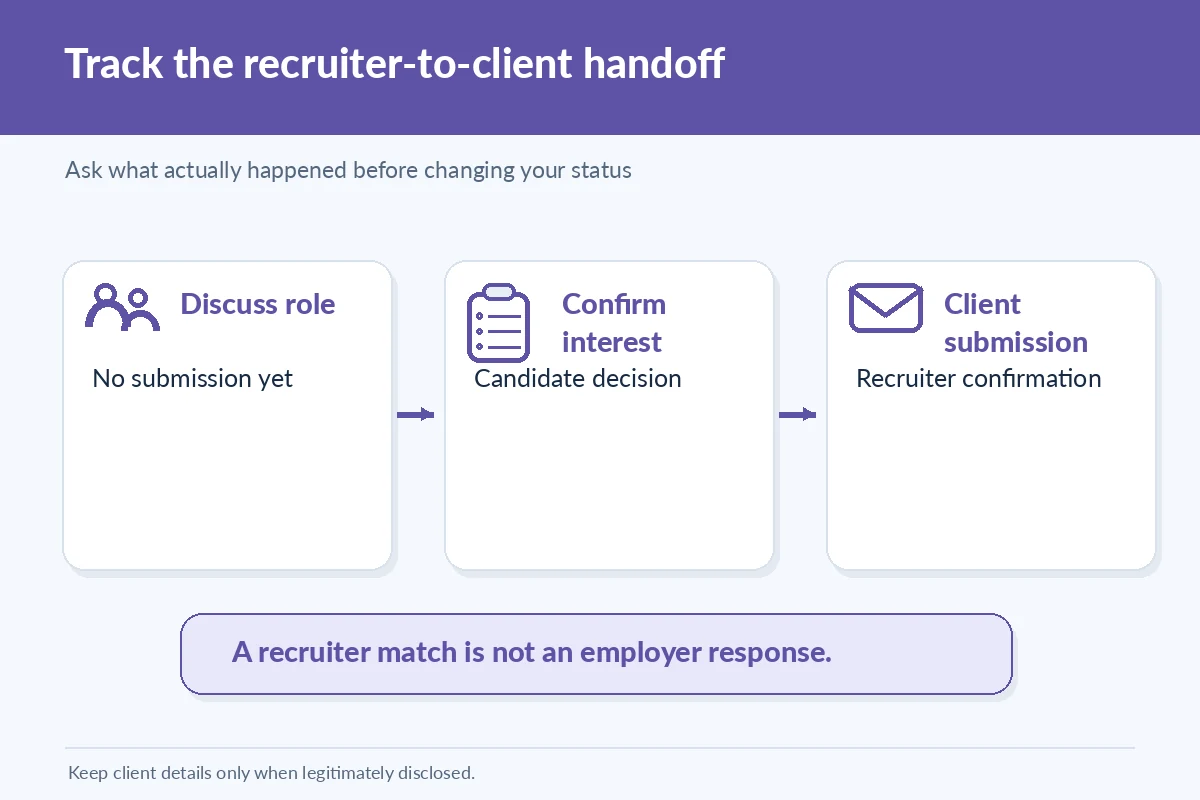
Distinguish a match from a real submission
Suppose a hypothetical applicant creates a profile with an agency on Monday and talks with a recruiter about office support on Wednesday. The recruiter says there could be a client shift next week but has not submitted the candidate. A precise tracker records “profile registered” and “prospective shift discussed.” It does not record “applied to Client A,” because no client submission has been confirmed. On Friday, if the recruiter confirms the candidate has been forwarded for a named job order, the child row can change to “submitted to client — recruiter confirmed.” Keep the confirmation date and the specific assignment reference separate from the agency registration.

Use a two-layer table to avoid double-counting
In the agency table, one row per firm tracks your registration and main recruiter. In the job-order table, one row per specific client opportunity tracks title, schedule, agreed representation, stages and outcome. A general agency intake form should not increase your confirmed role-application count. If an agency asks you to complete more than one skills evaluation, record assessment invitations separately and say which job they relate to. A candidate can be active with an agency and have zero current assignments. Likewise, a completed assignment does not automatically mean permanent employment or continued consideration for every future role.
| Record | Evidence you have | Do not infer |
|---|---|---|
| Agency profile | Registration acknowledgment | A specific client applied to |
| Job match discussed | Role details from recruiter | Client approved candidate |
| Client submission | Recruiter confirmation and role ID | Interview guaranteed |
| Assignment accepted | Written terms confirmed | Permanent position guaranteed |
Ask recruiters for the next meaningful stage
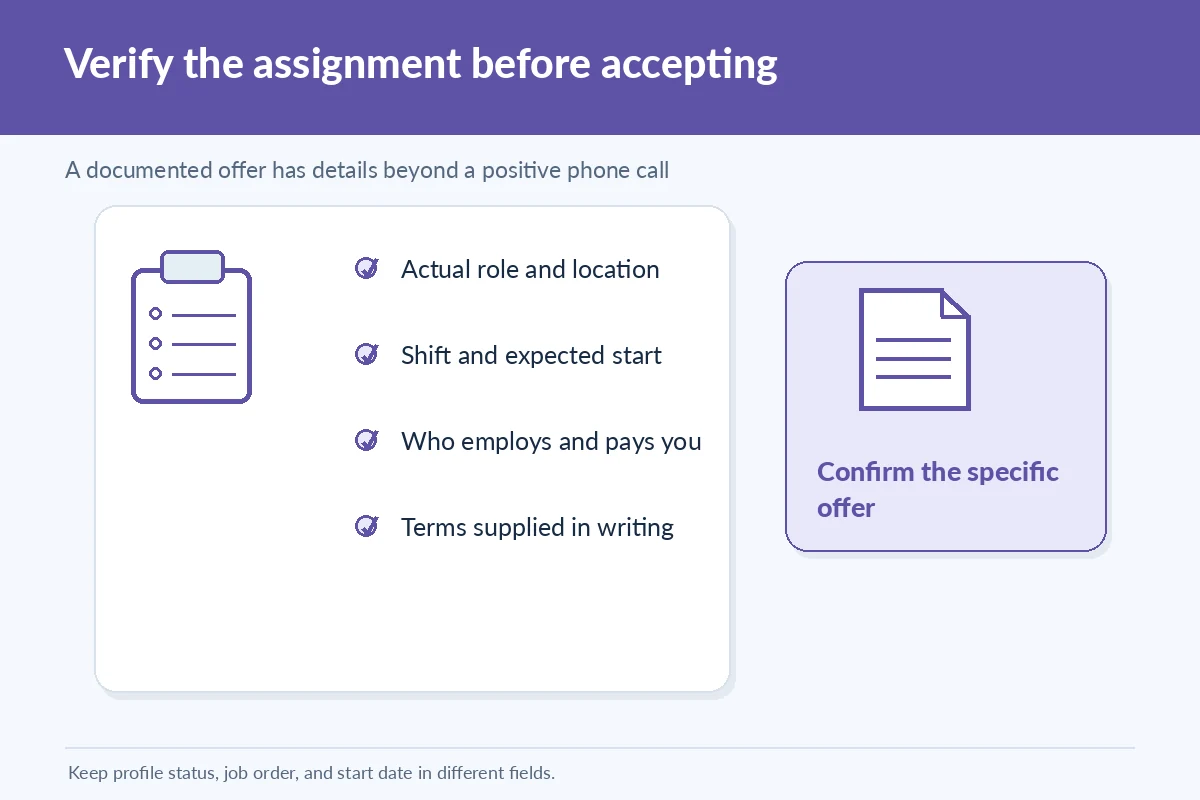
Useful questions include: “Is this a general registration or a submission for a specific opening?” “Has my profile been sent to the client, and with my permission?” “Who would be my employer for this assignment?” and “What schedule or end-date information is confirmed?” Ask for written clarification when an assignment changes. Avoid sending the same client application through multiple intermediaries without understanding any existing representation agreement. The agency can describe its own process, but only the actual offer or assignment documentation establishes specific conditions. Never mark a job as accepted because a recruiter described it enthusiastically on the phone.
Handle assignments and placements as separate outcomes
A role can progress through screening, client review, interview, confirmed assignment, assignment started, and assignment finished. Those stages are not universal; choose neutral labels that match written communication. An offer might include a shift, location, start time, manager contact, job duties, and payroll details. Check them using the legitimate agency channel before acting. If the employer changes a shift or the client pauses the project, add a dated update instead of overwriting the original message. For temporary jobs, it is especially useful to retain what was said about the planned duration and whether an extension is only a possibility.
Protect identity documents and contact details
Employment agencies may eventually need forms for lawful onboarding, but a casual recruiter message is not a safe place to send identity photographs, bank credentials, or Social Security data. Verify the organization on its official domain and use secure onboarding processes when genuinely required. The FTC warns that scammers may claim to represent a known employer while requesting money or financial information. Do not put passport scans, banking details, test scores, or third-party client confidential documents in an ordinary job search spreadsheet. A short reference such as “onboarding paperwork completed in official portal” is usually enough for tracking.
Review profiles and client opportunities separately
At your weekly review, update the agency-level availability only if it actually changed, then examine individual roles one by one. Close a job-order row when the client withdrew the opening, you declined it, or the agency reported a decision. Leave the parent agency profile active if you still want suitable opportunities and the company confirms you remain registered. If you start a job elsewhere, tell each relevant agency when appropriate and record the date. Your tracker should help you understand obligations, not serve as a guess about what the agency can or will offer next.
How We Research Application Tracking Decisions
This article compares published career-center guidance with employer or staffing-firm process documents relevant to staffing agency application tracker. The employer-specific examples are not universal policies; the hypotheticals illustrate how to record evidence without claiming an outcome. Source pages and URLs were checked on November 15, 2026. Policies, interfaces, and deadlines can change. Always verify a particular employer’s current instructions before sending information or making a time-sensitive decision.
Sources consulted: Staffing-firm and career guidance — 1; Staffing-firm and career guidance — 2; Staffing-firm and career guidance — 3; Staffing-firm and career guidance — 4. The linked materials support tracking and role-specific caveats, not a guarantee of hiring results.
For site relationships, advertising policies, and reader disclosures, review the JobAsk affiliate disclosure.
Related Job Search Guides
It counts as agency registration; label it that way. Record an actual specific job submission separately when confirmed.
Write “client confidential” and record the job order reference and duties that were legitimately shared. Do not invent a name.
Ask each recruiter about the job identity, representation and any permissions before agreeing to multiple submissions.
No. Keep prospective matches separate from a real offer with confirmed conditions.
No. Keep sensitive material in official secure channels and record only that a verified step was completed.