
Museum visitor services behavioral interview questions ask what you did when real people needed assistance, admission checks, accessible directions, or a calm response to a problem. Select an actual story from a visitor-facing job, volunteering, a campus event, or another relevant setting; label that setting honestly. Your answer should identify the visitor’s request, your assigned role, the information you checked, the action you personally took, and how the issue ended. Do not claim that you invented a museum policy, guaranteed access, handled a security incident alone, or made a medical judgment. The example prompts below are practice questions based on common visitor-service duties, not questions promised by a particular museum.
Pick visitor stories with a clear service boundary
Start with a short inventory of times you greeted people, explained entry rules, checked reservations, gave directions, or asked a supervisor to resolve a conflict. An answer about handing out maps may be stronger than a dramatic story about a crisis you did not actually manage. Choose one event you can reconstruct: the visitor’s need, what materials you were allowed to use, your exact words or actions, and the next handoff. A student gallery volunteer can use a campus exhibition example if the answer clearly identifies it as volunteer work. Avoid identifying real visitors, displaying ticket scans, or revealing an institution’s restricted procedures.
Describe a time you clarified an admission issue
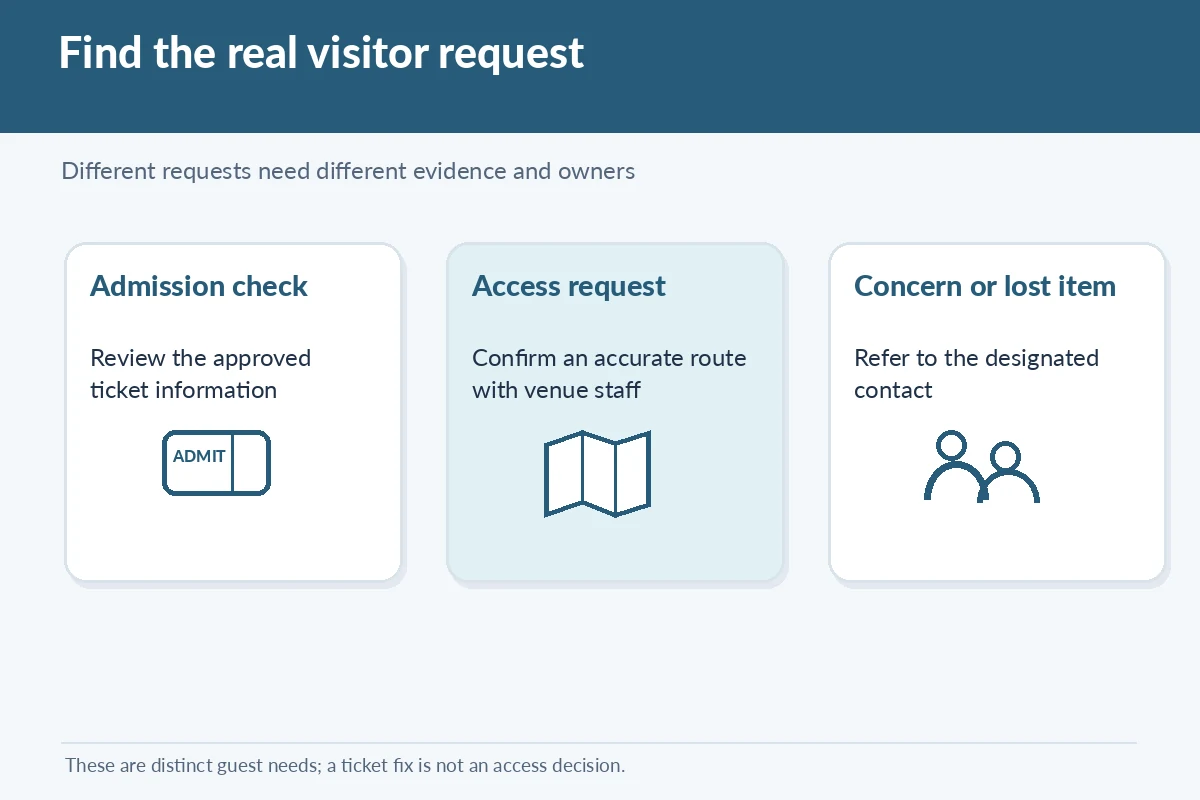
A possible behavioral prompt is: ‘Tell me about a time you handled an entry problem or conflicting information about a ticket.’ The interviewer is looking for an actual sequence rather than a claim that you always stay calm. Explain whether the problem concerned an expired pass, a confusing time slot, or an unclear reservation. Say what you verified through the permitted system or printed policy, which part of the question you could answer, and when you called the designated admissions lead. Do not say you waived a fee or changed an admission rule unless that was explicitly within your authority.
Explain assistance without making assumptions about access
Another prompt is: ‘Tell me about a time you adjusted your communication or directions for a guest.’ Focus on asking what the person needs, checking available information, and giving clear options. You can describe finding the accessible route shown on an official venue map, confirming a lift’s availability with staff, or calling the designated assistance contact. Do not assume a visitor’s disability or promise that a route, restroom, or exhibit is accessible without verification. The strongest answer communicates respectful choices and an accurate handoff, not a claim that you solved every access problem personally.
Build a STAR answer about conflicting visitor requests
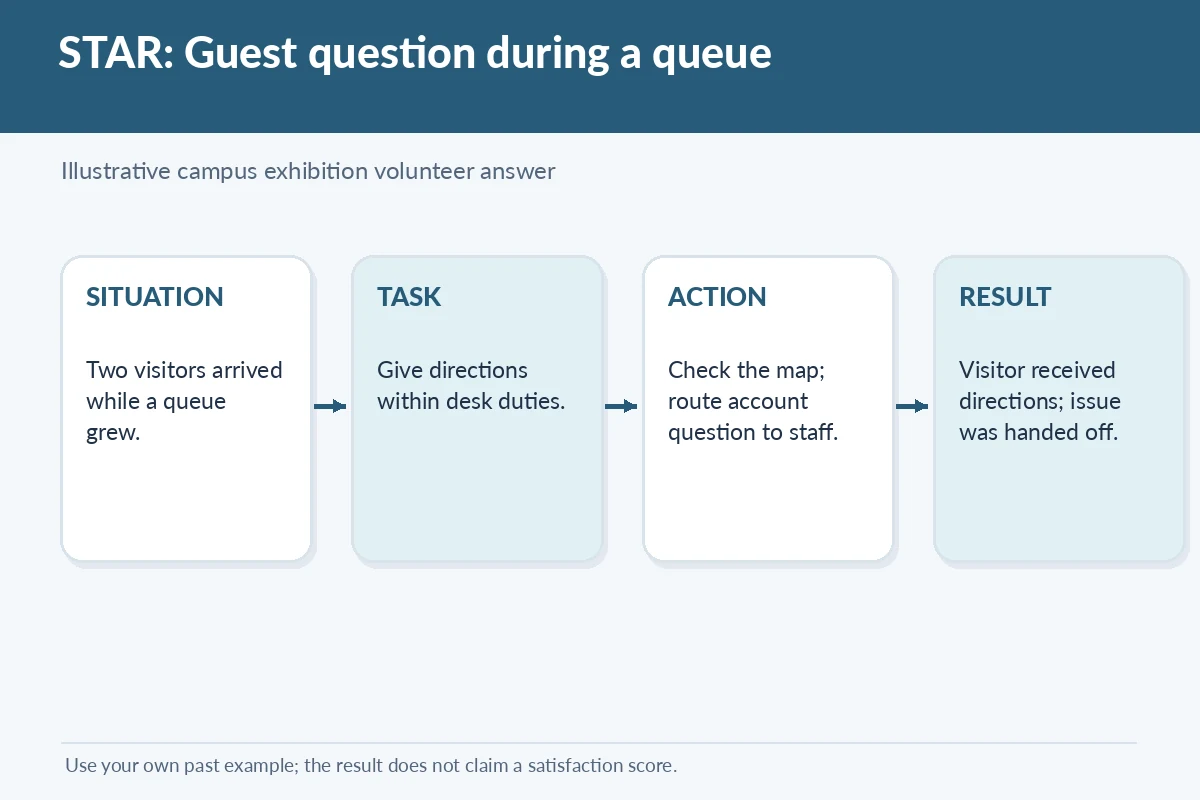
Illustrative example only; adapt it only if something similar genuinely happened to you. **Situation:** At a campus exhibition, two visitors asked for directions while a queue was forming. **Task:** As a volunteer, I needed to answer within my assigned desk duties and keep the line moving. **Action:** I checked the public floor map, gave a concise route to one visitor, and asked a staff member to handle the reservation question that needed account access. **Result:** Both questions reached the appropriate person, and I wrote the remaining issue in the volunteer handoff note. The result is a documented handoff, not a fabricated satisfaction score.
| Situation to discuss | Evidence of your action | Limit you should state |
|---|---|---|
| Admission mismatch | Checked the approved source; sent exceptions to admissions lead | Do not invent ticket override authority |
| Accessible directions | Asked about need; confirmed a posted route | Do not assume facilities or health needs |
| Lost property | Recorded permitted details; contacted assigned staff | Do not promise recovery |
| Visitor complaint | Listened, stated options, handed off policy decision | Do not invent refund authority |
Discuss missing items and safety concerns responsibly
A behavioral prompt might ask: ‘Describe a time someone reported a lost item or an urgent problem while you were assisting guests.’ Explain how you followed the venue’s instructions, avoided making promises, noted only the information the policy allowed, and told the person who owned the next step. Lost property, separated children, and emergencies can have different processes; do not blend them into one universal procedure. If you have no direct example, say so and use a truthful service handoff that tests the same skill, then explain that you would learn the organization’s official reporting route.
Separate an empathetic response from a policy exception
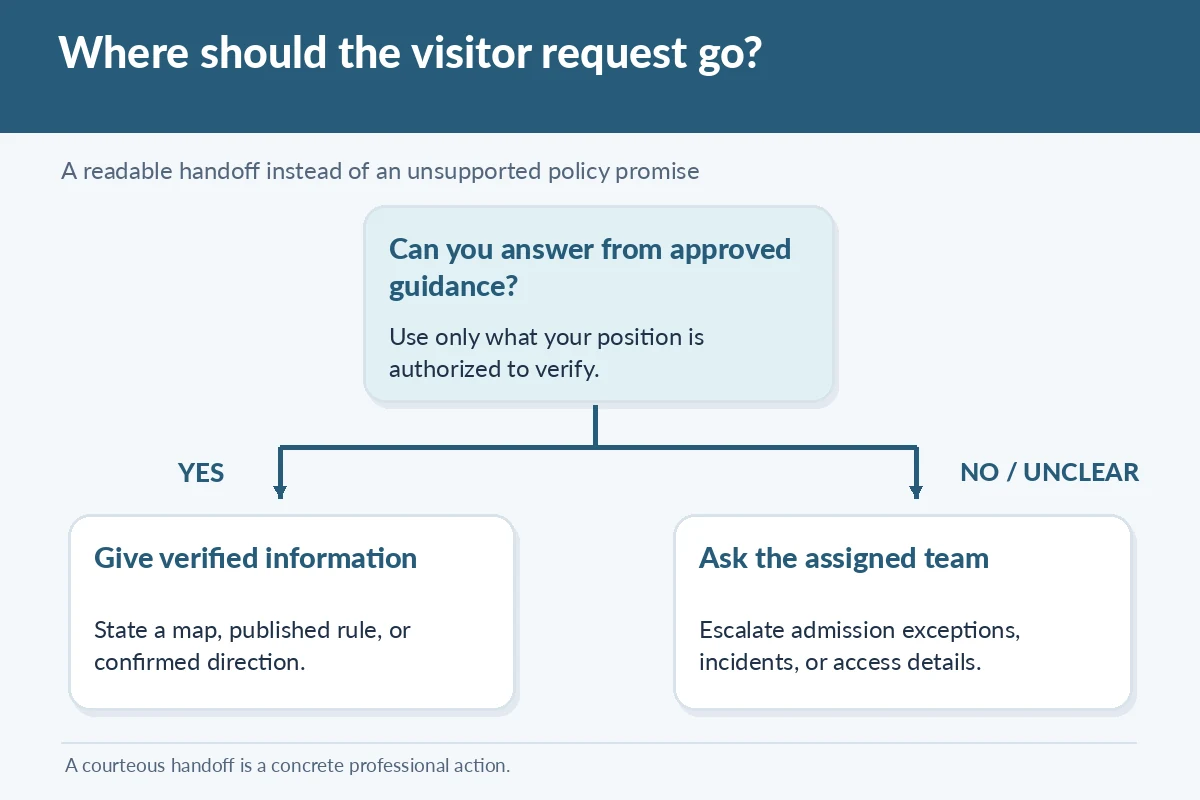
Interviewers may ask how you handled an upset guest. A useful answer shows listening, a brief acknowledgment of the concern, and a clear distinction between giving information and granting an exception. Avoid calling the visitor ‘difficult’ or declaring the person wrong. In your story, describe the policy you actually had access to and the supervisor you involved when a decision exceeded your role. A good outcome might be that the right colleague took over with accurate context. It need not end in a refund, waived admission, or instant agreement to demonstrate professional conduct.
Prepare for follow-ups about ownership and records
The interviewer may ask, ‘What did you personally say?’, ‘Who approved the change?’, ‘How did you record the issue?’, or ‘What would you do differently?’ If your original answer uses ‘we,’ distinguish your own actions from team decisions. Identify whether you consulted an admission guide, ticket screen, printed schedule, or staff member. When the record involves a visitor’s personal details, discuss the process at a high level and avoid reproducing confidential data. If you cannot remember the exact words, do not invent a verbatim quotation. Accuracy is a better sign of judgment than polished but unverifiable details.
Practice a small set of varied stories out loud
Prepare three separate examples: one routine request, one ambiguous problem, and one situation requiring another person’s help. Practice each in roughly a minute, then be ready to add detail if asked. Read the actual museum job description: a front-desk position, gallery attendant, and admissions associate may have different responsibilities. Ask the interviewer which team handles admission overrides, visitor access requests, and incident escalation rather than assuming the same structure everywhere. In the final review, remove details that imply that a volunteer independently applied security, medical, accessibility, or pricing rules.
How We Research Behavioral Interview Questions
We used the U.S. Office of Personnel Management’s structured interview guidance to distinguish behavioral questions about past experience from hypothetical situational questions. University of Maryland’s interview guide informed the use of STAR and practice with real experiences. For this occupation, we reviewed the linked public occupational source for representative duties and carefully separated possible tasks from work a particular candidate actually did. These sources were checked on November 15, 2026. The sample response is explicitly illustrative; the questions are preparation prompts, not a claim about the exact questions any employer will ask.
Sources consulted: OPM structured interview guidance; University of Maryland interview preparation; O*NET visitor service and ticket-attendant duties.
For site partnerships, promotional links, and editorial disclosures, review the JobAsk affiliate disclosure.
More Interview Preparation Guides
Yes. Label the setting accurately and choose a real example involving guest communication, rule clarification, or a responsible handoff.
Use a truthful example of checking reservations, attendance lists, or customer details; do not pretend you used an admissions platform.
Requirements differ. Describe respectful communication and how you verified options; do not claim knowledge of a particular site before learning its procedures.
No. A verified referral, corrected information, or clear lesson may be an honest result when you could not decide the issue alone.
Yes, without identifying the visitor or disclosing private records. Focus on actions and the boundary between assistance and policy approval.