
For second interview for a supervisor role, expect to go beyond the first conversation and explain what you personally did, how you made decisions, and which questions remain open about the work. A later-round invitation is not a promise of an offer. The format may include a manager, a panel, a work example or a practical case, depending on the employer. This guide focuses on assess the gap, coach and assign and review and elevate rather than memorized confidence claims. Use only genuine employment history in answers about your background; any sample situation here is hypothetical and must be adapted to your real authority and evidence. Before participating, confirm the invitation, time zone, participants and any approved presentation or work-sample instructions.
Understand what supervisory authority the job includes
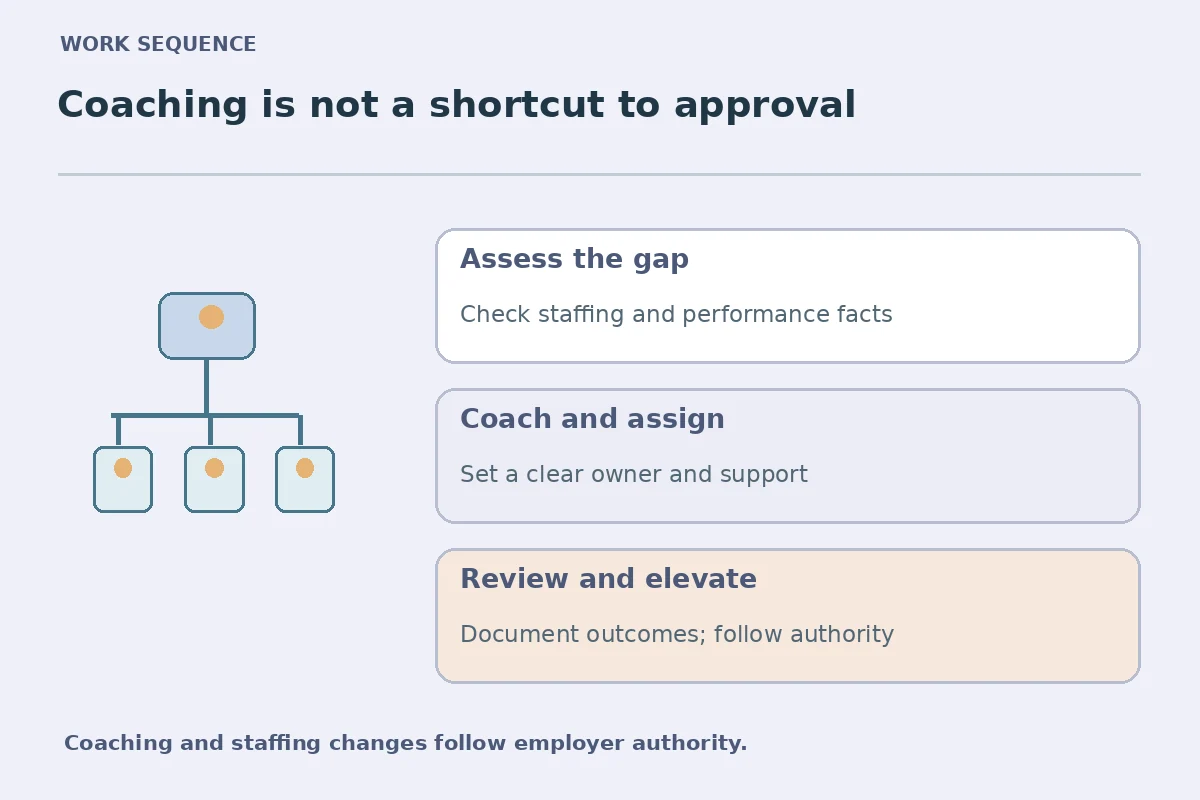
The word supervisor can cover scheduling, coaching, operational review and formal personnel decisions in different combinations. Before your second interview, reread the advertised duties and note which responsibilities you have personally performed. Assigning an approved shift roster is not the same as changing pay, issuing discipline or approving a safety exception. O*NET describes operational managers as coordinating tasks, directing teams and monitoring resources, but a particular employer controls the decision rights of its own supervisors. If the job description is ambiguous, ask who approves changes that affect staffing, performance records and spending. Use those boundaries when answering every scenario.
Prepare two coaching examples with outcomes
Select one example of helping a colleague learn a task and one example of handling a recurring operational problem. For each, establish the observable problem before you describe the solution. Say who was responsible, what assistance or feedback you gave, and what you checked afterward. Do not claim a staff member’s improvement solely because you gave advice; use work records you can accurately summarize or explain the limits of measurement. A hypothetical line is: “We agreed on a handoff checklist and reviewed the next shift’s missing items.” If you were a peer mentor, call yourself a peer mentor, not an official manager.
Show delegation as an explicit agreement
A credible delegation answer includes the expected result, a capable owner, a timeframe and a review point. If team members have different training or authorizations, the assignment must respect those limits. For a hypothetical retail shift, you might assign shelf checks to an available trained employee while you handle customer escalations, then verify both areas before closing. That scenario does not imply you may override company cash controls or authorize restricted work. Practice asking what information you would need before choosing a delegate. Avoid presenting delegation as simply giving people tasks without support or accountability.
Use a coverage scenario to demonstrate judgment
Imagine two colleagues call out before a busy shift. The diagram below separates the service need, the available skills and the approval path. Explain how you would check who is trained, what work can be postponed, whether another shift can provide approved coverage and whom you must notify. It is safer to identify a limit than to promise a full service level at any cost. If overtime, staffing ratios or employee accommodations are involved, refer to employer policy and the appropriate authority rather than improvising a legal rule. The evaluator is listening for priorities and the ability to recognize what cannot be solved alone.
Correct an underperforming process before blaming people
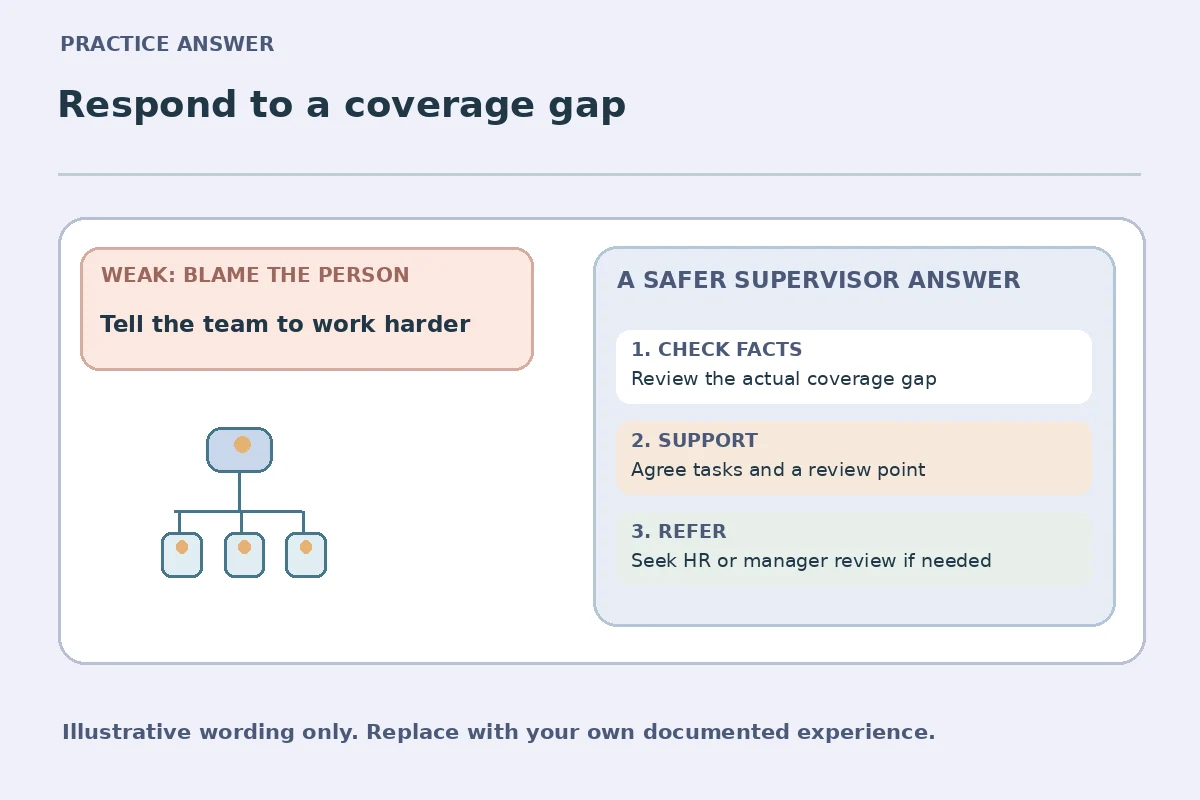
When an interview scenario describes a missed target, ask whether inputs, scheduling, training, equipment or unclear handoffs contributed. Document facts without diagnosing a coworker’s motivation. A manager may need to address individual performance, but that requires the proper process and access to reliable information. A good response might say that you would review the work record, clarify expectations privately and request authorized support before considering formal action. State what you would monitor over the next shifts. Do not reveal personal employee details or describe a disciplinary decision beyond the scope of your real experience.
Answer with a fair but concrete STAR account
Structured interviews may ask for a specific past example of teamwork or judgment. The Office of Personnel Management advises job-related, open-ended questions that elicit situation, task, action and result. Prepare a concise response about a real service delay, mentoring task or shift handoff. If you cannot share a measured outcome, state the observable next step rather than inventing a percentage. For example: “We moved open issues to a shared log for the next supervisor to review” is stronger than an unverifiable claim that you transformed productivity. Explain the choice you made and who approved the operational change.
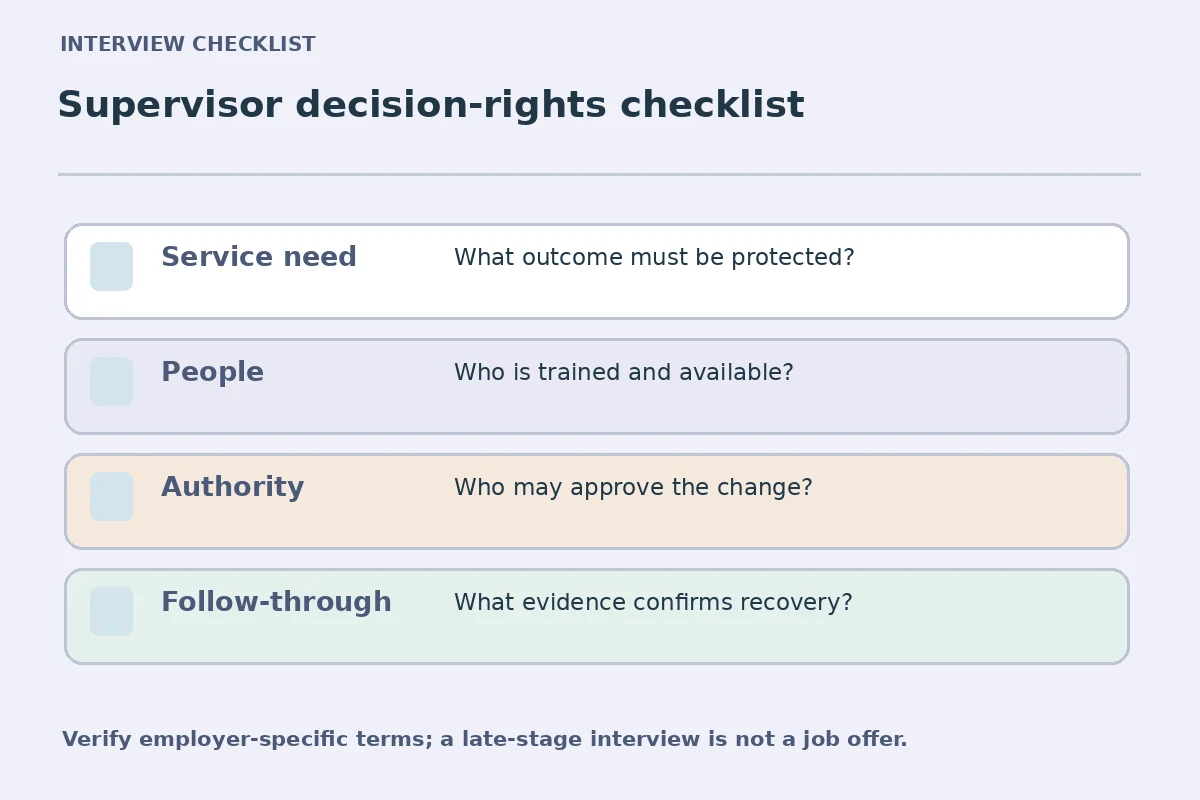
| Decision area | What to confirm |
|---|---|
| Service need | What outcome must be protected? |
| People | Who is trained and available? |
| Authority | Who may approve the change? |
| Follow-through | What evidence confirms recovery? |
Ask about team standards and available support
Use your questions to determine whether the employer expects coaching, task assignment, hiring, formal reviews or more than one of these. Ask which metrics the supervisor directly influences and what tools exist for tracking coverage and training. Another helpful question is “When a work-quality issue is discovered, who is responsible for the final disposition?” The answer can reveal whether the role has genuine decision authority or must escalate to a specialized department. Do not assume every team problem is yours to resolve privately. Clear escalation protects employees, customers and the person taking a first supervisory job.
Close with an evidence-based leadership promise
Instead of saying “I will fix morale and eliminate errors,” explain the practices you can perform: clear assignments, documented handoffs, timely feedback and escalation when approval is required. Ask what the next interview step will test, whether there is a practical scenario or another leader to meet, and when the team expects to communicate. You may thank the interviewer for discussing the real work without pretending to know the hiring outcome. Afterward, review your answer for unverified claims, particularly employee numbers, results and disciplinary authority. The strongest second-round response sounds like a responsible future supervisor, not a heroic exception to policy.
How We Research Second and Final Interview Advice
JobAsk reviewed these occupational, government and university sources on November 17, 2026: U.S. OPM explains competency-based questions and the distinction between behavioral and situational interviewing. U.S. OPM describes clear job-related interview questions and the situation-task-action-result structure. O*NET describes operational leadership as assigning work, coaching, evaluating results, coordinating others and managing resources. BLS identifies training evaluation, team management, budgeting and coordination among responsibilities of development managers. These sources describe typical interview formats or real occupational duties; they do not establish what any individual employer will ask or how a hiring decision will end. We checked that this scenario answers a more specific reader question than general interview preparation, while the employer remains the final source for its own hiring process. Examples in this guide are hypothetical and must not be presented as actual employer results or client outcomes. No affiliate approval, employment offer, guaranteed interview score or hiring outcome is implied. Read the JobAsk affiliate disclosure.
More Interview Preparation Guides
They may; prepare real examples and explain hypothetical decisions within policy rather than assuming a specific format.
Only describe authority you actually had and avoid exposing personnel information or inventing discipline.
Describe the shift leadership tasks you actually performed, while distinguishing them from formal supervision.
Own your action, explain the observed problem and show what you changed or escalated afterward.
No. Explain measurement, the limits of your control and the review process.