
For second interview for a remote job, expect to go beyond the first conversation and explain what you personally did, how you made decisions, and which questions remain open about the work. A later-round invitation is not a promise of an offer. The format may include a manager, a panel, a work example or a practical case, depending on the employer. This guide focuses on receive request, write handoff and escalate safely rather than memorized confidence claims. Use only genuine employment history in answers about your background; any sample situation here is hypothetical and must be adapted to your real authority and evidence. Before participating, confirm the invitation, time zone, participants and any approved presentation or work-sample instructions.
Ask what remote means in this actual role
A second interview for a remote role may probe how work reaches you, what you deliver and how teammates know when to act. Start by confirming whether the advertised arrangement is fully remote, hybrid, or location-restricted. “Remote” does not establish unrestricted work from any state or country, a personally chosen schedule, or permission to use any device. Ask the employer about approved locations, work hours, time-zone overlap, response expectations and the systems you would receive access to. Treat the answer as a condition to verify, not an assumption. Never promise twenty-four-hour responsiveness to sound cooperative when you cannot provide it.
Build a real asynchronous handoff story
Choose a task in which someone else needed your update before continuing. Describe the initial request, the ticket or document used, the status you recorded, the blocker you recognized and the next person responsible. If the example was in person rather than remote, say so and explain what documentation practice could transfer. Do not claim use of a remote collaboration tool you have never opened. The strongest point is not the app name but whether the message gave the next worker enough information to continue safely. Avoid using screenshots from a current employer, private channels or personal customer data.
Separate fast replies from sound escalation
A hiring manager might ask what you would do if a teammate were offline while an urgent issue remained open. A reliable answer first checks the agreed priority, tries the approved channel, records what is known and escalates according to policy. It does not promise to bypass access controls, share passwords, or make an unapproved production change. If the task is routine, a clear async update may be preferable to a late-night call. If there is an emergency, the escalation policy governs. Explain how you would identify the threshold rather than guessing what every employer considers urgent.
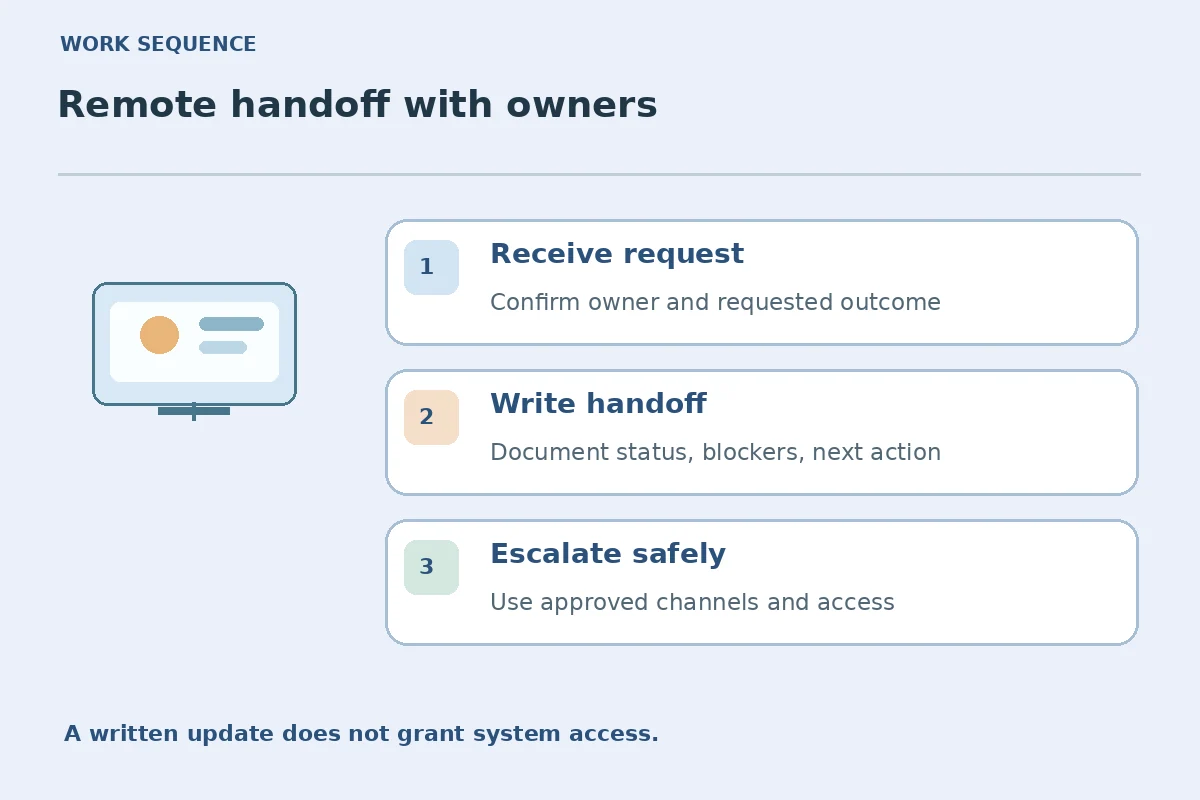
Show how the request moves across time zones
Use the first diagram as a model: a person receives work, records the owner and status, and hands off only the relevant next action. Time-zone differences change when colleagues overlap, not who owns the work. A hypothetical support analyst might leave a note that an error was reproduced in a test environment and that a named reviewer must approve a fix. Do not describe yourself as having performed that work unless it is genuine experience. If the employer’s hours include a shared meeting window, ask how shifts, breaks and incident coverage are handled before you agree to the arrangement.
Practice a concise example of written clarity
Remote interviews often involve video, but the work may depend just as much on writing. Try answering a scenario aloud, then draft a four-line handoff: what changed, the evidence, the current blocker, and the next responsible owner. Use neutral language instead of assigning blame. If a teammate missed a deadline, you could describe how you checked the status and offered a documented next step without exposing private performance records. A good answer makes the workflow visible while acknowledging your scope. It should not claim that you alone could approve access, payments, safety procedures or customer promises.
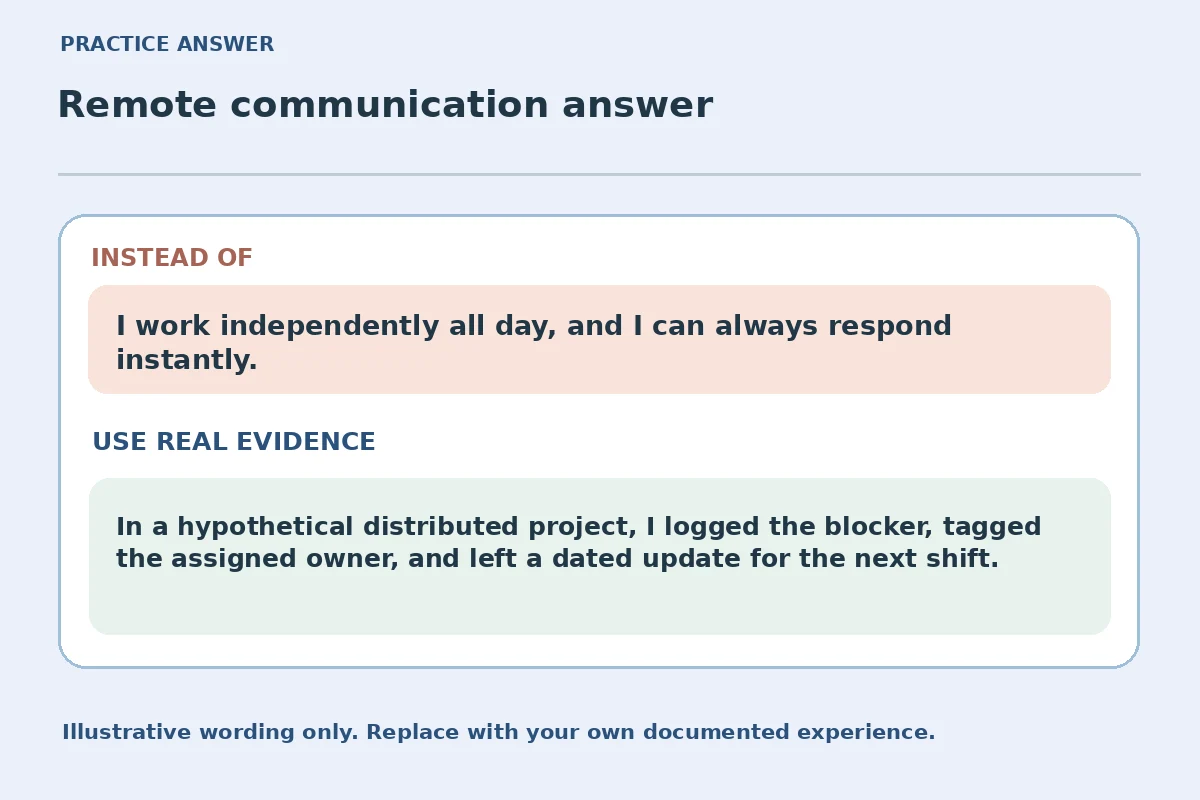
Prepare for a video second round without performative tricks
Check the interview invitation for platform, time zone and meeting link. Test camera, microphone and a quiet location in advance. A brief note sheet can help, but reading a memorized script into the camera may make follow-up questions awkward. Practice explaining one complex workflow without screen sharing. Ask before opening any materials; remove company logos, private chat threads or unreleased work. University of York recommends treating a live video interview with the same preparation as a face-to-face meeting while checking the technical setup. If an access problem occurs, contact the organizer through the official invitation details.
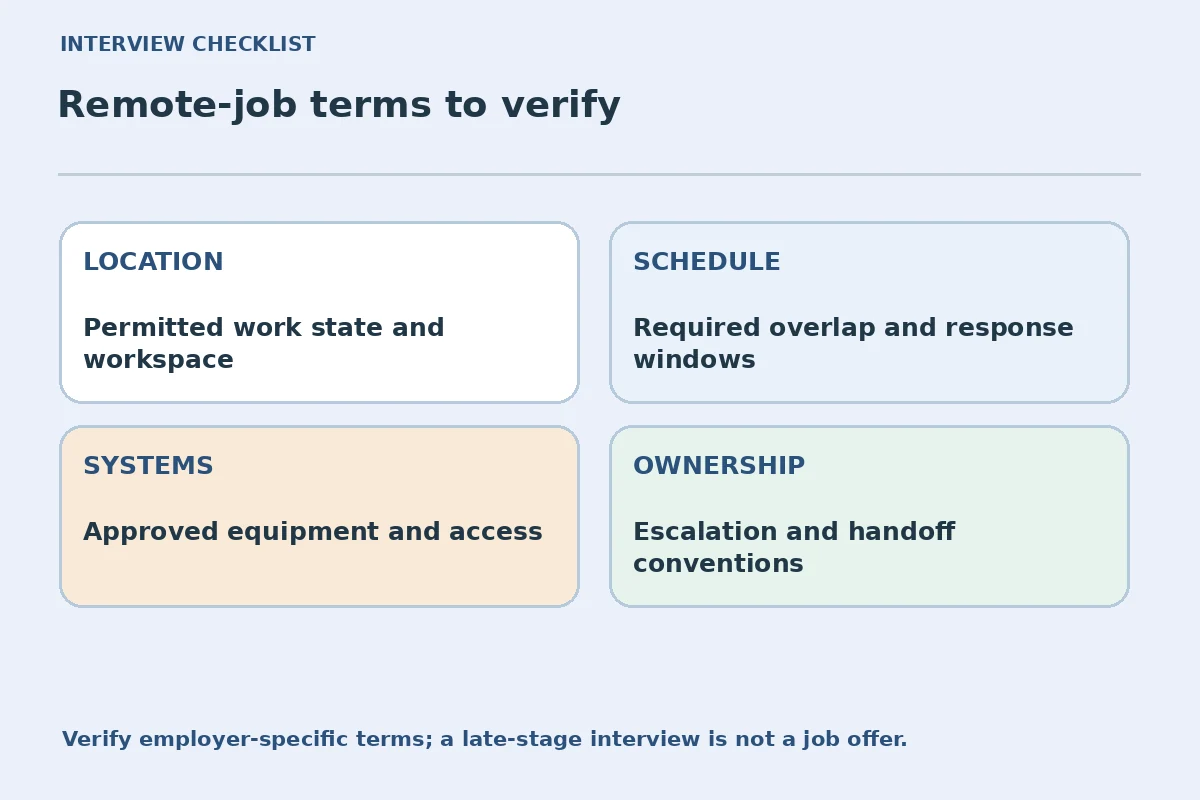
| Decision area | What to confirm |
|---|---|
| Location | Permitted work state and workspace |
| Schedule | Required overlap and response windows |
| Systems | Approved equipment and access |
| Ownership | Escalation and handoff conventions |
Use employer questions to test actual support
Ask what onboarding looks like, who reviews work, where instructions are maintained and how conflict or rework is resolved. A remote role that expects isolated work without defined ownership deserves careful clarification. Another useful question is “What would need to be recorded at a shift change so the next colleague can continue?” If the interviewer cannot discuss tools yet, ask about the process instead. Avoid insisting that every successful remote team operates identically; the right process depends on security, customer service hours and the organization’s work. Note any requirement that is different from the posting.
Finish with a realistic boundary statement
You can express interest while remaining accurate: “I can work within a defined shared-hours schedule and I am comfortable documenting status and escalating blockers through the team’s approved system.” Only say this if true for you. If the job requires equipment you lack, ask what the employer supplies and whether training is provided; do not purchase devices or pay someone to secure an interview. Record who will share the next-step decision and when. Sending one concise thank-you message is reasonable, but an interview invitation or a successful video connection does not prove an offer has been made.
How We Research Second and Final Interview Advice
JobAsk reviewed these occupational, government and university sources on November 17, 2026: Santa Clara University describes second interviews as deeper evaluations of qualifications, job interest and behavioral examples. University of York discusses in-depth second interviews, video interview preparation and different types of employer assessments. U.S. OPM explains competency-based questions and the distinction between behavioral and situational interviewing. Notre Dame notes that on-site and later-stage interviews are used for mutual evaluation of employer and applicant, including virtual arrangements. These sources describe typical interview formats or real occupational duties; they do not establish what any individual employer will ask or how a hiring decision will end. We checked that this scenario answers a more specific reader question than general interview preparation, while the employer remains the final source for its own hiring process. Examples in this guide are hypothetical and must not be presented as actual employer results or client outcomes. No affiliate approval, employment offer, guaranteed interview score or hiring outcome is implied. Read the JobAsk affiliate disclosure.
More Interview Preparation Guides
Possibly, but only the employer can confirm the interview format or any work sample.
No. Clarify required hours, overlap and response policies instead of promising what you cannot deliver.
Yes, if relevant: employers may limit approved work locations for operational or policy reasons.
Give a real, anonymized example of the update, owner, blocker and escalation channel.
No. Use fictional or sanitized examples and follow your employer’s information-handling requirements.