
For “Tell Me About Yourself in a Nursing Interview” in a nursing interview, identify your actual nursing status or current role, mention one relevant patient-care or clinical-learning experience, and explain why this unit or setting interests you. A new graduate can discuss a supervised clinical rotation; an experienced registered nurse can describe duties performed within their real role and authorization. Both should avoid implying clinical independence they did not have.
Patient care involves safety, documentation, communication, and teamwork, but a brief introduction is not an opportunity to reveal private patient information. Every example below is hypothetical. Never use a sample to claim a license, a completed clinical rotation, a specialty credential, or a patient outcome that is not yours.
Identify Your Nursing Status With Precision
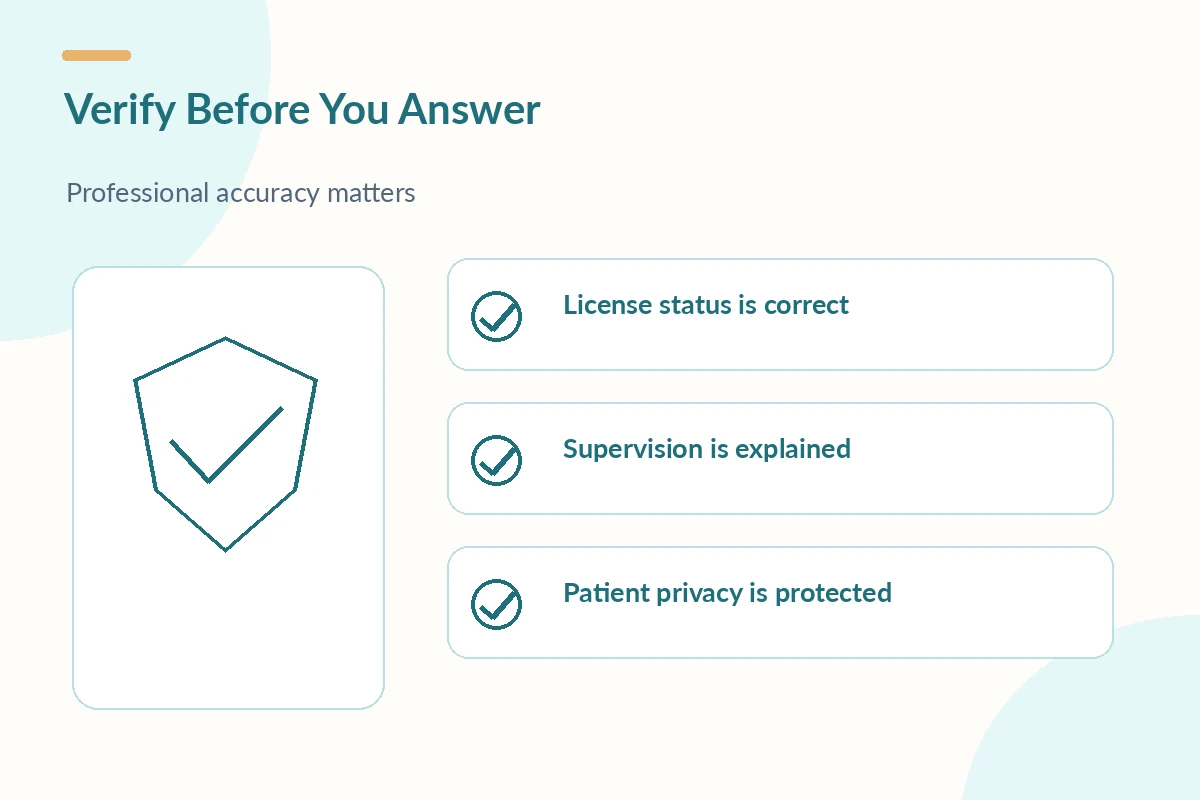
State whether you are a nursing student, a recent graduate preparing for entry-level roles, or an RN with professional experience. Name only degrees, licenses, certifications, and placements you have actually completed. If a license is pending, do not say you are already licensed. A recruiter may have a separate process for checking credentials, but your spoken story must be consistent with the application.
If you are an experienced nurse changing units, identify the actual specialty or setting in which you worked rather than implying all nursing roles are interchangeable. The same applies to leadership responsibilities: serving as a mentor on a shift is not automatically the same as holding a formal charge nurse or supervisory role. Accuracy creates context for the example that follows.

Select Evidence That Fits the Unit or Care Setting
BLS Registered Nurses guide describes RN responsibilities such as monitoring patient conditions, documenting observations, explaining care instructions, and collaborating with other professionals. Use the job description to choose one or two related tasks from your own actual practice or supervised training. A unit requiring frequent patient education may call for a communication example; another role may highlight safe documentation or coordinated handoffs.
Do not assume a clinical rotation gives the same responsibility as licensed employment. It can, however, demonstrate what you observed, practiced under supervision, learned, and contributed within approved student responsibilities. If your experience is mainly in a different care setting, explain the transferable communication and workflow skills while making the difference clear.
Describe a Supervised Clinical Example Honestly
A hypothetical student example is: “During a supervised rotation, I practiced communicating patient updates to my clinical instructor and documenting observations as directed.” It should only be adapted by someone who actually performed those tasks under the applicable supervision. Do not insert a named hospital, claim full patient assignment ownership, or pretend a clinical practice exercise was independent employment.
For an experienced RN, a real example might be organized around explaining instructions to a patient, recording changes accurately, or coordinating with colleagues within policy. Keep details general and avoid dates, distinctive cases, or other identifying patient information. The opening is about your practice and judgment, not a retelling of someone’s medical history.

Connect Clinical Communication to Patient Safety
Mention a relevant communication behavior you can genuinely describe: asking for clarification, documenting what was observed, checking understanding of instructions, or making a timely handoff. Avoid vague claims such as “I always keep patients safe.” Safety is a continuing professional responsibility, not a guaranteed result that an interview sentence can prove. Your contribution should be describable without breaching privacy.
BLS Registered Nurses guide identifies critical thinking, communication, organization, and attention to detail as relevant nursing qualities. This is a description of the occupation, not a certificate that a particular applicant possesses those qualities. Back one quality with a real clinical or learning action and be ready to discuss what you would do when unsure, including following applicable supervision and escalation procedures.
Build a Three-Part Nursing Interview Introduction
Use a simple flow: current nursing status, one role-relevant clinical example, and reason for interest in the setting. Yale Office of Career Strategy recommends connecting background to field interest and keeping the opening useful for follow-up questions. You need not recite an entire placement list or describe every specialty rotation in one answer. Select experiences based on the unit’s actual requirements.
Hypothetical new graduate wording: “I recently completed my nursing program and am interested in beginning in a setting where teamwork and careful patient communication are central. During supervised placements, I practiced documenting observations and asking for guidance when a patient’s needs changed. I’m interested in this unit’s collaborative approach.” This is only a formatting illustration, not a real graduate or verified facility.
Adapt for an Experienced RN or a New Graduate
An experienced RN can open with their actual recent setting, select a representative practice responsibility, and explain the move without overstating specialty expertise. If you have worked mainly in outpatient care, do not describe yourself as experienced in critical care unless that is true. A new graduate can emphasize learning, supervised clinical work, and commitment to safe practice without apologizing for being at an early career stage. For the fuller picture, see our guide “Tell Me About Yourself as an Experienced Professional”.
Read the posting for shift expectations, patient population, and required qualifications. Avoid inventing statements about a hospital’s clinical excellence or exact staffing practices if you have not verified them. Express interest in what is publicly described or what you directly learned through an authentic conversation. A precise, modest answer may be more credible than a scripted statement about saving lives.
Practice Without Sharing Patient Details or Exaggerating
Rehearse a short version that clearly distinguishes coursework, supervised placements, and licensed employment. Check license status, education dates, and unit names against your documents. Remove anything that could identify a patient or violate an employer’s policies. If a question asks for clinical actions outside your experience, say so and discuss your real training or how you would seek guidance rather than guessing. For the fuller picture, see our registered nurse resume summary guide.
Have a trusted reviewer listen for the three anchors: professional status, evidence, and reason for this care setting. You may prepare fuller behavioral examples separately, but the opening itself should stay concise. A nursing interview introduction should help the panel see your actual background and judgment; it cannot stand in for credential verification or competency assessment. Our guide to nursing resume format goes into more detail.
How We Research Interview Guidance and Examples
We compared the scenario with publicly accessible university career guidance and, where needed, occupation-specific information, reviewed on October 22, 2026: BLS Occupational Outlook Handbook, Yale Career Strategy, Mississippi State Career Center, Penn Career Services. These resources support general interviewing practices and occupational duties, not the alleged effectiveness of a particular script or any sample person’s qualifications. All answer samples are hypothetical.
This is general U.S. career guidance, not a promise of an interview or employment. We do not recommend affiliate products here. See the affiliate disclosure.
Related Guides
- Nursing Clinical Rotations on a Resume: Show Units, Hours, and Scope
- Questions to Ask in a Nursing Interview: Unit Support and Escalation
- Nursing Interview Strengths and Weaknesses: Safety, Examples, and Growth
- New Graduate Nursing Cover Letter: Explain Clinical Training Honestly
- Tell Me About Yourself as a Medical Assistant: Clinical and Front-Desk Fit
Yes. Label them supervised learning experiences and describe your actual role and tasks without claiming independent RN practice.
Describe its status accurately. Do not state that an unissued license is active.
Discuss practice at a general level without information that could identify a patient or violate privacy expectations.
Relevant real setting, clinical responsibilities, team communication, and why the target unit fits the next step.
No. Never invent or exaggerate clinical metrics or claim individual credit for complex patient outcomes.