
For a teaching resume, name the instructional practices you have actually used and explain the learner needs, materials, or decisions involved. “Creative,” “patient,” and “passionate” may sound positive, but a hiring team needs clearer evidence of planning instruction, checking understanding, supporting students, and collaborating within school policies. Student teaching and classroom support can supply honest examples; they should not be presented as independent licensed teaching when they were supervised.
Match Skills to the Grade Level and School Role
The strongest skill choices change with the classroom. A kindergarten classroom, an upper-elementary literacy role, and a substitute assignment may require different materials and responsibilities. Read the posting and choose the skills that correspond to its real work: curriculum alignment, lesson delivery, behavior routines, progress monitoring, or family communication. The BLS profile for kindergarten and elementary teachers lists planning lessons, assessing student work, communicating with families, and supporting students among common duties. It also notes state certification requirements for public-school teachers.
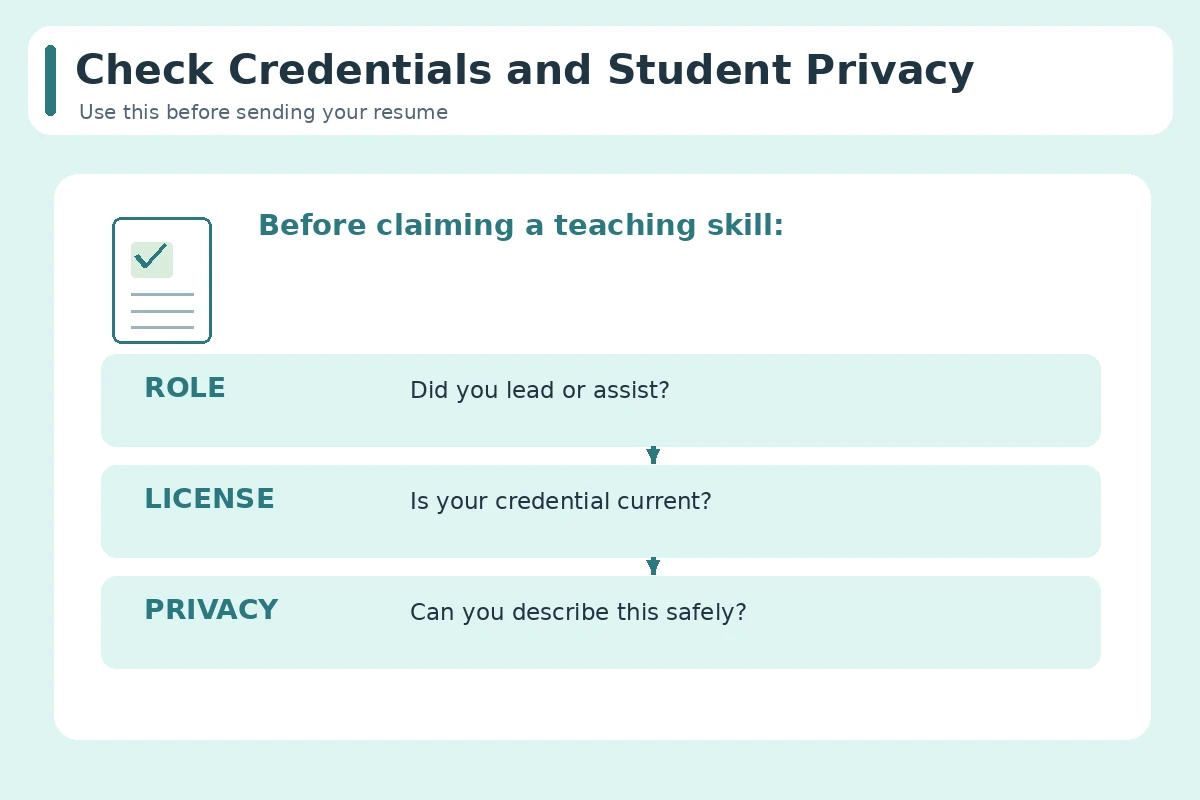
Before naming a skill, mark the setting where you practiced it: licensed classroom, supervised student teaching, teaching assistant job, tutoring, after-school program, or university project. A lesson observed under supervision is meaningful work but not proof that you independently held a licensed teaching position. Align skill words to evidence that can be explained without identifying students or disclosing school records. A good resume helps a principal see the fit while respecting professional boundaries.
Connect Lesson Planning to Instruction and Adaptation
Instead of writing only “lesson planning,” identify what you planned: learning objectives, materials, discussion questions, checks for understanding, or ways to differentiate instruction. O*NET’s elementary teacher task list includes planning activities and adapting methods to student needs. A hypothetical student-teaching bullet might say: “Prepared small-group reading activities aligned with mentor-approved objectives and revised prompts after observing confusion.” Use that wording only if those actions reflect your actual experience.
Describe the specific scope of your involvement. Did you draft a plan, teach a segment, modify materials after feedback, or coordinate with another teacher? Those steps are not interchangeable. A teacher aide who organized classroom materials should not claim to have designed the instructional program unless they did. Stronger bullets connect intent, action, and observable output while avoiding invented grade improvements. If you use school-specific terms, make them understandable to a reader outside that one district.

Show Assessment Skills With Appropriate Privacy
Assessment-related skills can include creating formative checks, reviewing student work, maintaining rubric records, or discussing observations with a supervising teacher. Be careful with the word “diagnosed”: formal student evaluations and special education decisions may have specific professional and legal processes. If you administered or scored assessments only as directed, state that supervision. The same distinction applies to decisions about accommodations, individualized education plans, and student records.
A believable example without sensitive student details is: “Organized anonymous exit-ticket patterns for the mentor teacher and helped revise the following practice activity.” This emphasizes a real instructional decision without exposing a child’s identity, disability, scores, or protected records. Make sure the actual setting permitted that work. Do not copy student work samples or photographs into a public portfolio without required authorization. If assessment evidence cannot be shared, describe the method and your role in general terms.
Demonstrate Classroom Culture and Family Communication
Words such as patience, collaboration, and classroom management are easier to evaluate when tied to a situation. A new teacher may have established a predictable entry routine, clarified transitions, or redirected questions under a mentor’s guidance. A teaching assistant may have tracked supply needs and communicated them to the lead teacher. Describe observed actions rather than claiming that every student behaved better. Classroom routines differ by school, and an intervention must remain within authorized policy and supervision.
Family communication deserves similar precision. Did you draft a classroom newsletter approved by a teacher, explain a general assignment, or participate in a family conference? Those activities have different levels of responsibility. Avoid publishing student names or suggesting that you made individual instructional decisions you were not permitted to make. The BLS discusses communication and resourcefulness as important for teachers; the resume should show your relevant examples, not convert an occupational description into a personal achievement.

Explain Technology and Collaboration as Teaching Tools
A list of digital platforms does not prove effective instruction. Name the software or learning system only if you used it, and describe the task: assembling accessible slides, collecting assignments, maintaining a shared schedule, or posting approved materials. Do not imply mastery of every learning management system merely because you used one. If your role involved accessibility support, distinguish modifications you created from decisions that required a licensed specialist or the teacher of record.
Collaboration can mean planning a lesson with another teacher, coordinating with a paraprofessional, or reporting an observed learning need through approved channels. Give the reader your part, not the team’s total accomplishment. A hypothetical example is: “Prepared visual instructions for a supervised science station and shared observation notes with the classroom teacher.” It identifies what was prepared and how information moved. Do not present it as a measured outcome unless records actually support one.
Check Credentials and Evidence Before Submitting
Teacher skills belong next to an accurate summary of education, certification, and teaching experience. Public-school licensure requirements vary by state and role; the BLS teacher guide notes state-issued certification is generally required for public-school teachers. Verify the actual state, license category, and status. “Certificate expected” must not appear as an active license. Similar care applies to endorsements, subject authorization, substitute credentials, and any training courses you have not yet completed.
Do a final skills audit: select three or four posting priorities and locate an example for each. Label supervised experiences honestly, remove anything you cannot discuss, and avoid disclosing student information. Then ensure the skills section and experience bullets tell the same story. If the school requests a specific application form or proof of licensure, follow its instructions instead of assuming a general resume format replaces those requirements. A clear, truthful description of teaching work is more useful than a long list of classroom buzzwords.
How We Research Resume Skills and Examples
We use public U.S. occupational descriptions, career-service guidance and documented competency frameworks to distinguish typical duties from individual qualifications. Links were checked on October 27, 2026. All sample resume sentences here are hypothetical writing examples, not claims about real applicants or JobAsk clients. Our review of public search results and the supplied local topic index does not reveal private WordPress drafts or establish availability of a slug in the database.
Source: BLS. BLS teacher duties and licensure discussion, including lesson planning and assessment.
Source: O*NET. O*NET classroom task examples, including instruction, adaptation and recordkeeping.
Source: CareerOneStop. Resume guidance on relevant accomplishment evidence.
These editorial references are informational, not a claim of endorsement or a commercial partnership. See the JobAsk affiliate disclosure. Skill examples must be adapted only to work you actually performed; no particular resume layout guarantees hiring or automated screening results.
More Resume and Cover Letter Guides
- Elementary Teacher Resume Summary: Lesson Evidence and Credential Scope
- Data Entry Resume Skills: Prove Accuracy, Tools, and Record Handling
- 911 Dispatcher Resume Skills: Prove Call Accuracy, Radio Work, and Records
- Elementary Teacher Cover Letter: Show Lesson Design and Student Support
- Teacher Assistant Resume Objective: Show Classroom Support and Supervised Scope
Yes. Name the activities and identify the supervised placement rather than describing it as an independent paid teaching role.
Only if you can explain the specific routines, responsibilities and grade-level context where you practiced it.
Do not expose identifiable student information. Follow school policy and applicable privacy requirements; describe methods instead when authorization is unclear.
State the status accurately and verify the state and authorization requirements; do not call an incomplete credential active.
Include specific applications you actually used for a relevant task, not every platform mentioned in a vacancy.