
Quick answer. A resignation email should make its purpose identifiable in the subject, state the decision in the first sentence, name one full date as the proposed last working day, and reach the correct recipient. A courteous sentence and realistic transition offer are usually more useful than a long story. Every draft sample here is invented; remove any claim about previous conversations or completed handoffs unless it truly occurred. The employer’s instructions determine which additional steps are needed.
Decide whether email is the right channel
An email can create a clear written record of your decision, but it may not be the only required step at your workplace. Check who should receive a resignation: direct manager, people operations or a specific internal portal. In a remote role, written notice may be ordinary; in another setting a conversation or form may be expected first. A polished message sent to the wrong person can still create confusion. Our walkthrough on how to tell your boss you are quitting sets out each step.
If you have already spoken to your manager, say that this message confirms the conversation. If you have not and a live meeting is feasible, consider whether a brief conversation first would make the transition clearer. Also, if safety or access concerns prevent that, use an authorized channel and document factual communication. This article focuses on email mechanics rather than determining legal validity.
Make the subject line searchable and neutral
A useful subject line is “Notice of Resignation — [Full Name]” or “Resignation Notice — [Role].” These are hypothetical wording examples, not company-approved formats. Avoid vague subjects such as “Important news,” which force the recipient to guess why the message matters. Avoid public or playful wording that may be embarrassing if HR forwards or archives the message.
If your organization has required subject naming or employee identifiers, use its procedure without exposing private details unnecessarily. The goal is straightforward sorting and recognition. Do not include highly sensitive medical, family or disciplinary information in the subject. Keep names and any expected recipient fields accurate before sending.

Write the first sentence without ambiguity
The first sentence should communicate a decision, not merely interest in discussing one. An original hypothetical line is “I am writing to resign from my position as [job title] with [organization]. My proposed final working day is [full date].” If the date is still under discussion, state that accurately and ask to confirm it; do not invent an already agreed final day.
Some templates use “effective [date],” which can be interpreted differently by busy readers. Writing “my last working day will be [date]” is often clearer, provided that is what you genuinely intend and the relevant process permits. Do not let a neatly formatted email obscure a real discrepancy between planned shifts and the last day you have proposed.
Add gratitude without a false endorsement
You can use a single sincere sentence such as “Thank you for the opportunity to learn from the team.” If you did not enjoy the job, neutral courtesy is sufficient: “Thank you for confirming the next steps.” Avoid praising experiences that did not happen merely because an online template recommends them. A resignation email should not become a testimonial or a list of grievances.
Likewise, do not use the message to make disputed assertions about pay, rights or misconduct. Those may need separate documentation or advice. An email that names the role, intended date and process is easier to act on when it is factual. Your reason for leaving can remain brief unless an applicable policy or procedure requires more information.
Offer transition help that you can actually provide
Rather than promise “I will train my replacement and close every issue,” name a manageable next step: “I will prepare a status summary for the projects assigned to me.” A clear, truthful offer gives the manager something to accept or adjust. If you are not able to remain through the proposed notice period, do not copy a paragraph promising two full weeks of training.
Use approved systems for handoff details, not a large attachment with client records or credentials. When a manager requests information about open work, agree on a format and location. You can state your willingness to document what you know without claiming that your future replacement, schedule or responsibilities are already settled.

Use a complete original sample carefully
Hypothetical email: “Subject: Notice of Resignation — Taylor Morgan. Hello [manager], Following our discussion, I am resigning from my role as [job title]. My proposed final working day is [full date]. I appreciate the experience of working on [real responsibility], and I can prepare a handoff list for the tasks currently assigned to me. Please let me know which HR process and handoff contact I should use. Thank you, Taylor.” Every name and circumstance here is invented. Our guide “Resignation Email to Your Manager” adds more detail on this.
This example is intentionally short and is not evidence of a real job, a manager’s approval or an employer policy. Replace every bracketed detail with something accurate. If there was no prior discussion, remove “following our discussion.” If gratitude would ring false, use a courteous neutral line instead. Never copy a sample without checking the date and recipient first.
Check delivery and the response you receive
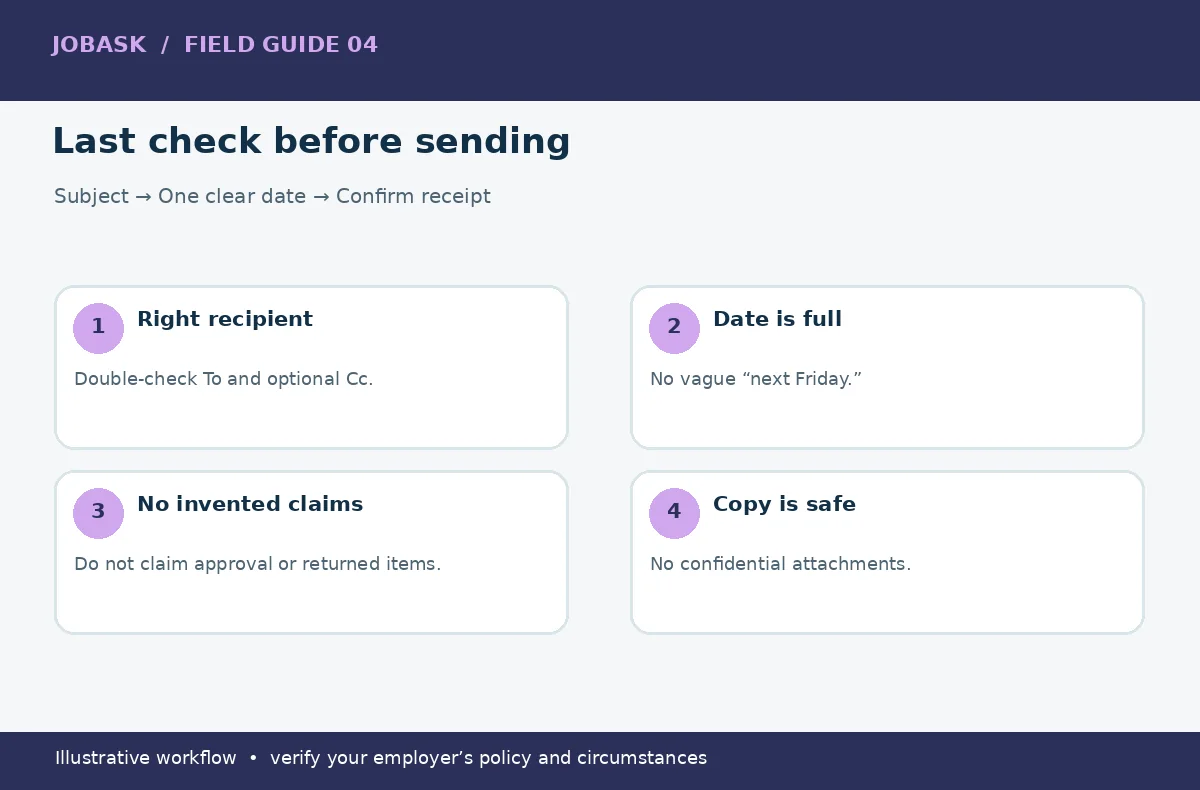
Before pressing send, check the To field, any necessary Cc, subject, job title, exact date and attachment list. Save a copy only through authorized channels. If you receive an automated acknowledgment, do not assume it confirms the proposed last day; it may only prove that a system received the message. Ask the relevant contact to confirm the resignation procedure and transition plan. Our walkthrough on how to give two weeks notice sets out each step.
If no reply arrives, follow the company’s normal escalation route rather than sending repeated messages to the whole team. A brief follow-up can refer to the original date and subject without rewriting the entire resignation. If the employer proposes different steps, make sure both parties understand which dates and handoff responsibilities are confirmed versus still open.
Avoid three common format failures
First, mixing a request for feedback with a definitive resignation creates uncertainty; decide which message you are sending. Second, adding a relative phrase such as “end of next week” when you meant a precise shift date can confuse payroll and scheduling. Third, attaching internal documents for convenience can create a confidentiality problem even when the intention is to help.
An email draft is also not the place for speculative claims about notice laws or benefits. The employer’s specific policies and applicable law may affect what happens after notice. Keep the correspondence focused and ask a qualified source for advice on rights or disputes. Good formatting can prevent ambiguity, but it cannot replace an accurate employment process. For more detail, our guide “Farewell Letter to Colleagues” looks at what to say after notice is shared.
How We Research This Resignation Question
For resignation email formatting, UNLV workplace professionalism guidance supports the recipient, subject, proofreading and next-step checks; its correspondence material and the university career resource support concise resignation content. The four-part email audit is editorial synthesis rather than an employer-approved form. Readers must verify dates and policy before sending.
Sources and Transparency for Readers
Sources reviewed on 2026-10-20: UNLV Career Services. UNLV Career Services. University of Wyoming career resources. SEEK career guidance. The university email advice supports informative subjects, appropriate recipients and proofreading. The linked resignation guides support naming a last day and maintaining a calm tone. Our sample is invented and should be updated to match employer policy; email delivery alone does not verify manager agreement. These links are informational and have no confirmed affiliate sponsorship. Read JobAsk’s affiliate disclosure for relationship transparency. This article is educational content, not individualized legal advice.
Related Guides
- Goodbye Email to Coworkers After Resigning: Thank the Team and Clarify Handoffs
- Interview Invitation Reply Email: Confirm Time, Format, and Next Steps
- How to Change Your Resignation Last Day With a Clear Written Request
- Interview Thank-You Email Subject Lines: Name the Role and Keep the Thread Clear
- Job Application Email: Subject Line, Attachments, and Submission Checklist
Use a plain, recognizable subject such as “Notice of Resignation — [Name]” unless your workplace specifies another format.
Only if your employer’s process requires it; a clear email may be accepted in some workplaces, while others specify a form or attachment.
Check the normal process. A private conversation may be helpful when practical, but use an authorized written channel if necessary.
Keep the reason brief and truthful if included. A detailed personal narrative is usually unnecessary for an informational notice.
Check the company’s acknowledgment or contact the appropriate manager or HR office; delivery is not the same as approval of a proposed final date.