
Gig work on a resume: Gig work can count as relevant work experience when you actually completed paid assignments or provided a service. On a U.S. resume, label the work truthfully, identify the kind of service, give an accurate period, and select achievements you can explain. Do not convert an app into a fictional employer, expand occasional shifts into continuous full-time work, or describe a customer rating you cannot substantiate. The useful decision is how to present the relationship and dates, not whether the work seems prestigious.
First identify who you actually worked for
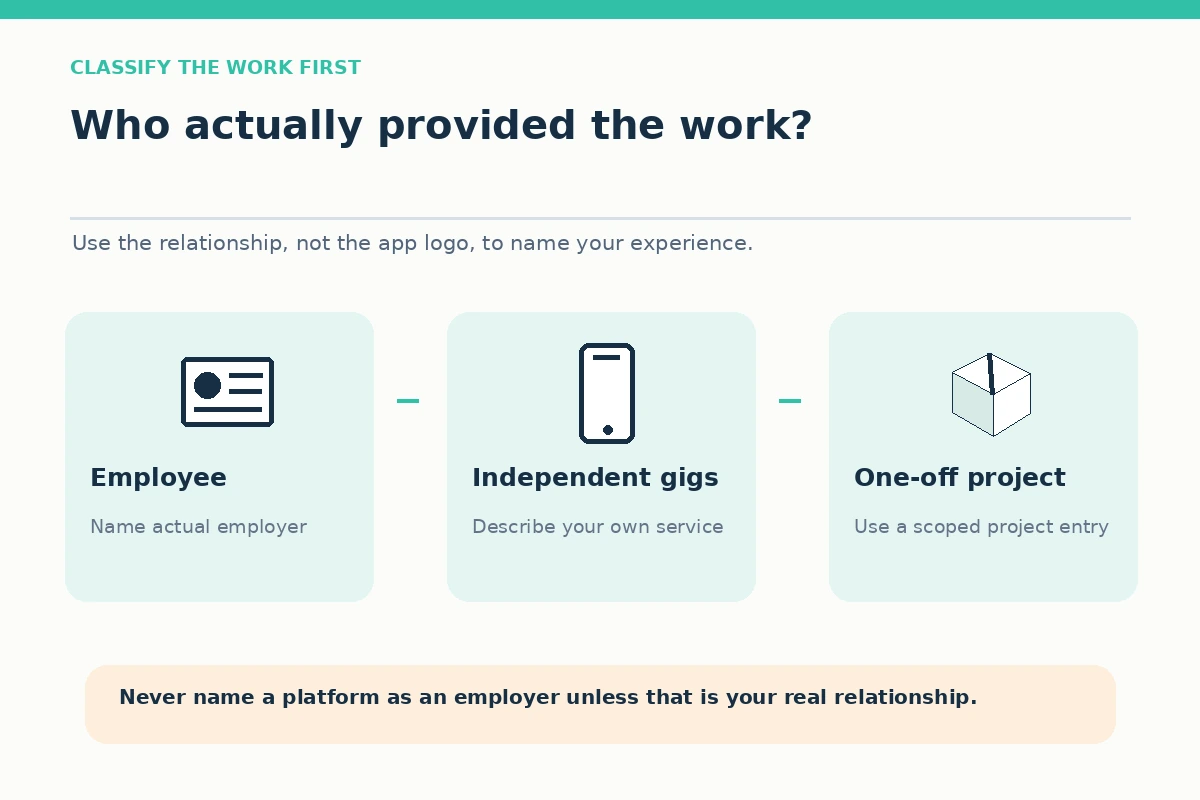
A delivery rider, on-demand errand worker, freelance designer and temporary shift employee may all call their assignments gigs, but their employment relationships need not be alike. The IRS describes app-based driving, errands, selling, professional services and temporary on-demand work as possible gig activities, while distinguishing employee and independent-contractor situations. Use your actual agreement and records to understand how the assignment was arranged; this page does not determine tax classification.
If a local business employed you directly, list that business as the employer. If you independently completed projects arranged through an app, an entry such as “Independent Delivery Contractor” may describe the relationship better than presenting the app as an employer. If you accepted a single paid project, a short project entry may be clearer than a long work-history line. Never use a client name, trademark or confidential detail unless you are allowed to.
Choose a grouping that matches your real assignment pattern
A long run of similar paid tasks can be grouped under one truthful independent-work entry. For instance, “Independent Delivery Services | Self-employed | 2024–2025” may be appropriate if the dates reflect real activity during that period. A single weekend assignment does not establish two years of uninterrupted work. Where the pattern was intermittent, write “selected assignments” or identify the months you were actually active, rather than imply a guaranteed weekly schedule.
If assignments came from several unrelated clients, avoid making the group look like one salaried position at one company. Consider a compact description under “Additional Experience” when the work is useful but not central to the target job. An employer application may require different fields from a resume; follow the form’s instructions, disclose actual employers and dates there, and do not force independent work into an inaccurate employer field.
Translate deliveries and short tasks into job-relevant evidence
A vague line such as “Did gigs and helped customers” gives a recruiter no sense of the task. A stronger hypothetical bullet for someone who really performed the work is: “Checked delivery details against the assignment, communicated schedule changes through approved channels, and recorded completion accurately.” For a task-based worker, an example might focus on clarifying a request, meeting an agreed deadline, and handling a handoff. These examples are templates to adapt, not claimed results.
Use a task, method and observable outcome that you can explain without disclosing customer addresses or app screenshots. If you know your actual number of assignments and have permission to summarize it, a count can add context; otherwise a precise description is better than invented statistics. Explain tools at the level you truly used: navigation apps, customer messages, calendars or invoicing are not the same as formal dispatch administration.
Protect personal information and client confidentiality
Gig records may include addresses, names, deliveries, earnings and private messages. Those records can remind you of authentic work without being attached to a public resume. Generalize sensitive cases and remove identifying customer details from any portfolio. If a client provided private information or restricted use of a work product, permission is needed before you show it. The resume should demonstrate your own work, not expose someone else’s data.
When writing about a problem, describe what you could personally do. “Notified support when delivery instructions conflicted” describes an escalation. “Resolved all payment disputes” would be inaccurate if a platform handled refunds or charges. Do not imply special access, security clearance, commercial insurance, or certification based on the fact that a platform allowed you to accept tasks.

Use the right place on the resume for this target job
Gig work may deserve a full experience entry when the target role requires scheduling, client communication, reliable documentation or independent execution. For an unrelated technical role, a single line in Additional Experience may be sufficient, leaving room for projects and recent relevant jobs. Reverse chronology remains easy to scan, and the date format should match the rest of your document. A short honest gig entry is not a weakness that needs elaborate decoration.
Look at the target posting and identify the most relevant transferable action. A dispatch support job might value accurate location instructions and documented updates; a retail job might value responsive customer communication; a creative role might value agreed deliverables and revisions. Do not borrow occupation-specific authority from the posting. Tailoring is choosing relevant true facts, not rewriting what happened.
Audit the sample before sending it
Consider this fictional entry: “Independent Errand and Delivery Work | Self-employed | May–September 2025. Confirmed task details, managed agreed pickup windows and recorded completion through the assignment platform.” It works only for a person who genuinely performed those actions within those dates. Substitute your own dates, working relationship and actual task type. If the work stopped and restarted, disclose that accurately rather than silently extending the dates.
A final check is to compare the resume with the work you would describe in an interview. Can you identify who assigned tasks, what the platform controlled, what you controlled, and what was delivered? Would the dates hold up against your calendar or lawful work records? If you cannot explain a metric, platform credential or job title with simple evidence, remove it. Clear scope matters more than borrowed labels.

How We Research Resume Work Experience
JobAsk reviewed these public career and occupation references on November 4, 2026: CareerOneStop: Work Experience (CareerOneStop guidance on work history, job titles, dates and demonstrable achievements). IRS: Gig Work (IRS description of types of app-based and on-demand gig work and differences in worker status). CareerOneStop: Resume Formatting (CareerOneStop resume formatting and date consistency guidance). These explain typical resume practices and job duties; they do not establish any applicant’s real employment history, certifications, or hiring outcome.
Every example and diagram is illustrative. Replace sample actions, employers, months and duties with facts you can verify from your actual work, and recheck each job posting before tailoring an application. For editorial and commercial context, read our affiliate disclosure. This article does not claim a paid referral relationship or guaranteed resume screening result.
More Resume and Cover Letter Guides
Yes, if it is real work and relevant to the target job. Use Professional Experience or Additional Experience according to its significance; label independent services accurately.
Only if that reflects your actual employment relationship. Do not assume that arranging tasks through a platform made you its employee; use the factual relationship and application instructions.
Give the actual periods or explain that assignments were intermittent. Never claim continuous full-time work when you accepted only occasional tasks.
Keep private messages and addresses off a public resume. Use a non-identifying task description; obtain permission before sharing protected work samples.
Only when accurate, verifiable and relevant. Task scope and dependable evidence often make a better bullet than sensitive earnings or an unsupported rating.