
Consulting behavioral interview questions are about what you did when the problem was uncertain, colleagues disagreed, or a decision needed influence rather than formal authority. Prepare real stories with a clear constraint, your reasoning, the people you coordinated with, your own actions, and the observable outcome. Do not reuse a case-interview framework as a substitute for a lived example, and never reveal a client’s nonpublic documents, identity, financial data, or confidential findings.
Distinguish personal experience from case interviewing
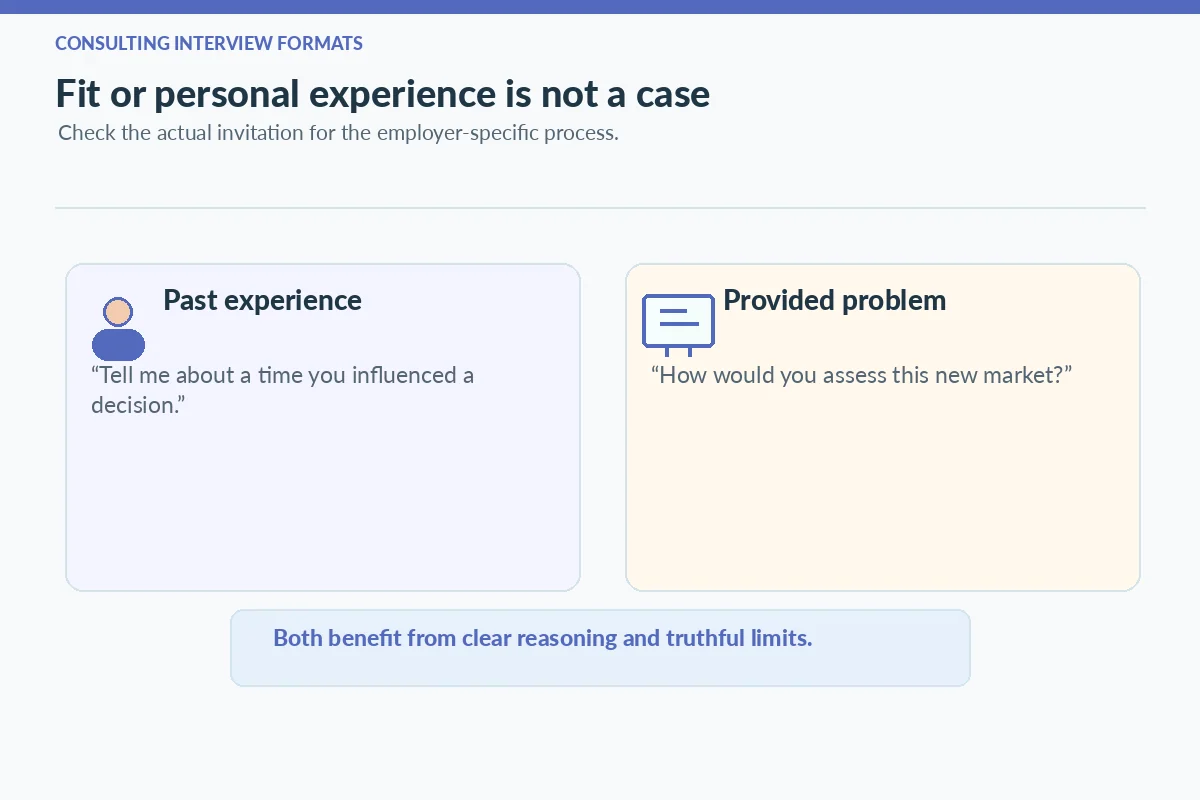
Consulting interviews may combine behavioral or “fit” conversations with a problem-solving case, but the exact mix depends on the employer and role. McKinsey describes its Personal Experience Interview separately from the problem-solving interview and encourages candidates to explain genuine accomplishments and challenges in detail. A case typically asks you to reason through a provided business problem. A behavioral prompt instead asks about something that actually happened to you. Confirm the format in the invitation rather than assuming a given firm always uses the same sequence.
Sort likely prompts into influence without authority, difficult collaboration, managing ambiguity, taking ownership, learning from feedback, and motivation for the role. “Tell me about a time you persuaded a skeptical stakeholder” needs a factual encounter with that stakeholder. “How would you convince a skeptical client?” is hypothetical. The first asks for personal evidence; the second asks for proposed reasoning. Keep the two forms distinct in your preparation notes.
Build a defensible influence story
Influence is not the same as winning an argument. Identify the person or team with decision authority, what they reasonably cared about, which facts or perspectives you gathered, and how your proposal changed after feedback. A strong example does not require a prestigious client or a huge budget. An academic club, nonprofit project, internal operations task, or early-career analyst assignment can demonstrate patient reasoning and collaboration if it is real and relevant.
Hypothetical sample: “A student consulting project team wanted to survey customers before agreeing on a recommendation. I was responsible for consolidating interviews. I noticed two teams were using different question wording, so I asked everyone to agree on one definition and created a shared coding sheet. The project lead accepted the standard, and we presented a more consistent summary. I did not personally design the client’s final strategy.” The story shows an action, a limit, and a credible outcome without fictional client revenue.
Discuss confidential client constraints safely
Consultants may encounter information that is contractually, legally, or professionally confidential. Use generalized descriptions such as “a regional service provider,” a neutral process stage, or an anonymized team structure when you have permission. Avoid identifiable customer data, proprietary exhibits, pricing, unreleased deals, or screenshots from internal tools. Anonymization is not guaranteed simply by removing a name: unusual combinations of figures and facts may still identify a client.
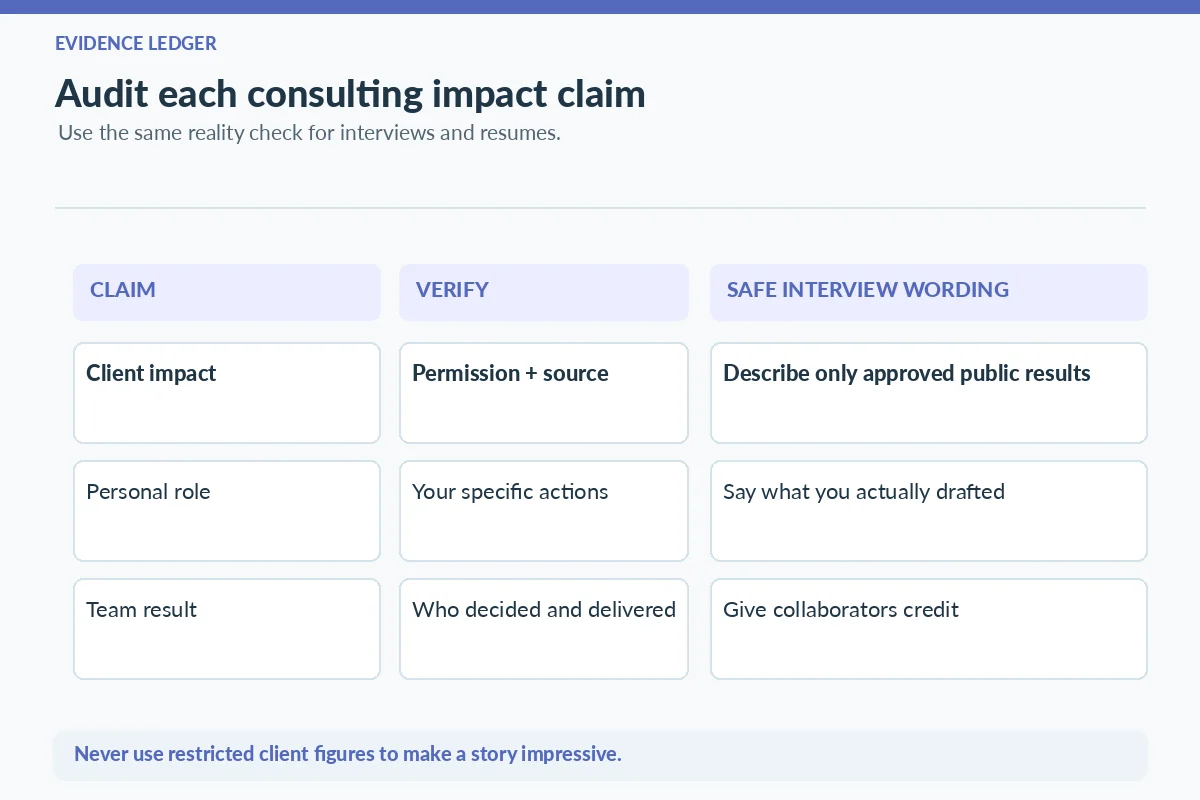
If a past project cannot be discussed even in summarized form, switch to an approved public case, volunteer assignment, school project, or another work experience. Your interviewer is assessing your judgment, not your access to secrets. State calmly that you can explain the approach at a high level but not restricted details. Do not claim a client endorsed your work, or that an outcome was caused solely by your actions, unless your records and disclosure obligations support it.
Show reasoning under uncertainty without invented data
A credible uncertainty story names what was missing, the decision deadline, the safe assumptions you made explicit, and the test or check you proposed. For example, a team may have two conflicting spreadsheet definitions; your contribution may have been tracing the source, clarifying owners, and presenting the unresolved difference to the lead. A weak answer skips the uncertainty and jumps straight to an impressive but unverifiable result.
Make your narrative practical: “The issue was not whether the numbers looked good; it was whether the two data sets used the same definition.” Explain how you compared records or asked domain experts for clarification, who made the final choice, and which part of the deliverable you owned. Results can include a documented assumption, corrected calculation, or a better-informed decision rather than an invented profit increase.

Prepare for deeper questions about your own contribution
McKinsey’s public guidance emphasizes your individual role and being prepared for detailed follow-up. Expect questions such as “What did you say first?”, “How did you know the alternative was workable?”, “Who objected?”, “What evidence could have changed your mind?”, and “What did the rest of the team do?” Write these probes beneath each story. If your answer depends on “we” without identifying your actions, revise it.
Practice explaining outcomes without exaggeration. “I drafted an options memo that the team reviewed” is distinct from “I made the executive decision.” If a proposal was not adopted, you can explain how you changed course and preserved a useful relationship. A good account of failure can demonstrate learning; it should not be transformed into an invented victory. Use plain language and let the interviewer ask for a technical detail where it is relevant.
Create a balanced consulting story portfolio
Select several different real events rather than rehearsing one heroic example for every prompt. One story might concern a challenging collaboration, another an uncertain analysis, another a time you persuaded people without formal authority, and another a mistake that changed your approach. Add a short motivation answer explaining why the actual consulting role attracts you, using specific public details of the work instead of flattery or unsupported claims about a firm’s culture.
Dartmouth’s consulting interview resources distinguish behavioral fit from case analysis and note the importance of communication and teamwork. Combine that foundation with the specific employer’s own preparation material when available. In a rehearsal, have a listener mark every unverified claim, missing decision owner, unexplained trade-off, and potential confidentiality breach. Edit those before polishing the delivery.
How We Research These Interview Examples
For this article we reviewed current original guidance from mckinsey.com; careerdesign.dartmouth.edu; careercenter.umich.edu; opm.gov on November 4, 2026. We distinguish the source organizations’ general guidance from our own hypothetical questions, diagrams, and answer illustrations. An employer’s actual selection process, professional rules, and the facts of your experience control the answer you give; we cannot know a particular panel’s scoring criteria. We do not claim interview access, job placement, or sponsorship. See our affiliate disclosure.
More Interview Preparation Guides
No. Fit or personal experience questions examine your actual history; case exercises ask you to analyze a presented problem.
No. Relevant, truthful school, nonprofit, project, or work examples can show collaboration and influence.
Use only details you are authorized to discuss, and avoid identifiable or proprietary information. Choose another story if needed.
No. Explain your contribution, who decided, who implemented, and how the result was observed.
Explain the reasoning, feedback, adjustments, and learning. A defensible unsuccessful result can still be a valuable example.