
Manager behavioral interview questions ask what you personally did when a team needed direction, development, or a difficult choice. Prepare specific, truthful stories of delegating work, correcting a recurring problem, coaching an employee, and explaining a decision. Name your authority, the input you requested, the action you personally took, and what the team could verify. A polished story about “great leadership” is less useful than a clear account of one genuine situation.
Match each question to a managerial responsibility
Start from the posted role rather than a generic leadership-qualities list. A front-line shift supervisor may be responsible for assigning coverage, documenting an incident, and escalating a staffing gap. A department manager may own a budget proposal, performance conversations, and cross-team priorities. Both can be asked about leadership, but their actual decision rights are different. Read the job description and mark each responsibility as “I can decide,” “I can recommend,” or “I must escalate.” This makes your examples accurate before you practice speaking.
Common prompts include: “Tell me about a time you delegated an urgent task,” “Describe how you coached someone after a mistake,” “Give an example of an unpopular decision,” and “When did your team disagree with your plan?” Write one real event beside each prompt. If you have only acted as a project lead, say so rather than suggesting formal supervision. Use peer coordination or onboarding examples to demonstrate influence while being explicit that personnel decisions belonged to someone else.
Answer a delegation question with ownership and controls
A delegation story should explain why you assigned the work, why the employee could reasonably handle it, which outcome remained your responsibility, and what check-ins you scheduled. Do not depict delegation as dumping a difficult assignment or taking credit after somebody else solved it. Explain what instructions and access the person had, what approval was required, how you balanced workload, and when you stepped in. A credible answer shows both trust and an escalation route.
Hypothetical example: “During a weekly inventory reconciliation, the incoming orders queue increased while the shipment cut-off stayed unchanged. As shift lead, I assigned the routine count verification to a trained associate, kept exception approvals with the authorized supervisor, and scheduled a mid-shift review. I checked the records before the handoff and documented the unresolved discrepancies. The team finished its assigned checks; I did not personally clear the items awaiting supervisor approval.” Replace this illustration with your real people, duties, decisions, and results.

Explain coaching without criticizing the employee
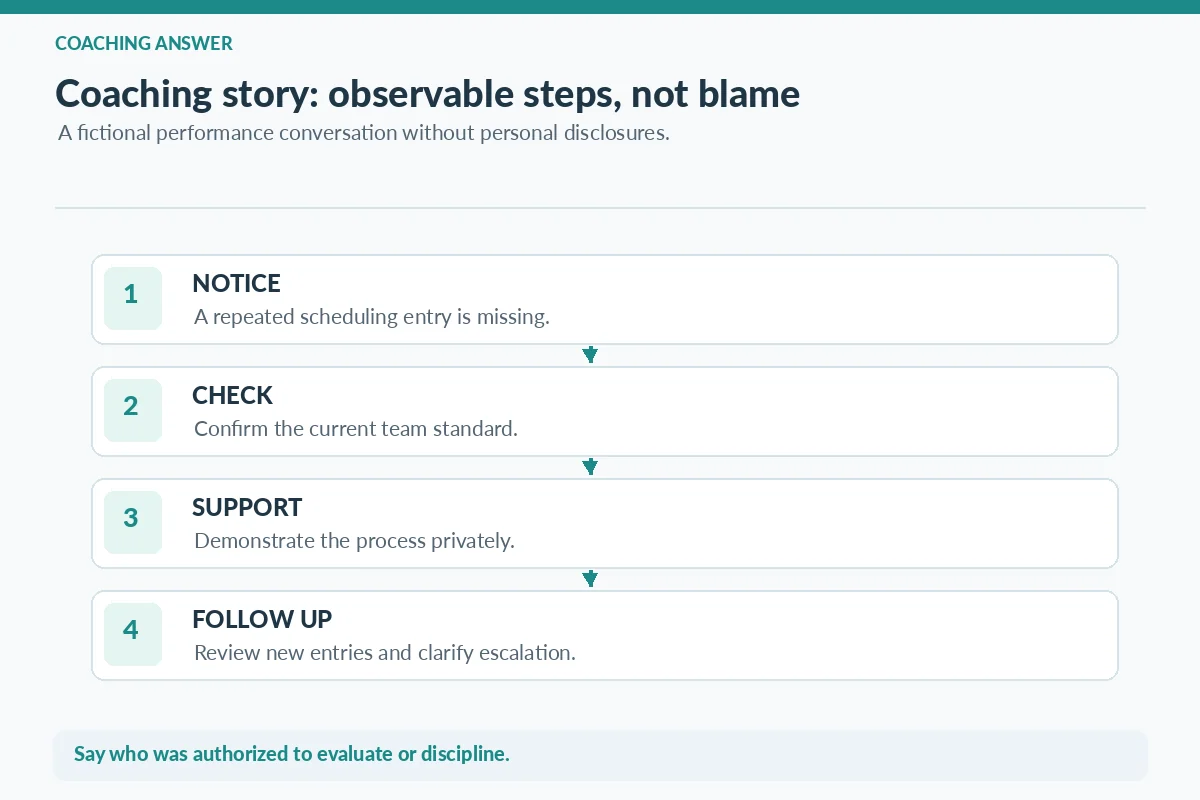
Interviewers may ask about a team member who struggled. Keep the story about observable work and support: the specific expectation, how you checked whether instructions or resources were missing, what feedback you gave privately, and how you followed up. Do not speculate about the person’s motivations, health, personal life, or confidential disciplinary history. Describe your role in the process and whether you had authority to evaluate performance or only to offer training.
A useful structure is “Observed a repeated issue → verified the agreed standard → demonstrated the task or arranged training → asked the employee to practice → checked later work.” The outcome can be partial improvement or a documented need for further support; it does not need to be a miracle turnaround. If you referred a personnel matter to HR or your manager, say exactly that. It often shows better judgment than inventing an independent disciplinary action.
Tell a difficult-decision story with trade-offs
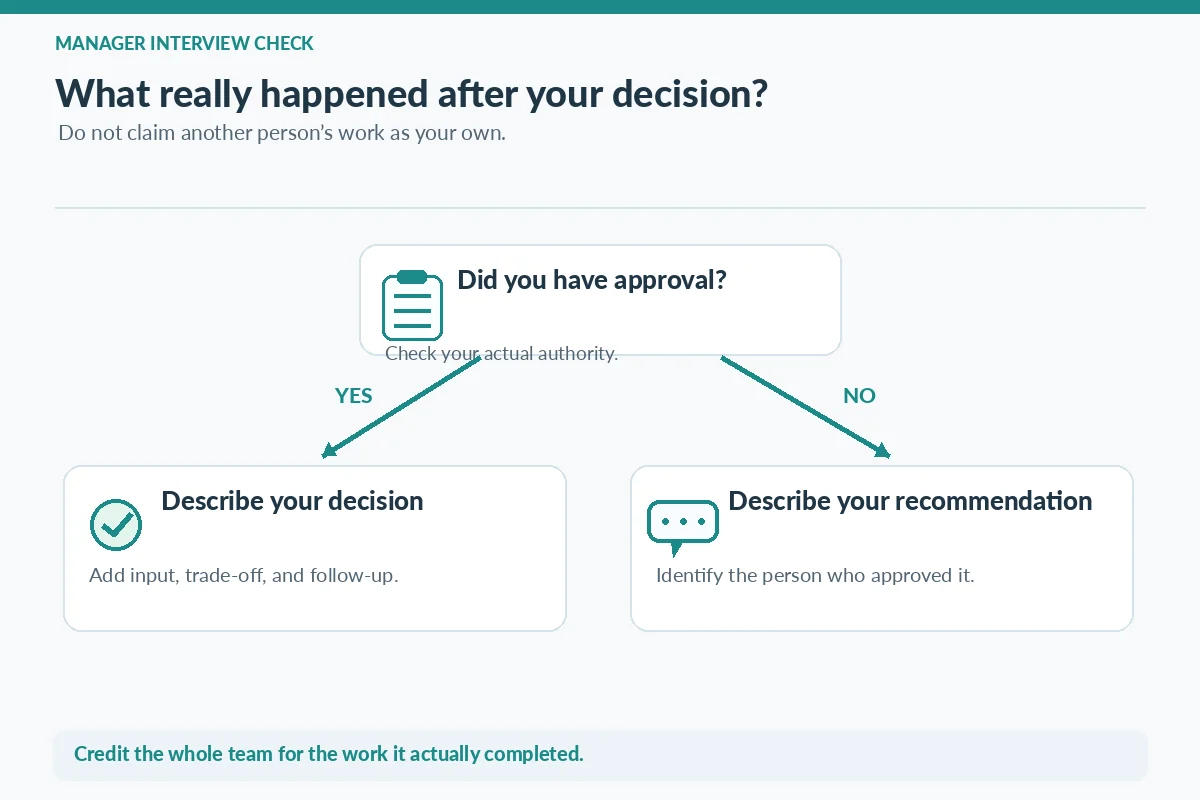
A managerial decision is not automatically good because everyone accepted it. Describe alternatives, constraints, whose input you sought, which rule or objective governed the choice, and how you communicated it respectfully. If a decision affected workload or shifts, explain the fairness standard you used rather than revealing a coworker’s protected information. Make it clear when you made the decision yourself versus when you prepared an option for an authorized manager.
For an illustrative shift-coverage scenario, a team leader receives two urgent requests and only one trained worker is available. The leader checks the documented priority and safety requirements, explains the immediate assignment and fallback plan, and alerts the manager about the unfilled task. The result is not “everyone was happy”; it is a transparent choice with ownership and a next update. Practice the same story once as a one-minute answer and once with the likely follow-up questions: “Who disagreed?”, “What would you change?”, and “Who approved it?”
Separate your actions from team outcomes
Use a brief ledger before rehearsing: what happened, what the whole team did, what you alone did, what you approved, and which result can actually be substantiated. An interview is not a reason to invent a percentage improvement or present another person’s analysis as your work. If the only evidence is qualitative, say that the team adopted a checklist or clarified ownership, not that the process improved by an unmeasured number.
Structured interviews generally ask candidates similar job-related questions and compare responses using common standards. This is described by the U.S. Office of Personnel Management, although your employer’s process may differ. Organize answers around context, your responsibility, specific actions, and an observable result or learning. When the panel probes, answer directly rather than forcing every detail back into a memorized script.
Practice a targeted manager interview answer
Make a set of four evidence cards: one delegation, one coaching, one decision under constraints, and one cross-team disagreement. Each card should name the exact situation, your authority, the people or departments involved without unnecessary identifiers, the action you can defend, and a result that happened. Avoid having all four cards describe the same project; different circumstances reveal different strengths and weaknesses.
Use a peer or recorded practice session to test for ambiguity. Ask a listener, “Could you tell which decision belonged to me?” and “Did my answer explain how I treated people fairly?” Then cut generic statements and keep concrete actions. If you cannot disclose a workplace incident, anonymize nonessential details without changing the truth, or choose another story. Review the actual posting again to make sure the skill you demonstrated is relevant.
How We Research These Interview Examples
For this article we reviewed current original guidance from opm.gov; opm.gov; ccc.bc.edu; careercenter.umich.edu on November 4, 2026. We distinguish the source organizations’ general guidance from our own hypothetical questions, diagrams, and answer illustrations. An employer’s actual selection process, professional rules, and the facts of your experience control the answer you give; we cannot know a particular panel’s scoring criteria. We do not claim interview access, job placement, or sponsorship. See our affiliate disclosure.
More Interview Preparation Guides
Use an authentic project-lead, peer-coaching, or shift-coordination example. Specify that formal performance decisions belonged to your manager.
Yes. Describe the standard, support, follow-up, and any authorized escalation; do not invent a successful outcome.
Identify the constraint, options, authority, stakeholder input, decision, communication, and follow-up without exposing private employee facts.
Only when you can defend their origin and your actual contribution. A verified process change can be a useful result without invented metrics.
Start with several genuinely different events that cover delegation, coaching, decisions, and collaboration. Adapt to the actual interview invite.