
Remote research assistant jobs can mean literature searching, dataset cleanup, coding records, preparing reports, or coordinating approved participant activities. Start by identifying the research domain and the tasks you are qualified to perform, rather than treating every “research” posting as an online search job. Check whether human subjects are involved, what project oversight applies, and whether the remote worker has approved data access. Academic research training and independent internet browsing are not the same qualifications.
Distinguish desk research, data support, and participant coordination
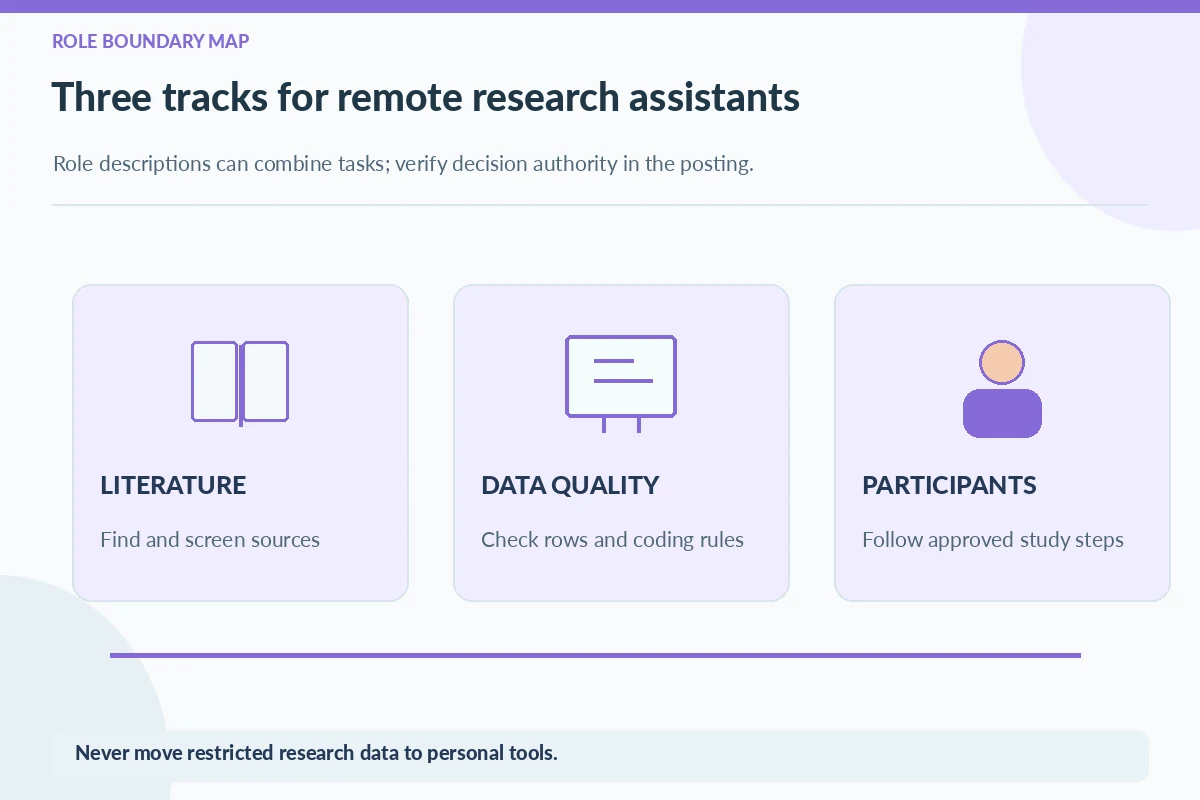
Research assistants support different stages of a project. Literature and policy research may involve searching academic databases, recording citations, screening studies against inclusion criteria, and checking the wording of a summary. Data support can involve cleaning missing values, maintaining a codebook, verifying entries, or preparing clearly labeled charts for a lead researcher. Participant coordination may involve scheduling, consent-related paperwork, or approved follow-up procedures. O*NET describes these task families broadly, but a position may involve just one of them and may require specialized methods or ethics training.
For each vacancy, mark its primary output: a citation table, a reproducible dataset, a participant schedule, or a draft report. Then identify the supervision described. A university laboratory may require enrollment or a relevant degree, while an applied social research group may value survey experience and precise documentation. Do not infer that a fully remote title means you can collect private participant data on your personal account. The project lead and institution determine approved protocols, access, and participant-facing duties.
Locate credible research roles using task-based searches
Search research centers, university employment pages, nonprofit evaluation teams, and reputable research organizations directly. Queries can include “remote literature research assistant,” “survey data assistant remote,” “research data quality associate,” and “remote research coordination assistant.” A job board result is a lead, not proof the university has an active opening. Verify the requisition in the organization’s own careers system and save the posting date, research group, supervisor, employment eligibility, and contact route. Beware of anonymous paid “research tasks” that resemble click-for-commission schemes.
Location restrictions still matter. A research project may allow remote writing but require staff to attend scheduled meetings in a particular time zone or access institution-managed data through a controlled environment. Some positions are temporary, grant-funded, part-time, or tied to student status; read the terms rather than assuming permanent work. If an ad offers unusually high pay for vague “optimization research” and requests cryptocurrency deposits, it does not resemble ordinary supervised research work; the FTC warns about task and work-from-home scams.
Prepare evidence from a real research workflow
An honest project description might say, “Created a source table, recorded inclusion decisions, and checked citation fields for a supervised class literature review.” If you actually used a statistical package, identify the software and specific task, such as recoding survey answers using supplied rules. Do not claim that a classroom dataset was original human-subjects research unless the project truly involved that type of approved study. Equally, do not present an automatically generated summary as a verified research finding without checking original sources.
A small, safe sample can be a synthetic dataset, a public-data cleaning notebook, or an annotated bibliography based on openly available works. Include the question, method, source, limitations, and your personal contribution. Never upload private respondent data, unpublished grant proposals, confidential peer-review files, or identifiable recruitment materials as a portfolio sample. If a project required team approvals, describe what your supervisor reviewed and how you recorded revisions. Evidence of methodical checking is more useful than a vague claim to be “passionate about research.”
Understand research ethics and access boundaries
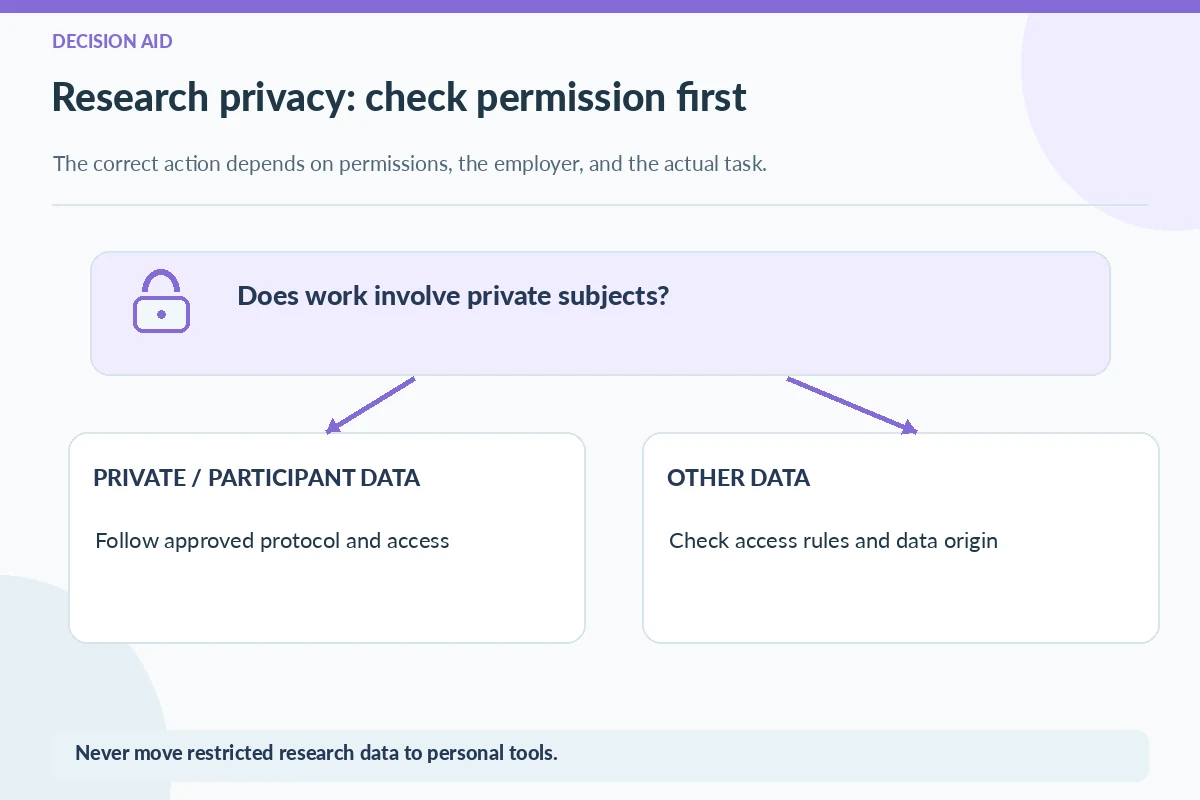
Projects involving people can carry human-subjects requirements and institutional oversight. HHS’s Office for Human Research Protections publishes guidance about research involving human subjects, including protections that depend on the study and institution. A job applicant should ask what approvals and training apply to the offered tasks, whether a human-subjects review is relevant, and who is authorized to contact or consent participants. Do not assume a research assistant may independently recruit subjects, change approved questions, or move restricted records into an unapproved cloud service.
Even research using publicly available data requires accurate source handling and a clear record of transformations. If an employer expects you to maintain a codebook or version history, ask which system the team uses and how changes are reviewed. If you are not authorized to view identifiers, that can be appropriate and should be respected. A remote arrangement should have a real access path and named contact for problems. “I will ask the principal investigator or project lead before changing the protocol” is a better answer than an invented personal ethical certification.

Compare a fictional assistant posting with your skills
Imagine a fictional university project seeking a part-time remote assistant to search policy literature, screen abstracts with a predefined rubric, update a citation database, and prepare a weekly discrepancy list. A qualified applicant might point to a genuine academic project in which they maintained references and documented decisions. If the vacancy additionally requires survey interviewing or IRB-related training and the candidate lacks it, the application should say so rather than claiming to have completed a real participant study. This illustration describes a possible workflow, not an active university vacancy.
A second hypothetical listing requires recruiting participants and tracking private interview appointments. That work has a different privacy and oversight burden. Ask whether contact scripts are approved, who handles participant consent, whether staff use institution-provided calling tools, and how reports are shared. Do not use a public research task site as evidence of a recognized employer. A credible posting identifies the research organization, reporting line, and expected work, even if the project details must remain confidential.
Finish with a reproducible application and interview plan
Before applying, record the employer URL, research discipline, data type, software, qualifications, location restrictions, and required ethics training. Match your resume to the specific output: reliable citations, validated rows, annotated code, scheduling, or report support. Keep any sample small, original, and safe to disclose. Write one honest paragraph describing a check you performed, the method you followed, and how someone else could reproduce or review it.
In an interview, ask who owns the research protocol, how data changes are tracked, which tasks can be done remotely, and who resolves uncertain cases. If the supervisor expects a method you have not used, say what analogous experience you have and what training you would need. After submitting, log the requisition and follow-up date, but do not assume a project is funded or currently hiring without an active posting. The objective is a well-matched search that respects research boundaries, not an invented success guarantee.
How We Research Remote Work Responsibilities
We reviewed primary occupational, regulatory, and consumer-protection sources from onetonline.org; hhs.gov; consumer.ftc.gov on November 4, 2026. The practical job-search workflows and sample records here are illustrative, not real job offers, professional advice, a certification, or a promise of employment. Requirements vary by employer, jurisdiction and actual duties; verify official postings and ask the decision owner when a task exceeds your authority. No paid relationship with these organizations is claimed. Read our affiliate disclosure.
Related Job Search Guides
Some support roles may accept coursework or project evidence, while others require advanced methods or credentials. Read each posting.
Not necessarily. Academic and applied projects often require documented methods, source evaluation, records, and quality checks.
Use public or synthetic data only when permitted. Never disclose confidential participant or unpublished project information.
The project and institutional oversight process determine the applicable protocol and who is authorized to act.
Verify the opening through the institution or employer’s own website and check the research team and application process.