
Quick answer. Put technical skills on a resume when the skill relates to the work you are applying for and you can describe a real task completed with it. Group related software, tools or methods in plain text rather than listing every program you have opened. A tool you independently use, one you practiced under supervision and one you are merely learning are different claims. This guide supplies a requirement-to-evidence matrix to help people choose accurate skills without inventing proficiency, project outcomes or applicant-tracking-system guarantees.
Define Technical Skills by Observable Tasks
Technical skills cover specific methods, software, tools, systems or procedures needed to complete work. Depending on the role, these can be spreadsheet functions, database queries, scheduling platforms, design applications, laboratory sample documentation or approved equipment use. Their defining characteristic is that another person could ask you to explain or demonstrate a task. Broad qualities such as “hardworking” or “great communicator” should instead be shown through examples of behavior.
Texas A&M career guidance distinguishes objective or technical skills from softer strengths that work better in experience bullets. Use that as an editing test: could you tell a reviewer what file, output, operation or process you completed? If the answer is only “I am good with technology,” the statement is too vague. The skills section is not an awards shelf. It is a readable index pointing toward specific documented abilities.
Match Skills to the Actual Job Description
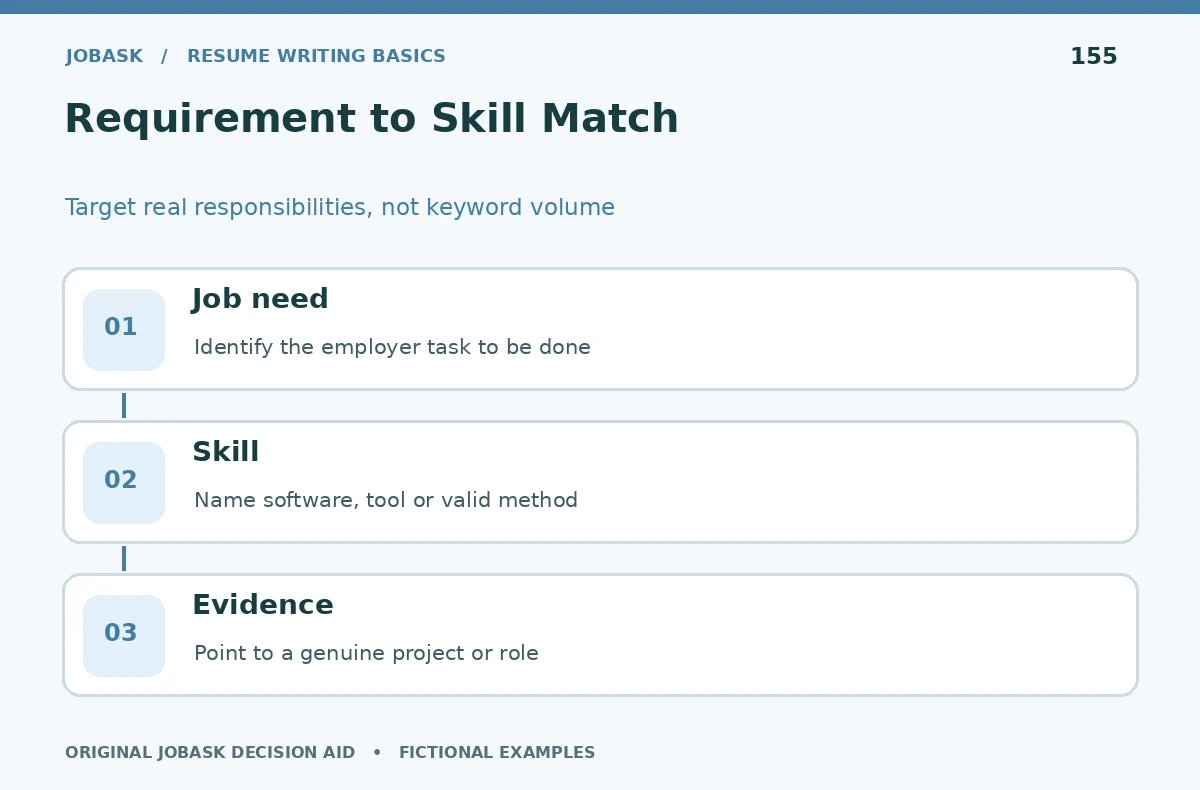
Read the position description and separate required tools from nice-to-have tools, general responsibilities and industry jargon. For each requirement, write down where you have used the tool and what task you completed. If you have no real experience with an item, do not include it merely to imitate the posting. Consider related methods only if they honestly help explain your transferable abilities. Do not infer that listing a word ensures passage through automated screening.
Imagine a fictional job posting mentioning spreadsheet data quality. An applicant who actually checked missing records and created a summary table could say “Spreadsheets: data validation and pivot summaries.” Someone who only viewed a tutorial should not claim that same competence. A job requirement provides vocabulary for research, not permission to borrow experience. Confirm product names and platform versions as needed, but prioritize the real workflow over a list of untested brand names. For the fuller picture, see our guide “Research Experience on a Resume”.
Group Tools So the Reader Can Find Them
Use compact categories when you have multiple relevant skills: Data Analysis, Documentation, Design, Laboratory Methods or Software. Avoid dividing one basic tool into many pretend specialties. A readable line could be “Data: spreadsheet filtering, formula checks, basic SQL queries” if each item reflects genuine experience. If you have only two skills worth listing, a simple Skills line may be better than multiple headings that fragment the page.
Do not mix licenses, completed certifications, professional memberships and software products as though they carry the same meaning. A current credential may belong in a separate section; familiarization with a system is not a license. Ordering also matters: put skills most relevant to the particular opportunity first, not the items with the most fashionable labels.
Describe Your Level Without Fake Ratings
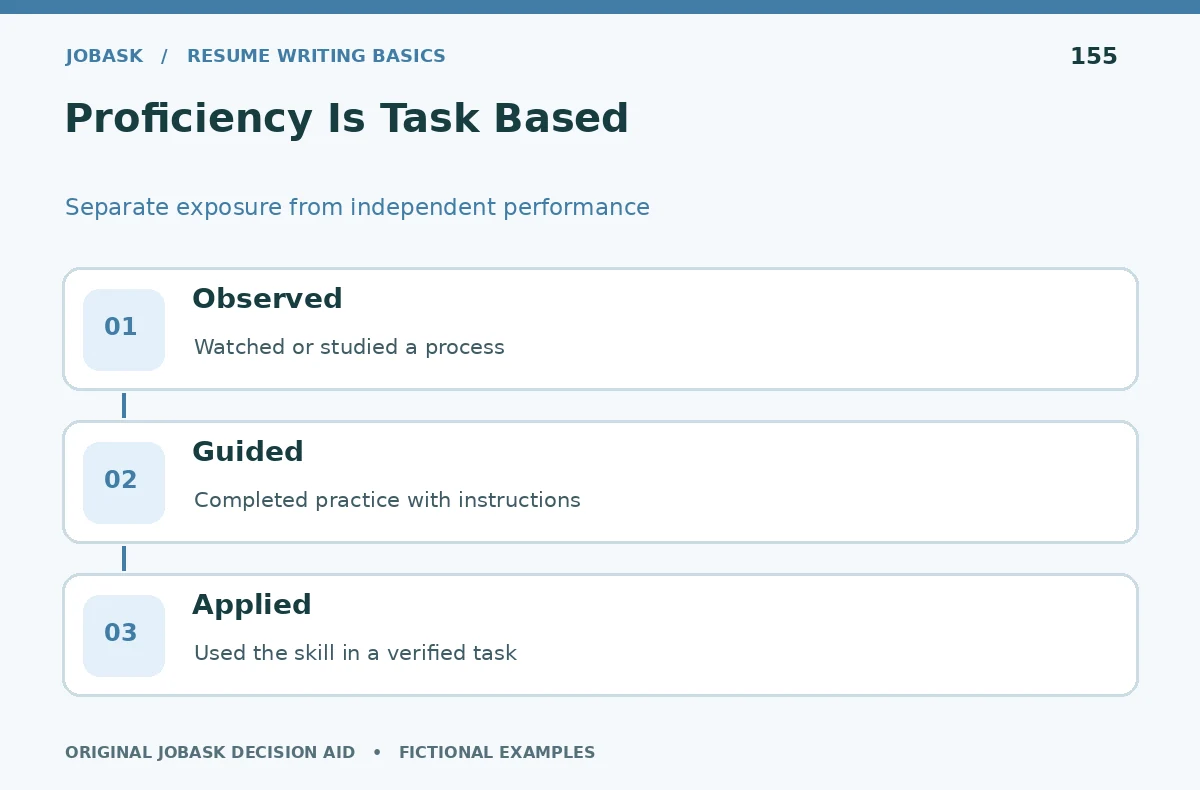
Labels such as beginner, intermediate and advanced lack a single universal meaning. If you use them, describe what they mean in your context and avoid implying independent proficiency when the work required oversight. A stronger technique is to name the task you can perform: cleaned data files, edited a simple design layout, documented test results or maintained a project board. Those claims are easier to discuss than a self-awarded score of five stars.
A hypothetical beginner who completed a guided exercise might write “Python: introductory scripts for coursework” rather than “Python expert.” A genuine lab assistant who used approved procedures could describe a supervised method but should not imply authorization to operate unfamiliar equipment alone. Maintain the distinction between having seen a feature, practiced it in class and used it responsibly in a real work setting. Update proficiency descriptions as experience changes.
Connect Every Important Skill to Project Evidence
A skills list gains credibility when the Experience or Projects section shows the same capability in context. If you list SQL, the related entry might explain the questions answered by your actual queries. If you list Adobe software, a portfolio can demonstrate authorized designs you made. For spreadsheet reporting, describe the type of checked report and the purpose it served. Avoid publishing confidential data, client records, protected code or unapproved visual work as proof.
Consider a purely fictional example: the skills line says “Spreadsheets: lookup formulas, validation checks,” and the project bullet says “Compared fictional order records and flagged inconsistent identifiers for review.” This is a teaching sample, not a real customer project. The pairing shows why the skill is relevant without manufacturing an employer, award or performance metric. A reader should have enough context to ask a meaningful technical question during an interview.
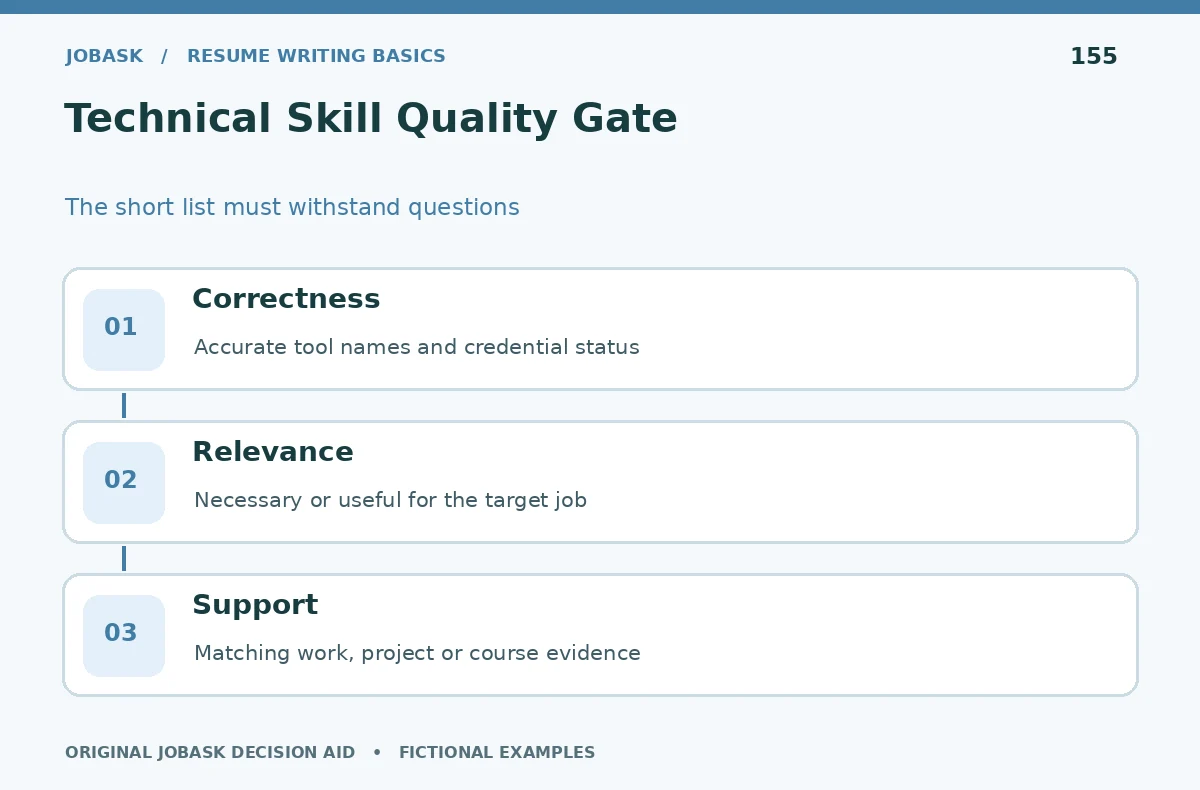
| Decision point | Practical verification |
|---|---|
| Correctness | Accurate tool names and credential status |
| Relevance | Necessary or useful for the target job |
| Support | Matching work, project or course evidence |
Check Software Names and Credential Claims
Use the correct name for a system and verify whether the organization still calls it that. Tools change, and one version may not imply familiarity with another. If the advertisement asks for an approved training credential, make a separate note and verify what the credential actually requires. Do not present a webinar, watched video or informal practice as a certified qualification. Use the issuer’s official wording for credentials you truly hold. Our guide “Excel Skills on a Resume” goes into more detail.
Technical skills can also involve safety and access restrictions. A resume statement is not authority to use regulated equipment, medical systems or restricted databases. Describe work completed within authorized training and supervision, and ask the employer about its required onboarding. Do not publish account credentials or sensitive screenshots to support a claim. Precision about permission and actual use is part of credibility, especially in technical and laboratory settings. If that is your next decision, our guide to skills for a resume explains how to choose relevant abilities you can prove.
Run a Requirement to Evidence Audit
Before sending the resume, build a three-column table: target responsibility, skill claimed and a project or task that proves it. Delete any skill that has no credible evidence and adds little to the target role. Check spelling, duplicate entries, irrelevant platform names and unsupported expert labels. If the listing becomes longer than the work experience that supports it, select fewer items and develop better context in the experience bullets. Our guide “Resume Headline Examples That Show Role Fit Without Empty Claims” adds more detail on this.
Prepare to answer three interview prompts for each important skill: what did you use it for, what limitations did you encounter, and what did you do when something was unclear? If you can answer using authentic work, the claim is likely specific enough. If you need to fabricate a project to explain it, remove or relabel the skill. The result is a trustworthy resume that helps readers evaluate capability, not a promise of any particular hiring decision.
How We Research and Verify Resume Claims
We checked Texas A&M career center guidance for graduate, alumni and general resumes on October 20, 2026. The advice supports listing objective technical skills, contextualizing work performed and remaining prepared to explain software and methods. We drafted a requirement–tool–evidence matrix rather than inventing test scores or hiring-system rules.
Research Sources, Example Scope, and Affiliate Disclosure
Source material reviewed on 2026-10-20 for technical skills resume: careercenter.tamu.edu — Texas A&M describes technical and objective skills as distinct from softer behaviors evidenced in experience bullets.; careercenter.tamu.edu — Texas A&M advises including demonstrable software, hardware and lab skills relevant to jobs.; careercenter.tamu.edu — Texas A&M discusses skill-section placement and practical technical examples.. Software projects, records and technical proficiency examples are hypothetical; they do not reflect a client, actual credential, benchmark score or hidden ATS formula. Tool permission and practical competence remain employer- or training-specific. See JobAsk affiliate disclosure for site policy; none of the actions on this page is an approved affiliate offer.
More Resume and Cover Letter Guides
- Accounting Skills for a Resume: Show Reconciliations and Control Work
- Computer Skills for a Resume: Show the Tools, Tasks, and Proof
- Research Skills on a Resume: Show Methods, Sources, and Your Contribution
- Hospitality Skills for a Resume: Guest Service, Handoffs, and Accuracy
- Teamwork Skills on a Resume: Prove Collaboration and Your Role
Include the relevant, defensible skills the reader needs to evaluate; there is no universal number that makes a resume effective.
Usually not. Use specific tools and methods in a technical section and show soft skills through experience examples.
Yes, when the task and learning context are described accurately without implying paid professional or independent experience.
They can be ambiguous. Plain-language tasks and genuine examples communicate skill level more clearly.
No universal ATS result is established; copying tools you cannot use is misleading and weakens the document.