
In US hiring, “application letter” and “cover letter” can mean the same thing: a brief letter explaining why you are applying and how your qualifications match a job. Some guides use “application letter” more broadly for a standalone, detailed pitch, while a “cover letter” accompanies a résumé. Employers do not apply those labels consistently, so follow the document instructions on the actual posting. If it asks for a résumé and cover letter, submit both; if it asks for an application letter in one upload field, use that field and check whether the résumé is also required separately.
Understand why the two document names overlap
UIC’s Engineering Career Center explicitly describes a cover letter as also being known as an application letter. Other career guides distinguish an application letter for a posted job from a letter of inquiry used when no position is advertised. These are useful descriptions of communication purposes, not binding definitions in an employer’s application system. The practical question is not which label is universally correct; it is which document the employer is asking you to provide and what information that document must contain.
Look for contextual clues. A posting may say “Upload résumé and application letter,” “Attach cover letter,” or simply “Explain why you want this role.” These instructions may produce nearly identical content in different formats. Do not refuse to apply because the vocabulary differs from a template. Conversely, do not assume that uploading a letter will satisfy a separately required résumé, screening form or written questionnaire. Each field serves its own role in the submission process.
Separate a posted-job application from an unadvertised inquiry
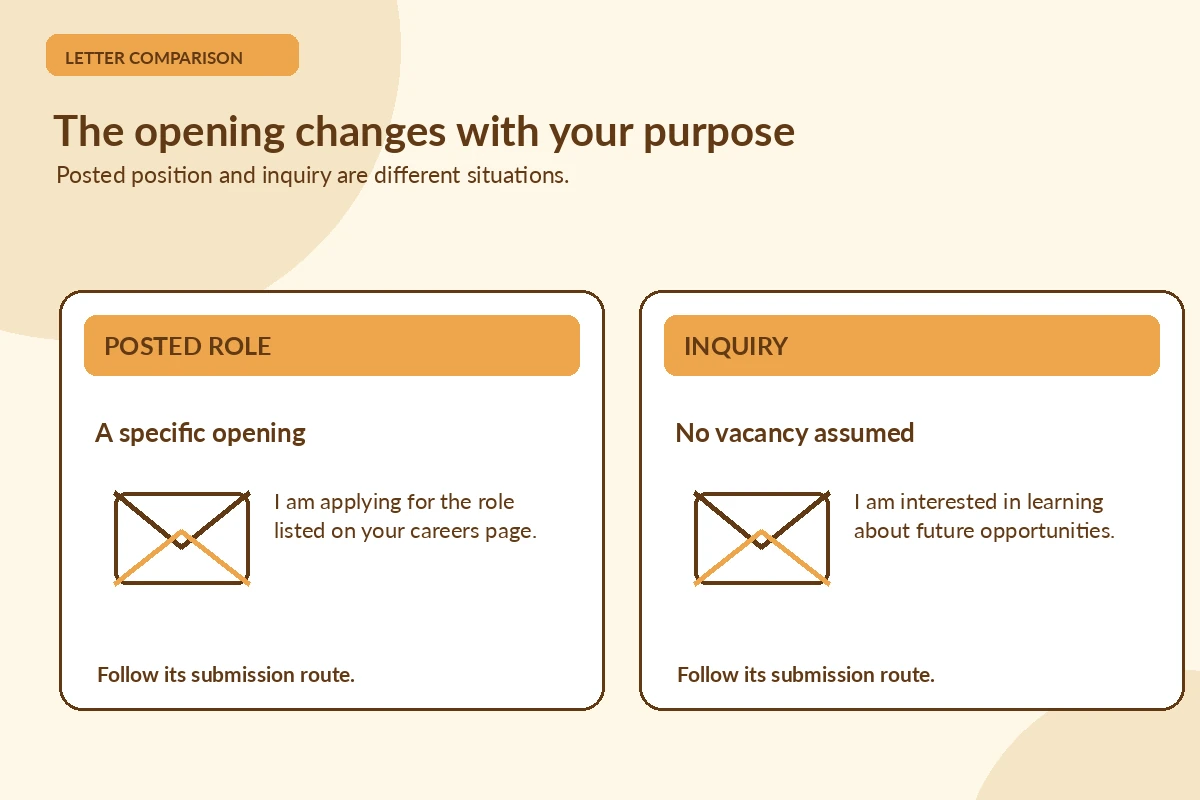
A letter for a posted vacancy should name the actual position and match its requirements. A letter of inquiry or interest may instead ask whether an employer has opportunities related to your skills. Florida Gulf Coast University describes that distinction in its career-center guidance. If you are responding to a numbered job posting, use the advertised title and follow its application route. If there is no advertised opening, avoid writing as though a vacancy or interview has already been promised.
For an inquiry, it is sensible to be concise, explain the type of work you are interested in, and request information about appropriate application channels. The employer may not accept unsolicited materials or may require applicants to use an official portal. That is different from submitting a response to an open requisition. This page addresses document choice; it does not suggest sending confidential information to speculative contacts or treating a personal email from a stranger as proof of hiring authority.

Read the posting as a document checklist, not a vocabulary test
Create a checklist directly from the instructions: job title or requisition number, résumé, letter, questions, references, work samples, and accepted formats. If the posting specifies a file naming convention or a single combined PDF, honor it. If only one field exists but several materials are requested, look for an employer FAQ or contact rather than guessing which attachment to omit. The University of Nebraska’s career materials guidance emphasizes position-specific documents and notes that some letters are required while others are optional.
If the online portal calls the box “cover letter,” do not upload a résumé into it merely because another webpage used the term “application letter.” If a form requests a short statement, you might need a concise plain-text version rather than a letterhead. The request’s length, content and upload controls provide stronger evidence about the right deliverable than terminology alone. The goal is a complete, correctly routed application.
Use one clear structure for either name when applying to a vacancy
For a typical advertised role, open with the position and the main reason you fit. Follow with a real example that illustrates a required skill, and close with a respectful statement of interest. This approach matches CareerOneStop’s and Harvard’s cover-letter guidance. The letter should complement the résumé rather than summarize every job you ever held. You can use an employer-specific format if one is provided; do not overwrite a required prompt with a generic story that does not answer it.
Illustrative first sentence: “I am applying for the office support coordinator position listed on your careers page; my experience maintaining volunteer schedules and checking record changes relates to the team’s scheduling responsibilities.” This is a fictional example and should not be copied as a real credential. If you have a real link to the role, substitute your own factual work. You do not need to add invented departmental awards, referral names or metrics to make the letter feel complete.
Compare content, attachment, and submission channel
An application letter used as a stand-alone introduction may need slightly more context about your qualifications, particularly if no résumé accompanies it. But do not assume a long narrative is welcome when a company sets a strict length limit. A cover letter accompanying a résumé can focus more tightly on a few matching examples. The difference is functional: what other documents are available to the reviewer, what the employer asked, and how the reader will use the note. It is not a fixed national standard.
Use the intended channel. A letter pasted into a portal may lose elaborate formatting. A PDF attachment should open correctly and display every line. A letter sent through an authorized company email address should name the role in the subject and refer to the actual attachments without claiming you included a file that is missing. Check that you are responding to an authentic posting on an official employer site and not a misleading third-party listing that requests sensitive information upfront.
Avoid confusing a cover letter with other hiring documents
A résumé is a structured record of experience, education and relevant skills. A cover letter makes an argument for the role using selected evidence. A reference letter is usually written by someone else who can speak to your work. A letter of recommendation is not a replacement for your own cover letter unless the application says so. A statement of purpose or academic motivation letter may ask for different personal or program-specific content. The fact that each contains paragraphs does not make them interchangeable.
Do not invent a referee, rewrite your own recommendation as though someone else wrote it, or assume that one letter answers every screening question. If the employer asks for two documents that sound similar, read the prompts carefully and use any published guidance to distinguish them. When the ambiguity is consequential, ask the legitimate application contact one short specific question, such as whether a stand-alone letter and résumé should be uploaded as separate files.
Make a final delivery decision and verify the package
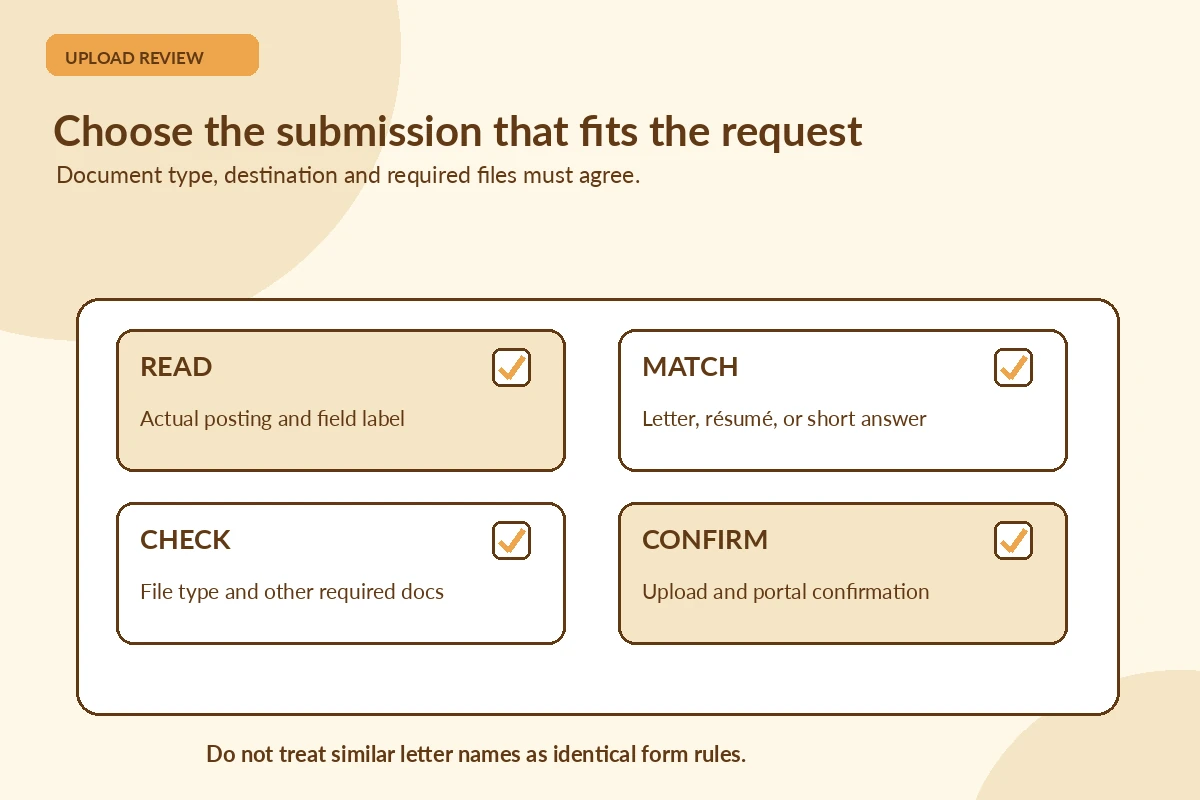
Before clicking Submit, compare the files with the posting line by line. Check the role and location, the file type and naming requirements, the applicant details, and the content requested. If the letter is optional, decide whether it adds a concrete reason to consider you that the résumé does not make obvious. If no letter is allowed, do not sneak one into a field meant for something else. Respecting the employer’s route is part of presenting organized, relevant material.
After uploading, use the portal preview or confirmation screen to verify that the intended document went to the intended field. Store a copy of the exact version submitted with the posting for your records. If you see only a generic error and no confirmation, inspect the portal instructions before trying again. A correctly labeled file cannot guarantee a hiring outcome, but it avoids a preventable mismatch between what the employer requested and what you delivered.
Compare the decision against a practical checklist
The following worksheet is a teaching aid, not an employer rule or real candidate outcome. Apply it to the current posting, using your own verifiable experience and the actual application instructions.
| Instruction you see | Likely next step | Important check |
|---|---|---|
| “Résumé and cover letter” | Prepare both documents | Two separate files or fields? |
| “Application letter” | Use requested letter field | Is a résumé required too? |
| “Letter of inquiry” | Describe interest, not a fictional vacancy | Does employer accept inquiries? |
How We Research Cover Letter Writing
The JobAsk editorial review used the US career and consumer-protection references below on November 6, 2026, checked the user-supplied WordPress post title inventory for overlapping intent, and compared public search results. Letter examples are explicitly fictional and are not actual applicants, employer endorsements or guarantees. Different employers may give different submission instructions. See our affiliate disclosure.
Sources checked November 6, 2026: ecc.uic.edu — UIC Engineering Career Center treats cover letter and application letter as terms that can refer to the same job-application document.; careerservices.fgcu.edu — FGCU distinguishes an application letter for a posted position from a letter of inquiry when no opening is advertised.; cloudfront.careeronestop.org — CareerOneStop describes tailored cover letters, often about 200–400 words with three or four short paragraphs.; business.unl.edu — University of Nebraska notes that employers may require or make a cover letter optional and recommends tailoring materials to the actual position.; careerservices.fas.harvard.edu — Harvard career services gives a cover-letter structure with a job-linked opening, evidence-based middle and concise closing..
More Resume and Cover Letter Guides
No. In US hiring the terms may refer to the same document; pay attention to what the employer actually requests.
Often yes for a posted role, but adjust the amount of context and the format to match the instructions and other required documents.
Only if the employer specifically says so. A request for both a résumé and letter requires both.
A note expressing interest in an organization without assuming a specific advertised vacancy exists. Not every employer accepts unsolicited inquiries.
Follow its description and published instructions; if they conflict and the employer provides a legitimate contact, ask about the required file combination.