
The best cover letter body paragraph does more than claim a skill: it shows where you used that skill, what you did, and how it matches a requirement in the job posting. Pick a single relevant need, describe a real assignment in plain language, and explain its connection to the position. One specific example is usually more useful than a list of adjectives. A middle paragraph should add context to your résumé, not paste the résumé bullet into sentence form. If the work was supervised, collaborative or hypothetical, label that boundary honestly.
Choose the employer need before you select the story
Underline an actual responsibility in the job ad, such as maintaining accurate schedules, organizing service tickets, or coordinating delivery updates. That requirement becomes the reader’s question: What have you done that makes this responsibility credible? Select one example that responds directly. A job seeker with many accomplishments should not start with whichever anecdote is largest or most dramatic. Relevance matters more than spectacle. UC Berkeley advises showing how skills and experiences relate to the specific position and company; this is where that advice becomes concrete.
Write down what you know from your own record: the setting, your role, the action, the review step, and the observable result. A class project may count if the task is similar, but call it a class project. An internship can demonstrate careful work without proving that you had final authority. If none of your examples fully matches the advertised duty, explain a transferable process and name what you would still need to learn. That is more credible than claiming expertise you have not developed.
Use four building blocks without sounding mechanical
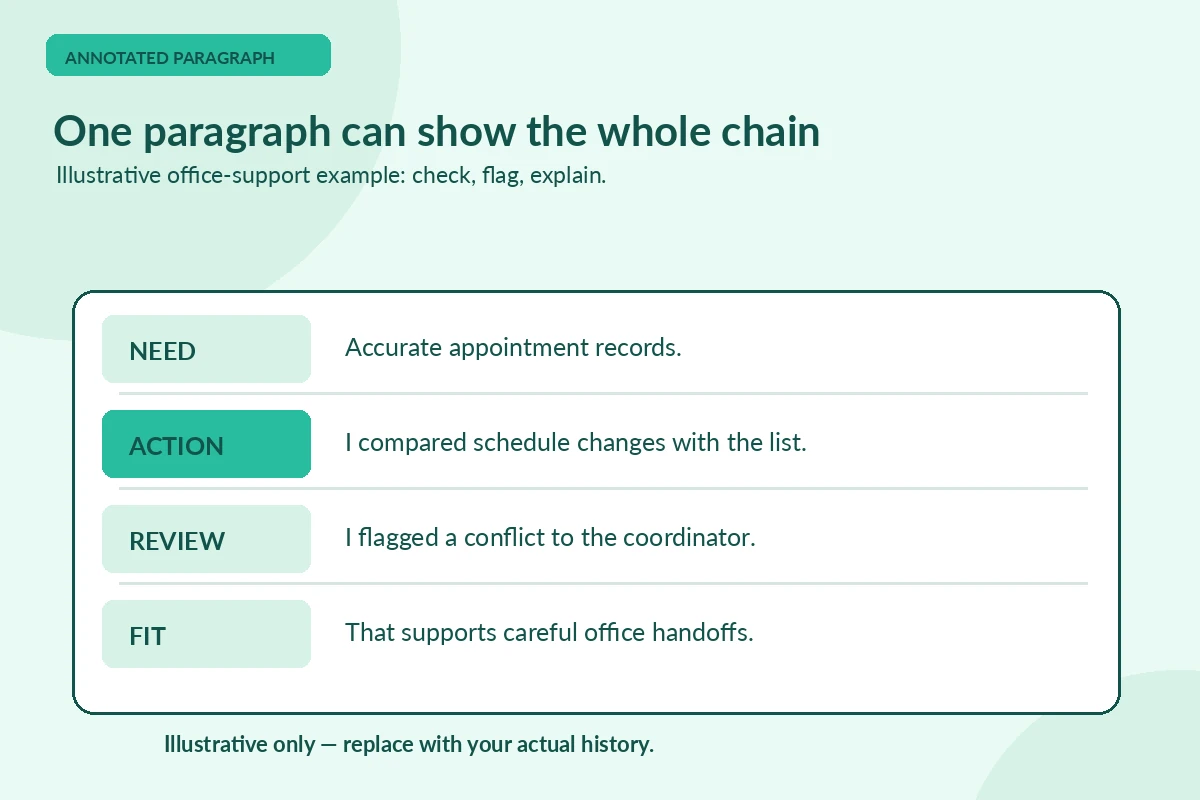
A practical paragraph has four jobs: connect to the employer’s need, identify your relevant context, describe your own action and checking process, and explain the contribution you could make. These elements may fit in two or three sentences. The order can vary, especially if the example is complex, but the reader should never have to guess why you included it. University career guides recommend using specific qualifications rather than a catalog of general traits. The point is a clear argument supported by what happened.
Consider the difference between “I am highly organized and detail-oriented” and “For a student event, I maintained the volunteer shift list, checked changes with the coordinator, and shared an updated schedule before opening.” The second is still only a fictional practice example. In a real application, you would need to have performed the action. Notice that the sentence does not invent attendance statistics, manager testimonials or guarantees. It lets the reader ask a sensible follow-up about the work.

Rewrite a vague administrative paragraph into useful evidence
Illustrative weak draft: “I have excellent communication, computer, multitasking and leadership skills. I am always ready for a challenge and consistently exceed expectations.” This gives the employer no task to evaluate. A stronger fictional alternative for an office support job is: “While helping coordinate a community workshop, I updated sign-up records, compared the list with the event schedule, and flagged a duplicate booking to the organizer for correction.” It shows recordkeeping, careful checking and the correct decision owner. Do not claim that you approved the schedule if you merely identified the issue.
Now add the role connection: “That experience would help me support accurate appointment records and timely staff updates in this position.” The two sentences together form a coherent body paragraph without inflated results. When adapting this structure to yourself, replace every event and action with something you actually did. If your outcome was uncertain, describe the step you completed or the feedback you received rather than inventing an improvement percentage.
Adapt the same logic to technical and customer-facing work
For a technical support role, a fictional paragraph might explain that you reproduced an error in a test environment, wrote down the steps, and passed the findings to someone authorized to change production settings. For a customer-facing job, the example might involve listening to a complaint, confirming the relevant policy, and giving the person a clear next step. Those situations demonstrate different skills; neither should be represented as a miracle rescue. Explain what was within your scope and who made final decisions.
A role involving health information, protected student records, bank data or regulated equipment requires particular care. Do not publish private facts about a customer or imply that you bypassed approval to deliver faster. You can describe the general method and the handoff without names or sensitive details. If the employer requires a current credential, do not suggest that a strong cover letter replaces it. Credibility includes knowing what the role does and does not authorize.
Avoid repeating a résumé bullet word for word
Your résumé might say, “Maintained weekly volunteer schedules.” The cover letter can tell a slightly different story: why schedule changes mattered, how you confirmed conflicting requests, and what you sent to the coordinator. This adds decision context while staying consistent with the underlying work history. Harvard’s cover-letter example gives the middle paragraph the purpose of explaining how applicants developed job-relevant skills. You do not need to restate every job title, project and date in that paragraph.
Compare the final paragraph with your résumé before submitting. If the résumé says you assisted a project leader, do not upgrade yourself to project manager in the letter. If the example happened during a course, keep the academic setting visible. If a metric is real but context-dependent, include it only when you can explain the measurement and your own role. An honest, bounded example is useful in an interview because it invites a clear conversation about what you did.
Decide whether to include one story or two shorter ones
One well-supported incident often makes a complete body paragraph. Add a second when it covers a different major requirement and does not make the letter long or confusing. For example, a records-quality story and a customer-communication story may demonstrate genuinely distinct aspects of an administrative job. Two accounts of nearly identical spreadsheet work probably do not justify two paragraphs. The appropriate number depends on the role, the instructions and the strength of the actual evidence you have.
If you need to compress, preserve the action and the connection. You can cut the detailed story of how the team was assembled, the long explanation of your interest in the profession and the extra adjectives surrounding the result. Do not cut the one sentence that reveals whether the work was supervised or who reviewed a change. The goal is to help a reader recognize your fit without making the passage sound like a generated testimonial.

Check every claim before you use the paragraph
Ask four questions: Is the duty drawn from the actual job posting? Did I personally perform the stated action? Can I explain any outcome or review process? Does this reveal anything confidential? If one answer is no, revise the paragraph. A short draft cannot compensate for mistaken facts. Proofread the application for the correct employer, title, and dates; ensure your story remains accurate in both the résumé and cover letter. Career-center guidance consistently values specific evidence and error-free writing.
Practice telling the example aloud without reading it. If the action sounds vague when spoken, ask what a coworker would have seen you doing. If it sounds grandiose, reduce it to the real assignment. The paragraph is ready when a hiring manager could ask a follow-up question and you could answer without inventing clients, awards or results. Keep any hypothetical examples in this guide out of your actual application unless your genuine experience supports them.
Compare the decision against a practical checklist
The following worksheet is a teaching aid, not an employer rule or real candidate outcome. Apply it to the current posting, using your own verifiable experience and the actual application instructions.
| Sentence role | Helpful detail | Weak substitute |
|---|---|---|
| Employer need | Accurate appointment records | “I am a great fit” |
| Your action | Checked duplicate entries and informed organizer | “Managed everything” |
| Role connection | Would support careful scheduling handoffs | “Guaranteed improvement” |
How We Research Cover Letter Writing
The JobAsk editorial review used the US career and consumer-protection references below on November 6, 2026, checked the user-supplied WordPress post title inventory for overlapping intent, and compared public search results. Letter examples are explicitly fictional and are not actual applicants, employer endorsements or guarantees. Different employers may give different submission instructions. See our affiliate disclosure.
Sources checked November 6, 2026: career.berkeley.edu — UC Berkeley Career Center advises connecting relevant experiences and qualifications to the job description.; careerservices.fas.harvard.edu — Harvard career services gives a cover-letter structure with a job-linked opening, evidence-based middle and concise closing.; careercenter.education.wisc.edu — UW–Madison advises specific examples, careful proofreading, and following requested cover letter instructions.; cloudfront.careeronestop.org — CareerOneStop describes tailored cover letters, often about 200–400 words with three or four short paragraphs.; careerdevelopment.princeton.edu — Princeton Career Development emphasizes a job-specific letter no longer than a page and approximately 250–400 words..
More Resume and Cover Letter Guides
Enough to identify the job requirement, your own action and why it matters. Two to four focused sentences often work, but follow the employer’s instructions.
Yes, when it is relevant and accurately labeled. Describe the project task, your contribution, and any review or feedback without inventing a client.
No. Use metrics only if you measured them accurately and can explain your role; an observable process or completed handoff can also be credible evidence.
Write what you personally did and how the team or supervisor handled decisions. Do not imply you independently produced the entire outcome.
Only after checking that the requirement and example really fit each posting; generic reuse often hides the specific link the reader needs.