
For a quality engineer interview, show how you distinguish an observed defect from an assumed cause, communicate test limitations, and route proposed changes for approval. A strong example might involve traceable inspection data or a cross-functional review; a credible weakness might involve making early reports too technical for a production audience. Do not take personal credit for an entire corrective action when you analyzed one step. Job titles vary across manufacturing, suppliers, medical devices, and software, so anchor every claim in your actual project.
Choose a strength that shows engineering judgment
“I solve problems” is not evidence. Name an actual defect definition, sampling limitation, measurement issue, or discrepancy between a drawing and an inspection record. Explain what information you checked before drawing a conclusion. You can show analytical rigor even when the final design or corrective action belonged to a different engineer. Say what you personally measured, documented, or presented rather than repeating the team’s end result as a solo achievement.
For example, if you organized inspection findings by lot or station, describe the data source, the grouping rule, and who reviewed the pattern. Avoid quoting a dramatic defect reduction without a reliable baseline. In a quality role, careful uncertainty statements can be strengths: distinguishing a suspected cause from a confirmed cause demonstrates more judgment than claiming the answer was obvious on the first pass.
Give a weakness with an observable adjustment
A believable quality-engineering weakness may concern report structure, how early you ask for cross-functional input, or a tendency to overexplore low-priority hypotheses. Make sure the issue is genuinely yours and not an excuse to bypass controls. For example, an engineer who included every chart in an initial presentation could learn to put the decision question first and preserve the detailed analysis as an appendix.
A stronger answer explains the feedback received, the specific change in the next review, and what you would still improve. Do not frame disregarding a test failure as a normal weakness. If an interviewer asks about errors, acknowledge the requirement to preserve data, report discrepancies promptly, and follow an authorized corrective-action process. A credible development story does not require a catastrophic incident.
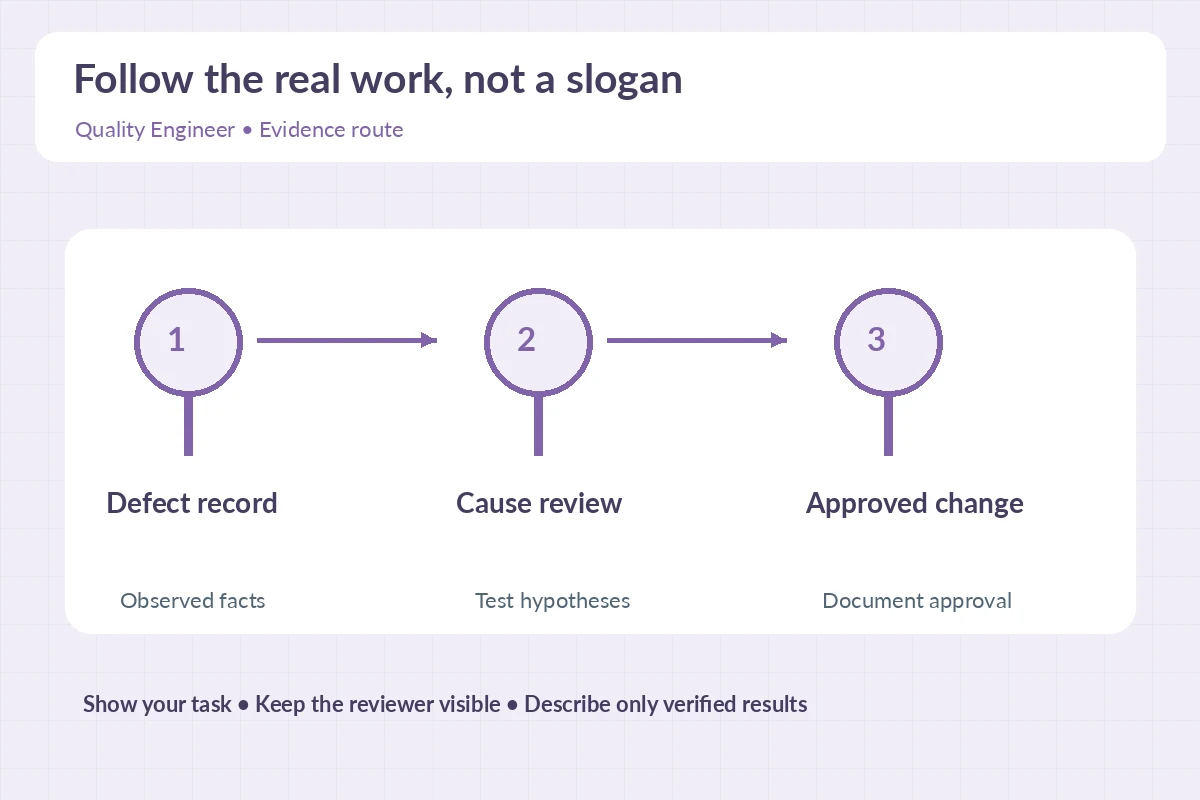
Separate investigation from corrective-action ownership
Many quality problems travel through collection, verification, root-cause investigation, proposed corrective action, validation, and controlled release. Different people can own different steps. Your answer should trace the segment you actually performed. If a manufacturing manager approved a fixture change or a separate team validated it, say so. This avoids the common overstatement that “I fixed the process” when you produced a data summary.
If you contributed to an 8D or similar investigation, specify the work product: a defect Pareto, documented observations, updated inspection instruction under review, or meeting notes. Do not imply that a named method automatically proves effectiveness. Describe what evidence would have been required to confirm the outcome, and indicate whether that confirmation occurred during your assignment.
Prepare examples for cross-functional challenges
Quality engineers often communicate with production, design, suppliers, and reviewers who need different levels of detail. Choose a story about translating evidence into an actionable question without blaming another team. Explain the conflicting needs, such as production continuity and inspection confidence, and how you presented verified facts. Distinguish the next step you recommended from the one that was authorized.
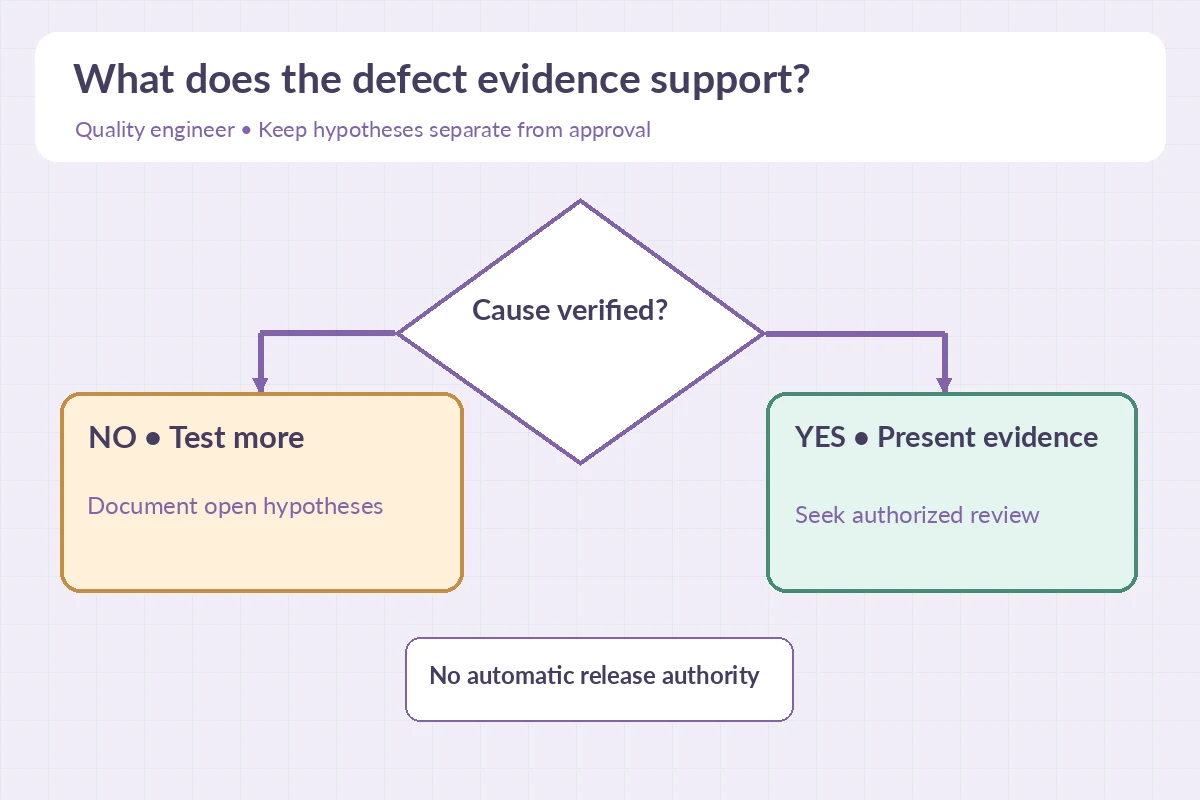
An interview follow-up may ask what happens if a supervisor wants a release without sufficient evidence. Avoid inventing legal rules or telling an unverified dramatic story. Explain how you would follow the organization’s escalation and release controls, document the gap accurately, and involve the appropriate quality authority. That answer shows the risk boundary without claiming veto powers you may not possess.

Compare a weak bullet with a defensible story
Weak answer: “My biggest strength is that I always find the root cause.” That claim is absolute, and many investigations remain inconclusive. Stronger answer: “I clarify the failure definition, verify the source data, and show which hypotheses still need testing.” If you can provide a real example, add an exact observation and reviewer response. Otherwise, the sentence is a preparation model, not a claim about your career.
Weak weakness: “I am a perfectionist.” Stronger weakness: “My initial reports were too dense, so I moved the decision point and evidence limitations to the first page.” It is specific, plausible, and directly relevant to quality communication. You can discuss a process change without making up financial savings or failure-rate improvements. The strongest answer can withstand a detailed follow-up.
Adapt the answer to the specific quality role
An incoming quality role may emphasize supplier documentation and acceptance criteria; a manufacturing role may emphasize process capability, test records, and dispositions. Read the vacancy and identify which reviews you have actually participated in. A quality engineer in one industry may not be authorized to sign documents in another. Never imply that using a familiar tool means you hold the required certification or approval authority.
Before the interview, prepare one evidence example with a problem statement, another about communicating a constraint, and a third about a development area. Keep confidential dimensions, drawings, customer names, and proprietary process information out of your presentation. Replace them with generalized descriptions that preserve the reasoning without exposing the underlying material.
Build your personal evidence checklist
Before using a strength claim, write down the setting, your exact task, who reviewed it, and one observation you can defend in a follow-up question. For a weakness, choose a real, bounded development area and prepare the feedback or changed habit that demonstrates progress. Your examples must come from experience, not from the hypothetical scripts on this page. If a story involves a customer, colleague, patient, or employer confidential information, describe the work pattern without identifying anyone. Interview preparation is not permission to disclose restricted details.
Illustrative strength answer (not a personal testimonial): “One strength I would bring is traceable problem definition. In a supervised production project, I grouped repeated defects by process stage, checked the underlying inspection records, and gave the engineer responsible for disposition a clear evidence table.” This wording is a model; replace the situation with your own facts. Illustrative weakness answer: “I have worked on explaining findings too technically. My first summaries buried the decision in test details. I began leading with the observed issue, evidence quality, options, and the approval still needed.” Never memorize these examples as achievements you did not perform.
How We Research and review interview advice
This guide uses O*NET’s description of the occupation to anchor the kinds of tasks an employer may assess and the U.S. Office of Personnel Management’s structured interview guidance for the principle that answers should provide evidence relevant to job competencies. O*NET describes occupations, not your personal work history or a universal license. OPM guidance informs interview assessment, not a guaranteed hiring outcome. All sample answers here are illustrative and must be adapted to the applicant’s actual experience.
We also consider the EEOC’s limits on pre-offer disability-related inquiries: job-relevant strength and weakness preparation should not pressure applicants to disclose medical diagnoses or other protected personal information. Verify the particular employer’s job description, authorization rules and interview instructions. Links or recommendations do not represent a paid endorsement. Read our affiliate disclosure.
More Interview Preparation Guides
Yes, when you describe which data you evaluated, what remained uncertain, and who reviewed your conclusion.
Label it as a class, lab or capstone project. Explain your own measurement and analysis, not a production result.
Only if it is verified, attributable to your actual role, and appropriate to disclose.
Yes, if you explain the precise problem, such as overly detailed summaries, and what changed afterward.
Use sanitized descriptions and avoid sharing customer, supplier or proprietary details without authorization.