
A graduate student academic CV is an evidence record, not a longer version of a corporate resume. Start with education and the status of the degree in progress, then organize research, teaching, presentations, publications and awards around the academic opportunity. Use the real status of each output: published, accepted, under review, or in preparation are not interchangeable. Academic committees need to understand your contribution and stage of training. A research fellowship CV may lead with publications and projects, while a teaching-focused application may bring instruction and mentoring forward.
Choose the CV format for the actual application
In US academic hiring and funding, CVs commonly present a fuller scholarly record than a general employment resume. University of Texas graduate career services distinguish a CV’s research, teaching and service history from an industry resume’s concise, job-focused snapshot. First read the application instructions. A research fellowship may explicitly request a CV, while an industry research job may ask for a two-page resume. Do not send a long CV simply because you are currently enrolled in graduate school.
If the institution gives a page limit or section requirements, follow them even when generic career advice suggests a different length. Your CV can grow over time, but the current application should show authentic evidence rather than empty headings for achievements you have not earned. Keep a comprehensive internal record and a tailored submitted version so section order and emphasis can change without changing factual claims.
State degree progress and research affiliation precisely
List each institution, degree program, field and date awarded or expected. Princeton’s graduate CV guidance recommends identifying academic training and, where appropriate, dissertation title and advisors. A doctoral candidate who has not completed the degree should not write “PhD” alone in a way that implies conferral. Use “PhD in Sociology, expected [date]” when the estimate is defensible, or “PhD student” when precise timing remains unclear.
If you moved between labs or institutions, distinguish formal enrollment from research appointments. Being a research assistant in a campus laboratory is different from holding a faculty position at that university. Separate the department and the employing institute if necessary. For a dissertation committee, name participants accurately and only when customary for the audience. Avoid exposing private funding records or reporting unpublished research findings without supervisor approval.

Present research contributions with observable methods
A useful Research Experience entry names project context, your appointment, methods and the work you performed. Instead of “conducted groundbreaking research,” say, for example, “Cleaned survey data, documented exclusion rules and prepared reproducible code for adviser review.” That sentence is hypothetical. Show your real contribution within a collaborative project; do not imply you designed an experiment or obtained a grant when that responsibility belonged to the principal investigator.
Choose terminology your disciplinary audience can understand. An academic committee may want equipment, protocols, archives or methodology; a broader funding panel may benefit from one plain-language sentence on purpose. Provide metrics such as sample sizes or number of interviews only when verifiable and permitted to disclose. Your CV should distinguish lab responsibilities, research assistantship duties, independent thesis work and outputs credited to a team.
Use exact publication and presentation status
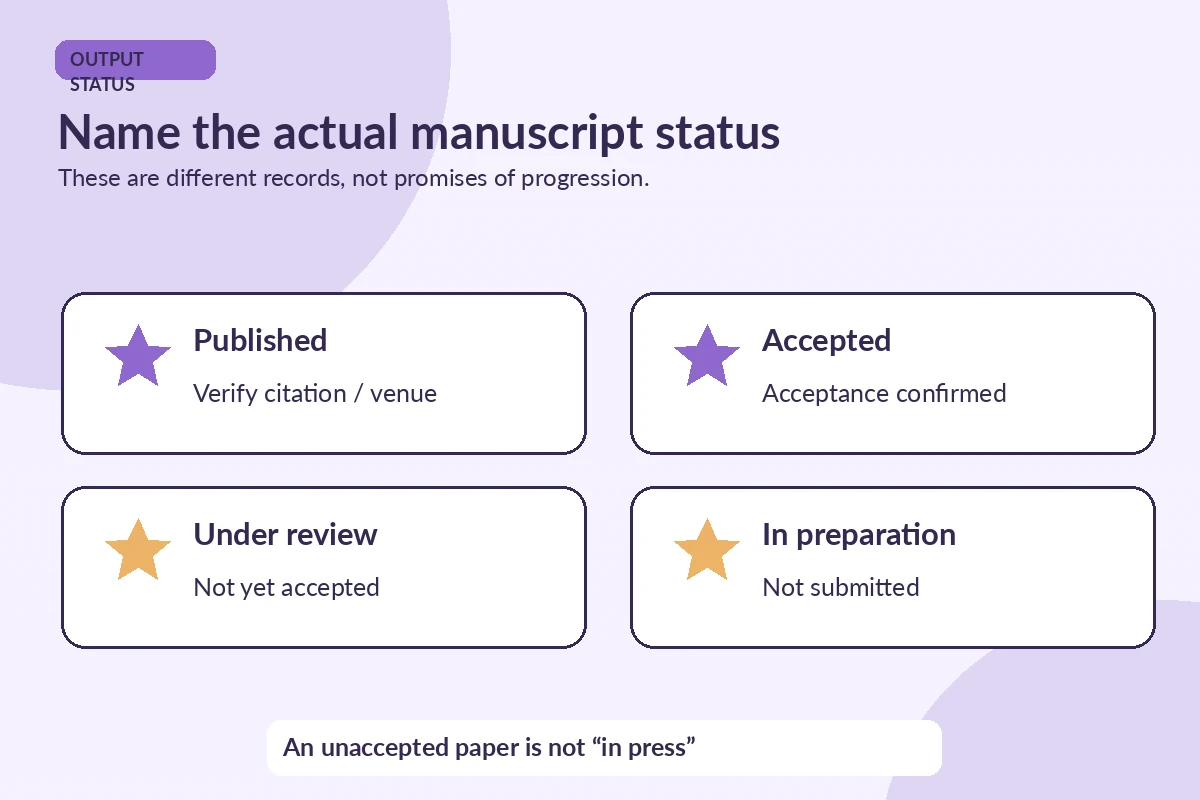
Princeton advises full bibliographic entries and discipline-appropriate citation styles for scholarly publications. A published article belongs in Publications with its correct authorship, title, venue, year and status. A manuscript accepted for publication can be labeled accepted or in press as appropriate; one merely submitted should not be called forthcoming. Work in preparation may be better placed in a separate section, if listed at all, with a clear status. Your dissertation is not automatically a journal publication.
Presentations need their own evidence: conference or symposium name, location or format, date and the title actually presented. A proposal you submitted but did not present is not a conference talk. A poster and an invited keynote are different, even if both involved speaking to researchers. Ask a coauthor or adviser how collaborative work should be cited, and avoid announcing confidential or embargoed results in a public document.
Organize teaching and mentoring according to audience
For teaching-focused applications, move Teaching Experience ahead of extensive research details. UC Davis recommends organizing CV sections by what the hiring committee cares about. Name the course, level, term and your actual role: instructor of record, guest lecturer, discussion leader or grading assistant. Those labels imply different responsibilities. If your department assigned you a graduate teaching assistantship, describe the duties rather than suggesting you independently designed the entire class.
Mentoring can be a separate section when you coached students or lab members over a meaningful period. State the form of mentoring and whether you coordinated a project, reviewed work or taught a specific technique. Do not disclose trainees’ performance, confidential learning needs or personally identifying details. If all you did was answer occasional questions in a shared lab, a formal “mentorship program” claim may overstate the relationship.
Handle grants, honors, skills and scholarly service honestly
Awards and fellowships may show how your work was recognized; list the actual awarding body and date. Distinguish a fellowship you received from a grant awarded to the lab or a principal investigator. If you assisted with an application but were not a named recipient, describe that contribution under research service rather than creating a personal award. Service items such as student committees or editorial review should reflect duties completed, not memberships assumed from attendance.
Technical skills should be specific to your research methods: software, statistical approaches, languages, archives or instrumentation you can discuss. Do not insert a skill only because it appears in a fellowship description. It is legitimate to list ongoing training under Professional Development but keep training separate from credentials already awarded. Sparse sections can be combined; content and verifiability matter more than the number of headings.
Audit authorship, chronology and confidential material
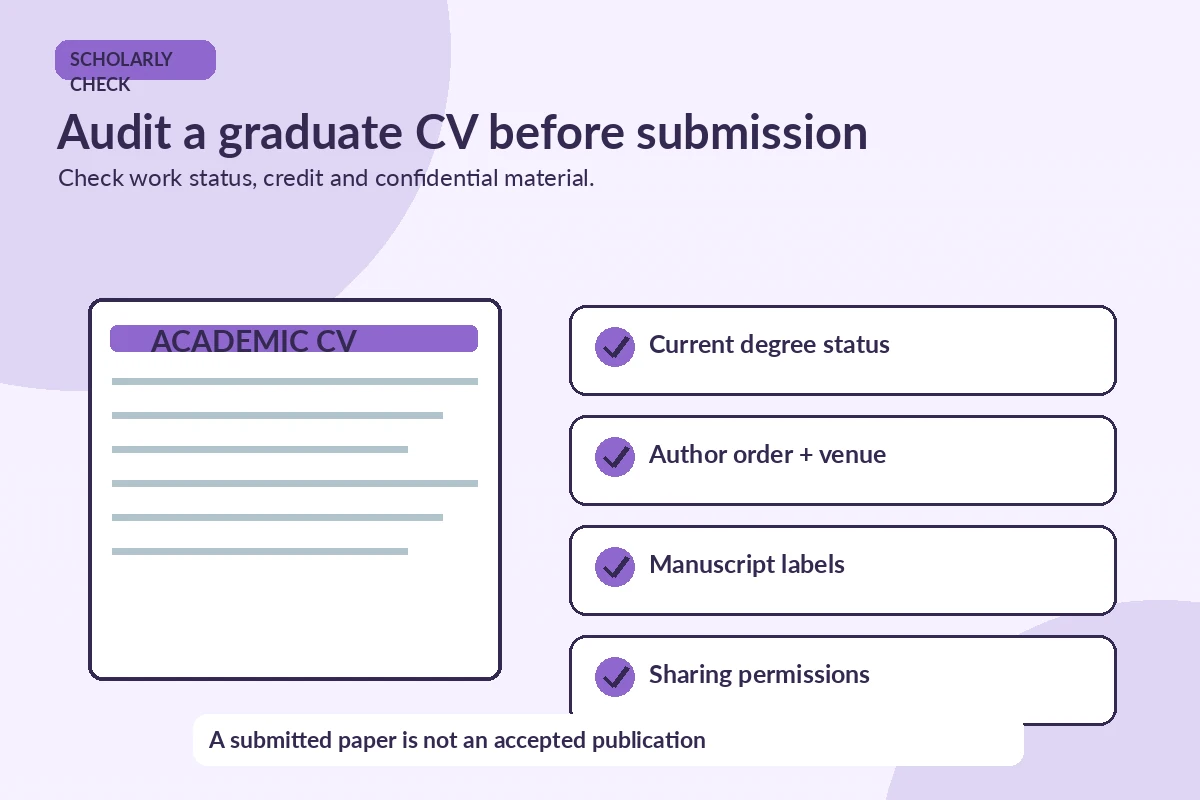
Before sending, check dates, author order, journal or meeting names, accepted status and advisor affiliations. Use one citation style within each field and keep the version history of the CV so updates do not accidentally move an under-review manuscript into the published category. The Princeton and UC Davis guides both emphasize readable organization and actual academic contributions. Check that every research activity is named by your own role rather than by the project’s collective ambitions.
Finally, tailor ordering to the recipient. For a teaching college, lead with teaching accomplishments; for a laboratory fellowship, show research questions and verified scholarly outputs. Remove unpublished data, participant details and proprietary protocols unless sharing is authorized. A graduate-student CV should be a truthful record of promise and work completed, not an attempt to appear as though a doctorate or faculty appointment has already been conferred.
Compare the credential or experience with verified evidence
The comparison below is an editorial worksheet. It illustrates how to name your educational record, academic experience or application claim without exceeding what is documented. The real school, awarding body and application instructions determine your exact wording; examples in this page are fictional where labeled.
| Claim | List it when | Never substitute |
|---|---|---|
| Published article | Venue and bibliographic record exist | Manuscript merely drafted |
| Accepted manuscript | Acceptance confirmed by journal | Only submitted for review |
| Graduate teaching | Assigned course and real tasks | Faculty instructor title |
How We Research Education and Resume Guidance
We reviewed the primary career-service, educational and occupational resources listed below on November 6, 2026, compared intended search purposes with the supplied JobAsk WordPress inventory, and checked current public search context. The examples are editorial illustrations, not actual academic awards, endorsements or hiring outcomes. Institution and employer policies always govern credential verification and permission to disclose student data. See the JobAsk affiliate disclosure.
Source references checked on November 6, 2026: careerdevelopment.princeton.edu — Princeton guide to graduate CV organization, degree status, publication citations and academic experience.; careercenter.ucdavis.edu — UC Davis career guidance on matching academic CV section order to research or teaching goals.; gradcareer.utexas.edu — University of Texas graduate career distinction between academic CVs and industry resumes..
More Resume and Cover Letter Guides
It can be because it records scholarship comprehensively; application instructions and relevance still determine appropriate length.
Only with that exact status where appropriate. Do not label an unaccepted submission published or in press.
In Education beside the degree program, explicitly marked expected when it is not yet awarded.
For teaching-focused roles, often yes. Research fellowships may call for research and publications first.
Not automatically. Describe a dissertation in Education or Research unless it has separately been published in a qualifying venue.