
Accepting a production scheduler offer requires more than checking the title and start date. Confirm which facility or product line you will support, whether you publish schedules or only prepare drafts, what planning system is in use, and who approves changes after shortages or breakdowns. Request a written offer and compare it with the description given during interviews. A scheduler who coordinates updates has a different decision scope from a planner who can independently commit revised completion dates.
O*NET identifies schedule distribution, materials requirements, progress reporting, and coordination with supervisors as tasks of production planning and expediting clerks. Actual plant procedures vary. Ask for a walkthrough of the planning cycle, from order intake and material checks to line release and end-of-shift notes. The goal is to understand who owns the board and where your authority ends, not to promise that you can optimize an unfamiliar production operation on day one.
Check the Exact Role Described in the Offer
A helpful question is: “When materials are short, who decides which work order moves?” Ask how supervisors, production control, inventory, and sales communicate priorities. Some roles prepare suggested sequences while a manager authorizes the final plan; others have more delegated discretion. Clarify whether your work involves reviewing manufacturing orders, recording quantities, checking available capacity, or coordinating expediting. Do not infer authority from the word “own” in a job advertisement.
Learn how the schedule is distributed: printed work orders, an ERP work queue, a shared board, or a plant-specific system. Ask who checks the accuracy of quantities and how changes are logged so the next team does not follow an obsolete plan. If the role includes reporting delivery delays to customers, ask who approves external commitments. Communicating a delay internally and promising a new shipment date are separate decisions.
| Offer item | Ask before accepting | Record the answer |
|---|---|---|
| Assignment | Production sequencing and schedule changes | Exact responsibilities and location |
| Authority | Who reviews exceptions or changes? | Named approver and escalation contact |
| Coverage | Which shifts or deadlines apply? | Normal schedule and any rotations |
| Training | Which systems and tasks are taught? | Trainer, access route, and first-day plan |
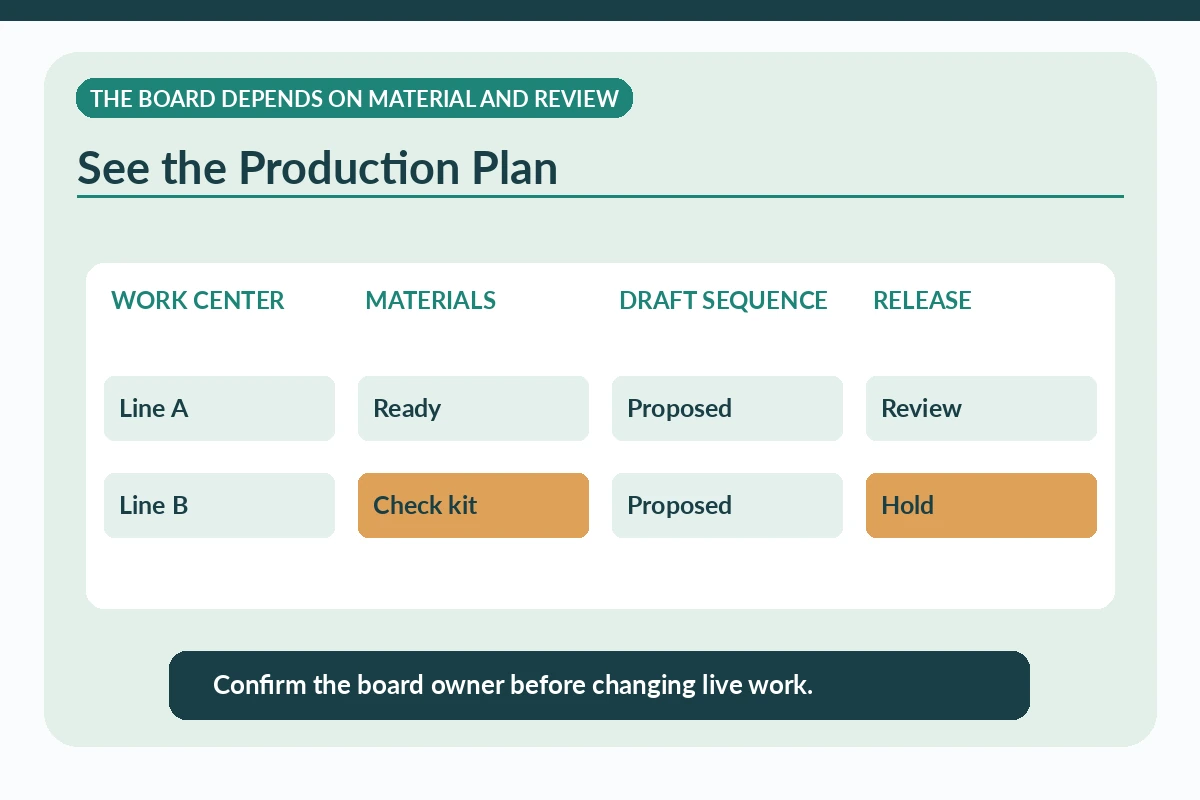
Confirm Schedules, Location, and Daily Handoffs
Plant shift patterns can be more complex than office hours. Ask whether your role supports one shift, covers multiple crews, joins a morning production meeting, or answers questions at changeover time. Clarify whether weekends, early starts, or on-call coordination are ordinary expectations. Also ask where you will work: scheduling office, production floor, distribution site, or a mixture. Those details matter even if most planning tasks are completed in software.
Handoffs deserve a sample: What does the outgoing scheduler note when a machine is down, a kit is incomplete, or an urgent order arrives? Who reviews the unresolved items? Ask whether there is a backup when you are absent and who approves after-hours schedule changes. These specifics help you evaluate the offered position without relying on a generic promise that the team will “be flexible.”

Ask About Systems, Training, and Role Boundaries
Confirm access to the scheduling system and how training occurs. Production planning can involve work-center identifiers, bill-of-material checks, line capacities, and revision logs, but the particular tools depend on the employer. Ask whether training uses a test environment before live board updates. You can describe your familiarity with spreadsheets or other ERP modules without claiming proficiency with this plant’s exact configuration.
The first-week review might involve observing a planning meeting, reading an existing work-order sequence, and documenting a supervised schedule update. Those are possible activities, not universal requirements. Ask who checks the board when you publish your first changes, and what you should do when a production leader disputes a sequence. Escalation should be built into the workflow; it should not be improvised after an avoidable missed handoff.
Use a Short, Accurate Acceptance Email
Illustrative email, not a real correspondence: Subject: Acceptance – Production Scheduler Position. Dear [Hiring Contact], thank you for offering me the Production Scheduler role supporting [facility or team]. I am pleased to accept on the terms in the written offer, with a start date of [date]. I look forward to learning the planning board, update procedures, and handoffs with production supervisors. Please advise where to report for orientation and who will guide my first scheduling-system access. Best, [Your Name].
The message does not promise to resolve shortages or set delivery commitments independently. If worksite, shift coverage, or schedule-change authority remains unclear, seek an answer before sending acceptance. Keep the official team designation and start date consistent with the actual offer rather than adding unconfirmed details to make the email sound more confident.
Keep the Offer and Onboarding Record Clear
Retain the written offer, job posting, worksite details, accepted schedule, and confirmed manager contact. Do not copy production schedules, customer orders, internal prices, or access details from a past employer to demonstrate interest. If onboarding includes an unfamiliar planning platform, wait for official credentials; sending screenshots from a live system to a personal email is not a safe training substitute.
Ask which orientation sessions cover change logs, materials shortages, production status, and plant-specific procedures. If you must visit the floor, learn where the team communicates and what supervised introduction is required before performing tasks outside the office. The job offer should make your reporting line and shifts clear; detailed operating procedures may reasonably be taught after arrival.

Complete a Role-Specific Before-Reply Audit
Your final checklist should name the production line or facility, regular coverage hours, planning platform or training arrangement, publication authority, and escalation contact. When the interview described schedule ownership but the written terms imply data entry only, ask for a clearer explanation. Conversely, if the posting suggested collaborative scheduling but you are expected to make unreviewed production promises, flag that discrepancy.
After questions are answered, send a clear acceptance by the employer’s deadline and preserve the agreed terms. Once hired, use documented change control, but do not claim an unapproved scheduling system or supervisory power in your reply. A good acceptance confirms readiness to learn the employer’s process rather than offering unrealistic production improvements before you have seen the actual constraints.
How We Research Role-Specific Job Offers
Sources checked on 2026-11-15: O*NET Production Planning Clerks explains relevant work tasks; Harvard Career Services advises acknowledging offers, examining written terms, and confirming deadlines; UW–Madison SuccessWorks recommends confirming details in a formal acceptance. We use occupational profiles only as comparisons, not as proof of what this employer promises. All emails and workplace situations here are hypothetical. For job-offer impersonation and payment warnings, we also consulted FTC Consumer Advice. We do not have a relationship with a hiring employer. For site disclosures, see Affiliate Disclosure.
Related Workplace Guides
Ask who may publish revised production schedules, who approves priority changes, and how shortages or breakdowns are communicated to affected teams.
No single arrangement applies. Confirm whether the job is based in a planning office, includes floor coordination, or supports multiple work areas and shifts.
State your actual experience and ask about employer-specific onboarding. System names in an occupation profile do not prove that a particular company uses those tools.
Request the expected coverage pattern in writing before you commit. A recurring weekend rotation materially changes the schedule you are accepting.
Accept the identified position, start date, and agreed terms. Ask separately who reviews live board changes and which team manages customer delivery commitments.