
A library assistant offer is worth accepting only after you know which branch you will serve, which desk and shelving duties belong to the position, and what your scheduled hours really look like. Confirm the official employer contact, request the offer details in writing, and reconcile the title, location, start date, and shift expectations before you send an unqualified yes. A circulation assignment is different from a back-room processing role even if both use the words “library assistant.”
The useful questions are operational: Will you register patrons, renew loans, collect returns, process holds, shelve books, help with programs, or close the branch? Which requests are referred to a librarian or circulation supervisor? Ask about records access without requesting real patron data. O*NET lists circulation, shelving, and opening or closing duties among library assistant activities, but it does not establish the duties of the particular position you have been offered.
Check the Exact Role Described in the Offer
Compare the written job description with what the interviewer described. A small public branch may combine desk shifts and materials processing; an academic library may assign a distinct circulation station, reserve desk, or shelving section. Clarify whether you are the regular desk closer, a floating substitute, or a team member assigned only during public hours. A change in branch or service point can change both the commute and the work, so record the specific location rather than accepting a vague system-wide title.
Do not read “assist patrons” as permission to give specialized research advice or manage account exceptions alone. Ask what kinds of card problems, disputed fees, damaged items, patron behavior concerns, and special accommodation requests go to a librarian or manager. If the job includes processing records, confirm which circulation system you will learn and whether a trainer will review your first transactions. This is an accountability question, not an assumption that the employer uses one particular software product.
| Offer item | Ask before accepting | Record the answer |
|---|---|---|
| Assignment | Library circulation and branch coverage | Exact responsibilities and location |
| Authority | Who reviews exceptions or changes? | Named approver and escalation contact |
| Coverage | Which shifts or deadlines apply? | Normal schedule and any rotations |
| Training | Which systems and tasks are taught? | Trainer, access route, and first-day plan |
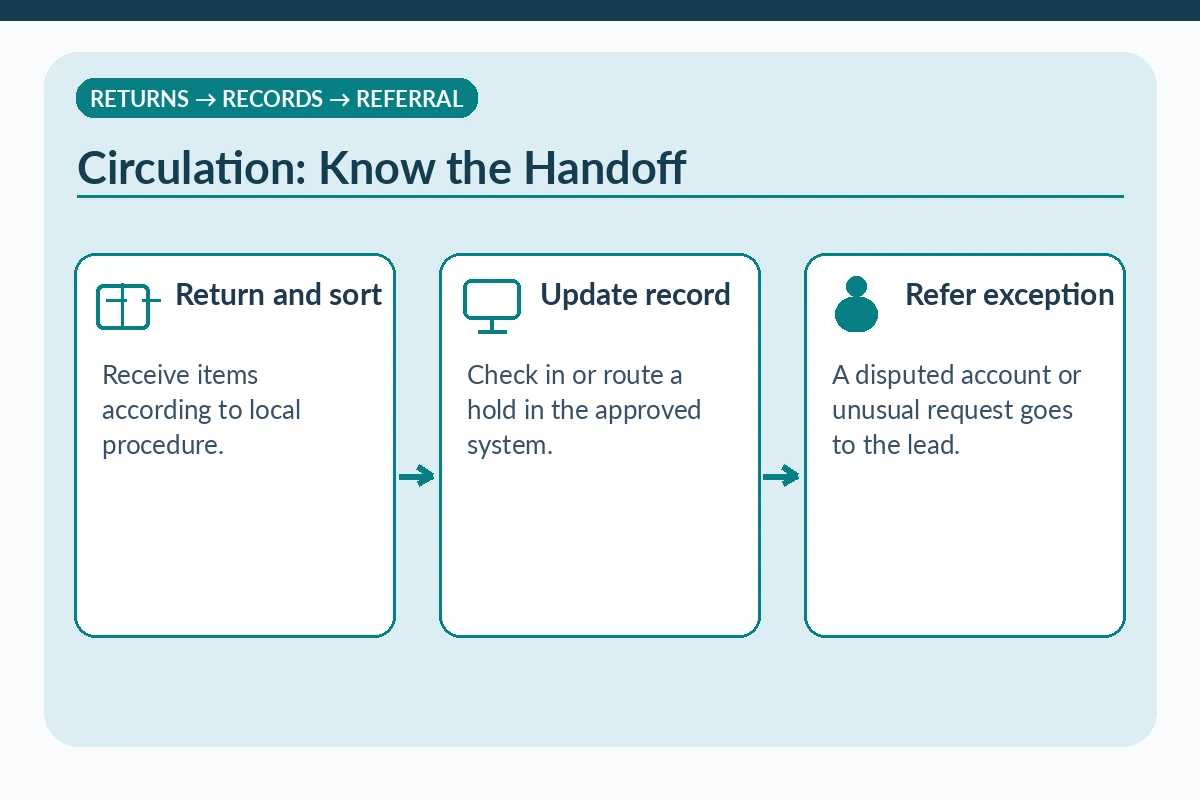
Confirm Schedules, Location, and Daily Handoffs
Request a representative schedule, not just a statement that the library is open from morning to evening. Ask about evening rotations, occasional Saturdays, coverage during school breaks, program setup, holiday closures, and how last-minute absences are handled. A person who can work weekdays but not regular Saturdays should surface that constraint before accepting. The offer should identify the normal work location and whether moving between branches is an ordinary requirement.
Opening and closing responsibilities deserve a separate question. Who checks return bins, signs off on the desk, reconciles materials for the next shift, and secures equipment? You may help close the branch without being the person authorized to resolve patron disputes or make facility decisions. Request an example of a normal shift handoff: what gets recorded, what needs a note, and when a supervisor must be notified. That is more useful than assuming every branch has identical procedures.

Ask About Systems, Training, and Role Boundaries
Ask how you will learn loan policies, borrowing privileges, overdue-item handling, privacy practices, disability-access workflows, and the circulation interface. If volunteers and pages work nearby, distinguish friendly day-to-day assistance from formal authority to supervise or discipline them. The employer should tell you whether someone shadows your early desk shifts and who answers questions when a patron makes an unusual request.
The first-week plan might include observing a checkout, practicing with test accounts, shelving by call number, and reviewing service referrals. These are illustrative onboarding steps, not promises about this particular library. Confirm where written procedures are kept and which manager signs off on completed training. Avoid sending a copy of a patron list, library card record, or other real account information in email when asking questions about the role.
Use a Short, Accurate Acceptance Email
Illustrative email, not a real correspondence: Subject: Acceptance – Library Assistant, [Branch]. Dear [Hiring Contact], thank you for offering me the Library Assistant position at [Branch]. I am pleased to accept on the terms in the written offer, with a start date of [agreed date] and the scheduled branch hours we discussed. Please let me know where to report, who will introduce the circulation procedures, and whether I should complete any forms through your official portal before my first shift. Sincerely, [Your Name].
Use the schedule sentence only after the supervisor confirms those hours. If weekend or branch-rotation expectations are still unclear, send a short clarification request first, not a conditional acceptance disguised as agreement. You can be enthusiastic and still ask for a written answer. Keep the branch name and the title consistent across the email, offer letter, and onboarding portal.
Keep the Offer and Onboarding Record Clear
Save the signed offer or email, the job posting, contact information verified through the library, and any correspondence specifying work site or coverage. Keep private identification documents out of ordinary email until you have verified the official onboarding channel. If you are asked for a payment, gift card, or unusual personal account transfer to secure the job, stop and independently verify the request. An authentic-sounding name alone does not prove the recruiter is authorized.
Before the first day, find out where to enter, whether a staff badge is prepared, whether shelving or program work requires particular clothing, and whether orientation happens before your first public desk assignment. You do not need to invent credentials or claim you already know the library catalog. A precise question about training reads as professional preparation, while promising independent circulation decisions before training can create misunderstanding.
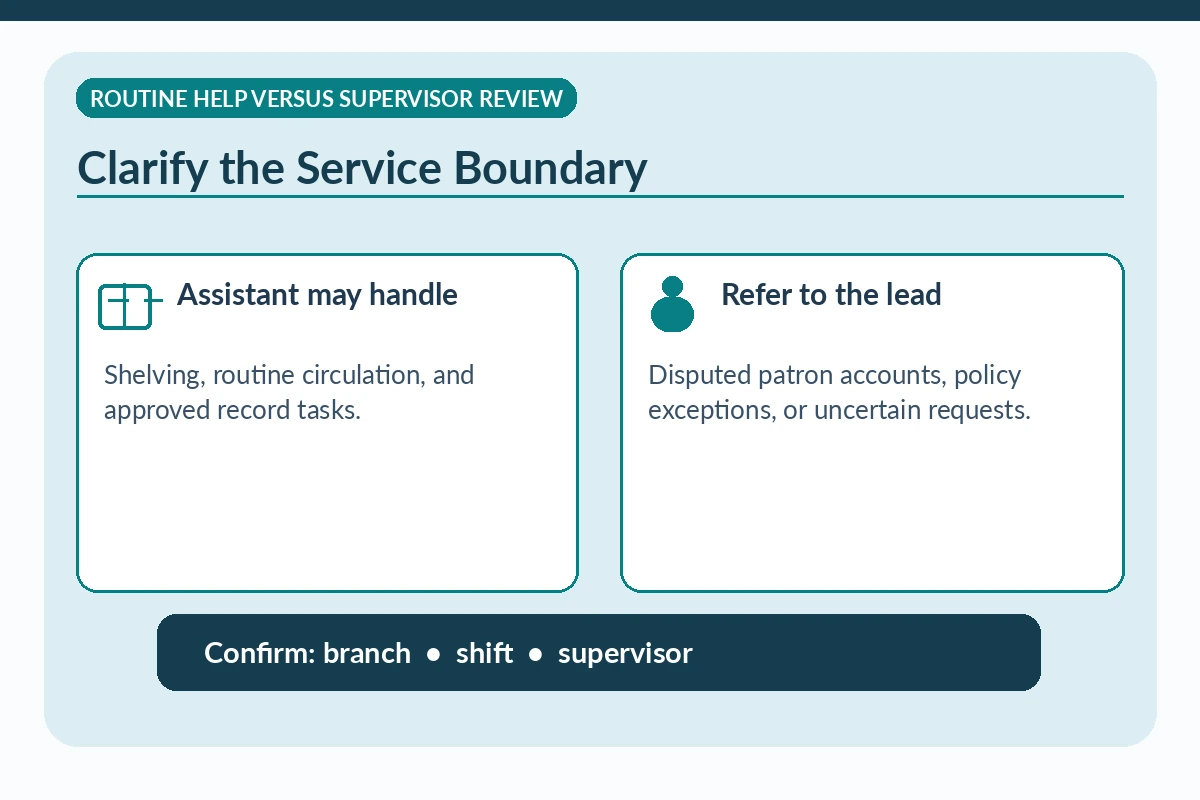
Complete a Role-Specific Before-Reply Audit
Read your final reply and verify four separate facts: the branch and department, the duties you are accepting, the hours you can actually cover, and the manager who will train or supervise you. In particular, resolve any conflict between a listing that says “weekday” and an interviewer who mentioned regular Saturday coverage. Keep the agreed version of the schedule in the same thread or formal letter where possible.
If the employer has not answered a material question about weekend rotation, patron-account permissions, or whether your first shift is training, ask for a specific response before committing. If the details match and the employer has supplied the offer terms, accept concisely and meet the stated deadline. A short factual acceptance is stronger than promising that you can handle every library inquiry without help.
How We Research Role-Specific Job Offers
Sources checked on 2026-11-15: O*NET Library Assistants explains relevant work tasks; Harvard Career Services advises acknowledging offers, examining written terms, and confirming deadlines; UW–Madison SuccessWorks recommends confirming details in a formal acceptance. We use occupational profiles only as comparisons, not as proof of what this employer promises. All emails and workplace situations here are hypothetical. For job-offer impersonation and payment warnings, we also consulted FTC Consumer Advice. We do not have a relationship with a hiring employer. For site disclosures, see Affiliate Disclosure.
Related Workplace Guides
Request the normal schedule and any recurring evening or weekend rotations before accepting. Opening hours on the public website do not tell you which shifts your position must cover.
Not necessarily. Ask whether routine circulation questions are part of the role and which research, policy, or patron-account issues should be referred to a librarian or manager.
You can accept a role that offers appropriate training if the hiring requirements fit your experience. Be explicit about the software you know and ask who provides supervised practice.
Clarify which branch is your primary site, whether rotations are required, and whether the written offer reflects the agreed location before you confirm acceptance.
Retain the offer and acceptance, confirm receipt if necessary, complete instructions through official employer channels, and ask where to report for orientation and training.