
Before accepting a grant-funded nonprofit or research position, read the offer’s actual appointment term and ask what the employer means by ‘grant-funded.’ The funding source, your employment classification and any stated end date are related but not identical. One employer may hire into a regular position supported by grant money; another may offer a fixed-term appointment that ends unless funds and approvals remain available. Do not infer that the grant expires on the same date as your position, or that a hoped-for renewal is guaranteed. Ask the hiring contact to explain the organization-specific arrangement in writing.
Do not confuse the funding source with appointment type
A position paid from a grant account is not automatically identical to a temporary employment contract. UC Berkeley’s HR FAQ explicitly distinguishes positions funded by grants from employment-contract appointments for its own internal processes. That illustrates why labels alone are unreliable. Check the offer for a job title, employer, reporting line, start date, classification, any fixed end date, and statements about continuing funding.
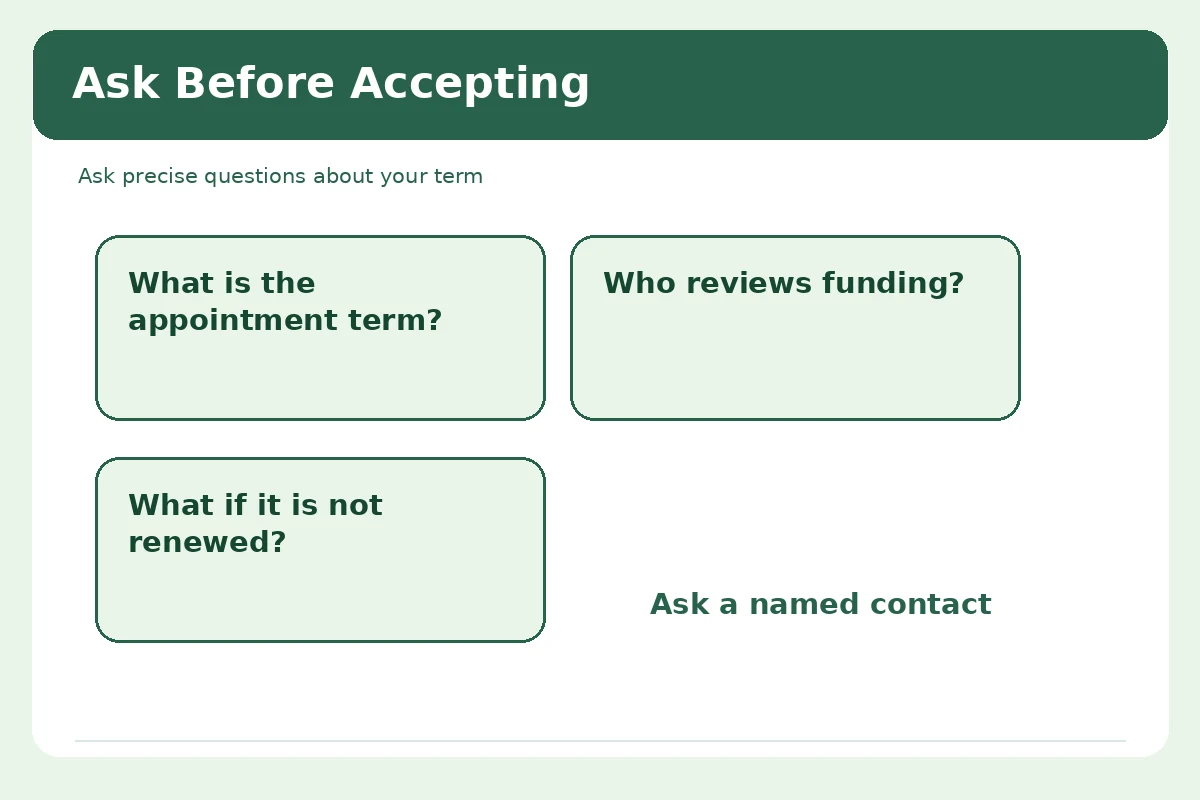
Ask a plain question: ‘Is this a regular position currently supported by an award, or a time-limited appointment with a defined end date?’ Follow with ‘If it is time-limited, is the end date stated in the written offer?’ Do not accept ‘the grant runs for a while’ as a replacement for a clear answer about your own appointment.

Map the grant, project and work dates separately
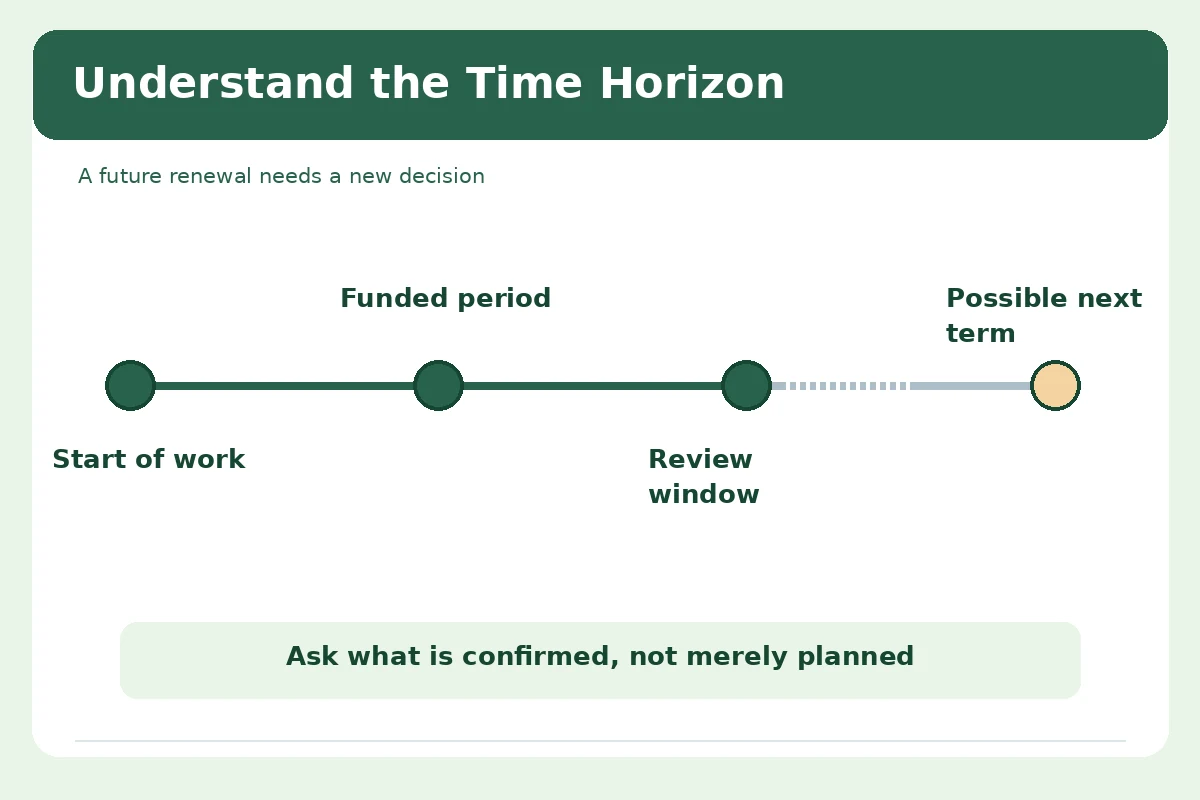
A grant award can have reporting and spending dates that are different from the calendar of an individual employee. The funded project might start before you are hired and continue after your specific work ends. Build a simple timeline with your proposed start date, any stated appointment end date, project milestones, funding review point and scheduled discussion of continuity. Mark each item as confirmed or still pending.
Some organizations describe renewal as subject to external funding and operational need. Georgetown’s Beeck Center publicly explains its own externally funded term-employment model, while Brandeis publishes a specific policy for ending certain grant-funded positions. These examples show that institutions use different practices; neither is a universal rule for the employer making your offer. Request that employer’s own written terms.
Ask what renewal actually depends on
A recruiter may say that funding usually renews. Treat that as context, not a promise. Ask who makes the renewal decision, approximately when it is reviewed, whether the position itself needs approval and what happens if another award is not obtained. The employer may be unable to give a firm answer about future grants; it should still be able to distinguish current confirmed terms from scenarios that depend on future funding.
Avoid converting general optimism into a statement like ‘guaranteed extension after one year.’ If your offer includes a fixed term, an option to extend is not the same as an automatic extension. If continued employment is a critical requirement, decide whether the certainty actually offered meets your needs before sending a final acceptance.
Review the actual work and reporting obligations
Grant-funded teams may combine public-facing activities, records, coordination and progress reports. Ask which tasks belong to your role, who approves spending and deliverables, and whether you work with sensitive participant data. A role that supports budget tracking is not necessarily authorized to approve expenditures; an outreach assistant is not automatically permitted to make clinical, legal or financial decisions. Make the boundaries visible before agreeing to the job.
If you will interact with a funding partner, ask who is the official contact and what documentation you are responsible for producing. Clarify whether you will inherit an existing project or help launch a new one and what training will be provided. Your acceptance can mention the program and supervisor, but do not promise outcomes, renewed donations or funding that neither you nor the organization controls.
Compare the offer against your continuity needs
Imagine a hypothetical eight-month appointment supporting a community program. The hiring team hopes to secure another year of support, but a renewal decision has not been made. The honest comparison is eight months of stated work plus an uncertain possibility of more, not an assured twenty months. Build your personal decision around the confirmed term, any practical relocation or schedule commitments, and your ability to plan if the position ends on time.
A shorter appointment can still provide meaningful experience and a fair fit. The question is whether its documented duties and term meet your goals. If you would only accept with guaranteed additional time, ask whether the employer can actually make that commitment. Do not invent a funding schedule or demand access to confidential donor records that the organization cannot share.
Reply with a term-specific acceptance or targeted question
Illustrative acceptance: ‘Thank you for offering me the Program Coordinator position. I am pleased to accept the appointment beginning on the agreed date and understand the term stated in the written offer. I appreciate the explanation that any renewal would require a separate decision. Please let me know the next onboarding steps and who will confirm the initial project priorities.’ Include the exact term only if it appears in your real offer.
If the letter does not say whether your appointment has an end date, ask before accepting: ‘Could you confirm whether the grant-funded description changes the position’s appointment term, and whether there is a specified end date?’ Request the employer’s written response and make sure any substantive correction is reflected by the authorized hiring team.
Store the documents that describe the real commitment
Save the offer, any formal term or contract, the final written acceptance and the employer’s explanation of the funding arrangement. Keep planned review points in your own calendar without treating them as promised renewal dates. During onboarding, ask who handles project changes and whether you should document work against specific grant deliverables. Follow the official process for project data and funding records.
Do not imply that a public grant listing is your employment agreement. External materials can help you formulate questions, but the employer’s written terms and the applicable policies are what you must evaluate. If a dispute arises about legal rights or termination, qualified advice for the applicable jurisdiction is more appropriate than a generic online article.
How We Research and Verify Offer Advice
This guide compares advice from official university career centers and relevant U.S. government or institution sources with the separate issues raised by accepting a grant funded job offer. The cited policies are examples from their own organizations, not terms automatically governing your employer. Dates, benefits, work classification and legal requirements depend on the actual written offer, applicable rules and the responsible hiring contact. Hypothetical emails and scenarios are labeled as examples; no salary, hiring outcome, or future renewal is promised.
Research sources (checked November 10, 2026): hr.berkeley.edu (A grant-funding source and a formal appointment term are different concepts.) www.brandeis.edu (Example of an employer policy governing grant-funded roles when funding ends.) beeckcenter.georgetown.edu (Example of term employment tied to external funding and conditional renewal.) nonprofitwa.org (Nonprofit employer guidance on communicating terms, job classification and schedule.) careers.bu.edu (Written offers, supervisor and start-date details, and timing of a reply.). These are editorial references, not endorsements or a substitute for official employer paperwork. Read our affiliate disclosure; this article does not claim an affiliate arrangement.
Related Workplace Guides
Not necessarily. Funding source and appointment type are distinct concepts. Read the exact appointment language and ask whether there is a stated end date.
No. A plan or hope to renew is different from approved funds and a written employment commitment. Ask who decides renewal and when the decision is expected.
Yes. Ask about the confirmed appointment term, program priorities and continuity process without insisting on confidential donor information.
If a fixed-term appointment is being offered, the candidate should request the employer’s clear written description of the term. Specific document requirements vary.
Reference the actual stated appointment and start date. Avoid inserting words such as permanent, guaranteed renewal or indefinite unless the employer has confirmed them.