
A payroll clerk resume objective should say which payroll or timekeeping work you can support and what experience proves that readiness. An applicant may have checked hours, reconciled spreadsheets or handled restricted employee records without independently running payroll or authorizing corrections. Those are meaningful distinctions. Build the opening around a verified task, the requested clerk role and careful review of discrepancies. Avoid inflated phrases such as “payroll compliance expert” when your background is limited to entry or support work.
Start With the Timekeeping Problem the Employer Needs Solved
Examine the vacancy for its central workflow: collecting timecards, entering hours, matching approved leave, checking overtime flags, preparing payroll inputs or answering employee questions. Payroll assistant, payroll coordinator and timekeeper can mean different scopes at different organizations. An objective that merely says “detail-oriented professional seeking growth” ignores those differences. Use the opening to show that you understand accuracy, deadlines and confidentiality matter to the position, while keeping your claim within the tasks you actually know.
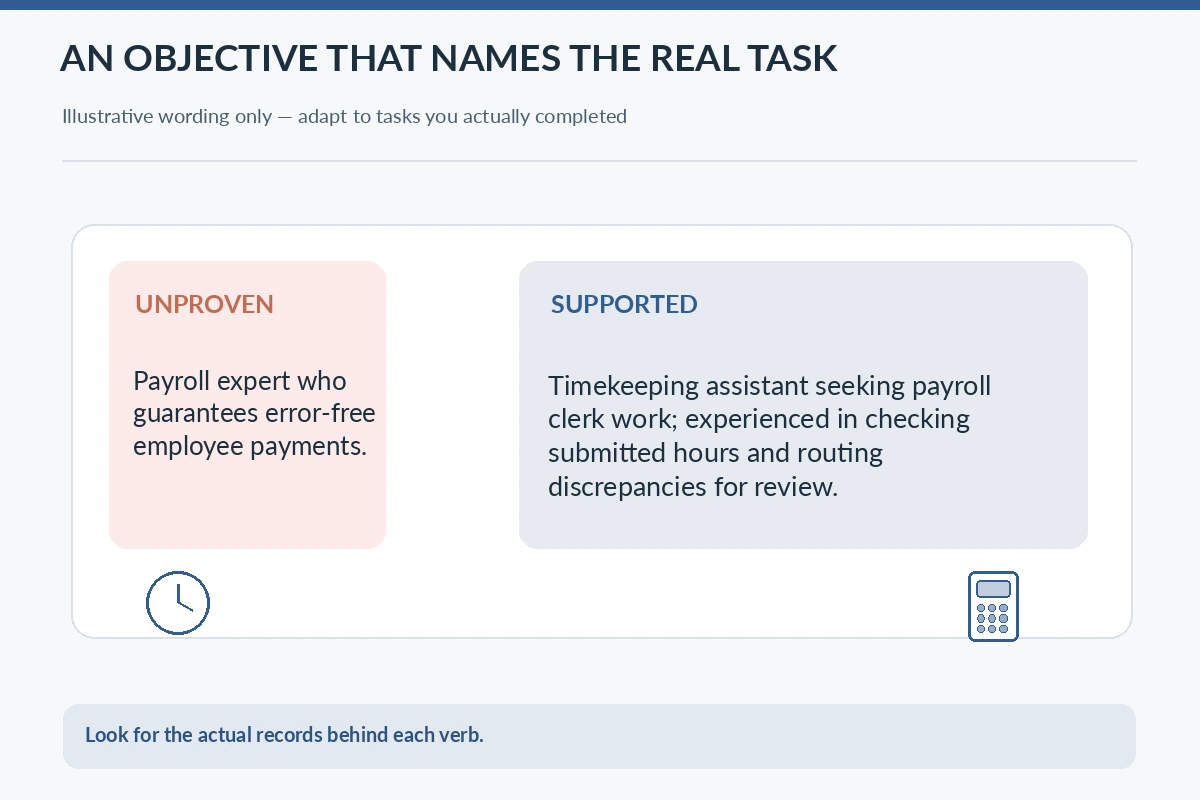
A hypothetical person who checked attendance sheets could write: “Administrative assistant pursuing a payroll clerk role, bringing experience reconciling weekly attendance records and following an established approval process for corrections.” A person with a genuine payroll internship might name verified payroll data entry instead. Neither statement promises independent tax interpretation or final approval authority. If you have not used the listed payroll platform, omit the platform name or state clearly that you are seeking training. A targeted objective should reduce uncertainty, not introduce a new unsupported claim.
Choose Credible Examples From Records and Reconciliation
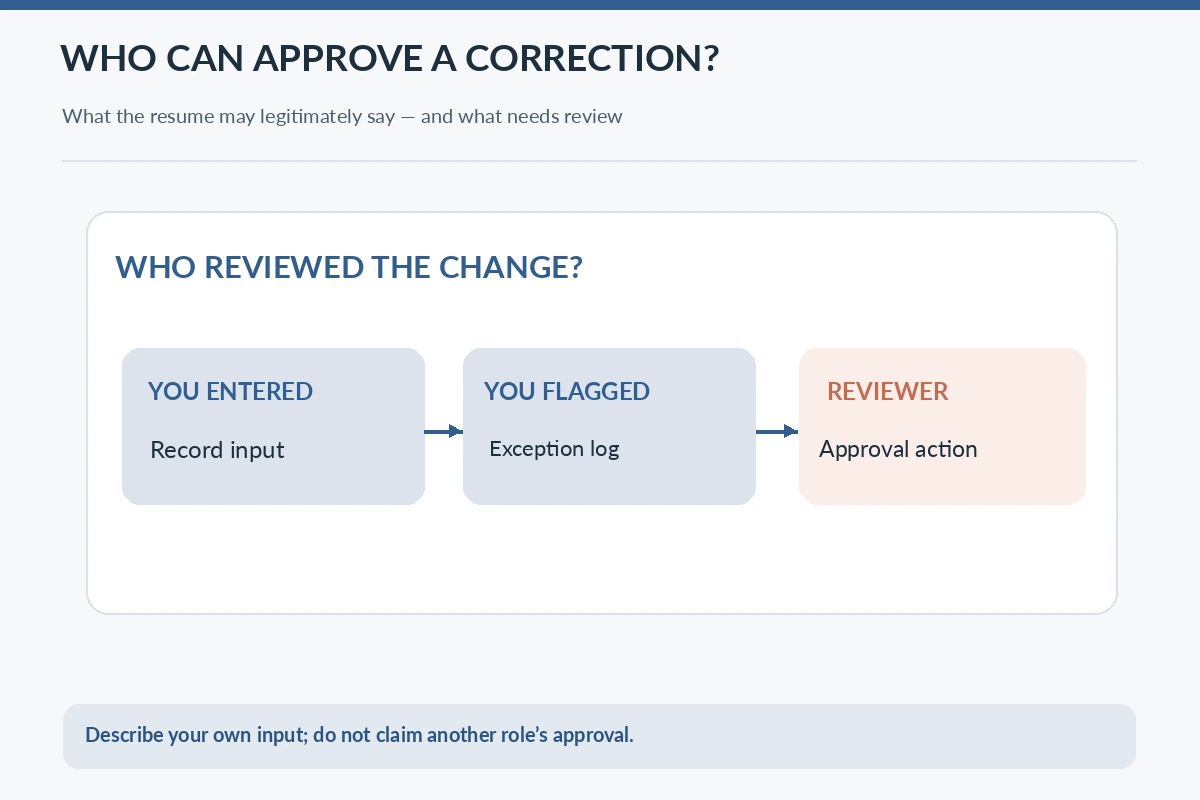
Useful evidence comes from an actual record you were allowed to maintain: matching work schedules to submitted hours, entering approved leave, reviewing missing sign-offs or checking a spreadsheet for duplicate entries. Describe how you identified an exception and who reviewed it. For example, “Flagged incomplete time entries for supervisor review” is a narrow, credible duty; “fixed payroll for the company” could imply authority you did not have. Proof can come from an administrative placement, internship, student employment office or small business role.
Before mentioning numbers, find the real source. Do you know the number of entries you checked, or are you guessing based on a busy week? If no reliable figure exists, describe frequency or process instead: “Maintained weekly timesheet logs for a multi-shift team” only if you did. Do not publish coworkers’ wages, employee IDs or private time records as sample work. A hiring manager can evaluate your method from a de-identified description of the task and the control points.

Separate Processing Tasks From Payroll Approval
O*NET lists several tasks for this occupation, from data entry to processing checks and reconciling reports. That list does not prove every entry-level clerk has every permission. Ask what is done by a clerk, what requires a payroll specialist and what receives manager approval. If you prepared inputs but did not release payments, the objective should say “supported payroll preparation” rather than “executed payroll.” Accuracy in the distinction is especially important when discussing deductions, employee changes and adjustments.
An objective can convey responsibility without exaggeration: “Payroll support candidate with experience reviewing submitted hours, documenting discrepancies and routing changes for authorization.” If you completed a bookkeeping course or practiced with a simulated payroll exercise, label it coursework, not an employer’s production system. Be equally clear about software: experience with spreadsheets, a training database and an enterprise payroll platform represent different skill levels. Employers can train new systems; they still need truthful descriptions of your starting point.
Rewrite a Vague Objective Into a Verifiable One
Before: “Experienced payroll manager with strong leadership and accounting skills.” After, for a hypothetical office assistant: “Office administrator seeking a payroll clerk role, offering weekly timesheet reconciliation, careful spreadsheet checks and experience escalating missing approvals.” The revised line is useful because it names an actual task, a target job and an approval boundary. It is not suitable for an applicant who never reconciled timesheets; that person should substitute their own evidence, perhaps accurate invoice entry or other recordkeeping.
Try a second version for a new graduate: “Accounting coursework graduate seeking an entry-level payroll clerk position, with verified practice exercises in wage calculations and record reconciliation and a strong interest in controlled payroll workflows.” Coursework must genuinely include those exercises. Do not invent a grade, certification, accuracy percentage or expected payroll outcome. The goal of an objective is to invite a review of evidence, not to perform as an unverifiable marketing claim. The following sections should clearly distinguish school practice from paid payroll work.
Place Training, Systems and Confidentiality in the Right Sections
An objective is too short to hold every software tool and every accounting class. Use the Skills section to list applications you actually used, and Education or Training for the relevant course title and date. Show the employer how recordkeeping experience transfers: a weekly accounts payable log can support a claim of careful data entry, but it is not direct payroll experience. If you handled personal information, describe the control you followed—restricted access, approved routing or secure storage—without revealing the information itself.
Tailor the remaining resume to the work environment. A multi-location employer may emphasize different timekeeping schedules or exceptions, while a small organization may need broader administrative backup. Do not present broad experience as permission to make final pay decisions. If the announcement requires experience with a specific HRIS or tax procedure, check whether your own background satisfies that requirement. If it does not, the objective can still reflect trainable strengths, but it should not disguise a missing required qualification.
Check Every Claim Against the Approval Chain
Review the objective word by word. “Reviewed,” “flagged,” “entered,” “prepared” and “approved” are not synonyms. Pick the verb you can defend in an interview. If a manager signed off the correction, say you prepared or routed it. If a specialist calculated withholding, do not present their decision as yours. Confirm that employer names, dates and any system access described elsewhere are accurate. A short, cautious opening can be more persuasive than a broad claim contradicted by the work history.
Read the objective with the actual job description side by side. Keep only the two highest-value strengths and one clear target. Then test the whole resume for confidential information: no employee pay details, screenshots of live payroll systems, real IDs or internal reports. Use a hypothetical anonymized example if you need to show a workflow. A payroll clerk objective should signal someone who knows that clean records and proper review are part of the job, not obstacles to it.
| Activity | Possible evidence | Boundary to confirm |
|---|---|---|
| Time entry | Match original records | Keep source and date |
| Discrepancy | Flag and document | Name reviewer |
| Payment release | Authorized payroll staff | Do not claim approval |
How We Research and Verify These Objectives
We compared CareerOneStop guidance on targeted resume objectives with Harvard resume guidance and occupational descriptions from O*NET and, where relevant, the U.S. Bureau of Labor Statistics. All sample objectives and resume statements here are explicitly hypothetical. They are not employer endorsements, actual candidate results or promises of an interview. Facts and source pages were reviewed on 2026-11-05. Requirements vary by posting, employer and jurisdiction. Please consult the exact vacancy and licensing authority where applicable. Our affiliate disclosure explains the site policy.
Research sources: CareerOneStop resume advice — CareerOneStop explains that a tailored objective may help someone with little direct experience and should highlight actual education, skills, and professional interests.; Harvard resume guidance — Harvard career guidance emphasizes relevant evidence, clear language, accurate action verbs and a readable resume.; O*NET occupation profile — O*NET identifies time-sheet review, payroll records, discrepancy checking and documentation among payroll/timekeeping clerk tasks.; O*NET occupation profile — O*NET details how timekeeping records, reconciliation, payroll documentation and processing tasks differ across clerical work.. These sources identify common duties and resume principles; they do not certify the accuracy of any individual applicant’s experience.
More Resume and Cover Letter Guides
Some employers train entry-level hires. State your actual spreadsheet, timekeeping or records experience and check each vacancy for required systems rather than claiming software proficiency you lack.
No. Reviewing, entering and routing corrections may be support tasks; calculating and releasing payroll can involve different approvals. Describe exactly what you performed.
Yes, if you label the exercises as coursework and identify the relevant calculation or reconciliation practice. Never reclassify classroom work as employer payroll responsibility.
Avoid identifiable compensation details and private records. Explain your control process using anonymized or hypothetical examples instead.
The target clerk role, a demonstrable recordkeeping or reconciliation strength, and a truthful description of your approval or training scope.