
An acting resume with no credits should not look like a standard office resume padded with invented productions. For a beginner audition, make it easy to see your real training, any school or community performances, and special skills you can demonstrate. If you have genuinely never appeared in a production, omit the credits section for now; a short, accurate page is more useful than a false list of film roles. This guide is for U.S. beginner actors preparing a truthful resume, not a promise of casting success.
Choose the audition format before listing experience
Start with the casting notice. Stage, screen, voice-over and educational performance opportunities can request different materials. A theater audition may value stage roles and movement or voice study; a screen submission may ask for a self-tape, headshot or reel. Follow the actual submission instructions rather than using a single oversized general employment resume. Give your professional name, a reliable contact route and representation details only when true. Use a simple clean layout that a reader can scan quickly. If a company specifies a print or digital format, follow that instruction instead of treating one resume dimension as universal.
Decide what deserves a genuine performance credit
A real school play, community theater role or completed student film may belong under an accurately named section when you actually participated and have permission to mention it. A class exercise, private rehearsal, audition you did not book, or a production you only watched is not a performed role. For each possible credit, verify the production name, your role, the producing group and whether the work was staged or recorded. Do not invent a director, theater, billing category or release. If all you have are classes, move straight to training rather than printing an empty Film section or creating a grand-sounding credit for a scene study.

Build a training section with specific instruction
Training can carry a beginning actor’s page. Name a completed workshop, scene-study course, movement class, speech class or school theater program with its actual provider, subject and completion status. If training is ongoing, say ‘currently enrolled’ when that remains accurate rather than describing the course as finished. Short informal practice can be described as independent preparation only if a specific audition or portfolio truly calls for it; it is not the same as instruction by a coach. Prioritize work relevant to the role you want: an on-camera class is more informative for a film audition than an unrelated list of every school course.
Show a real beginner layout without false roles
Hypothetical example for an applicant who has taken classes but has no performance credits: ‘Avery Morgan | Chicago area | professional contact email | non-union, if accurate.’ Next: ‘TRAINING — Introductory Scene Study, community arts center, completed 2026; Voice and Diction, college course, completed 2025.’ Then: ‘SPECIAL SKILLS — piano, intermediate; Spanish, conversational; swimming, competent.’ There is no invented movie, contract or famous school. For someone who actually performed in a school production, a verified credit might read ‘Our Town | Ensemble | Northside High School Theater, 2025.’ These are fictional examples, not claims about a real actor.

Audit special skills before publishing your page
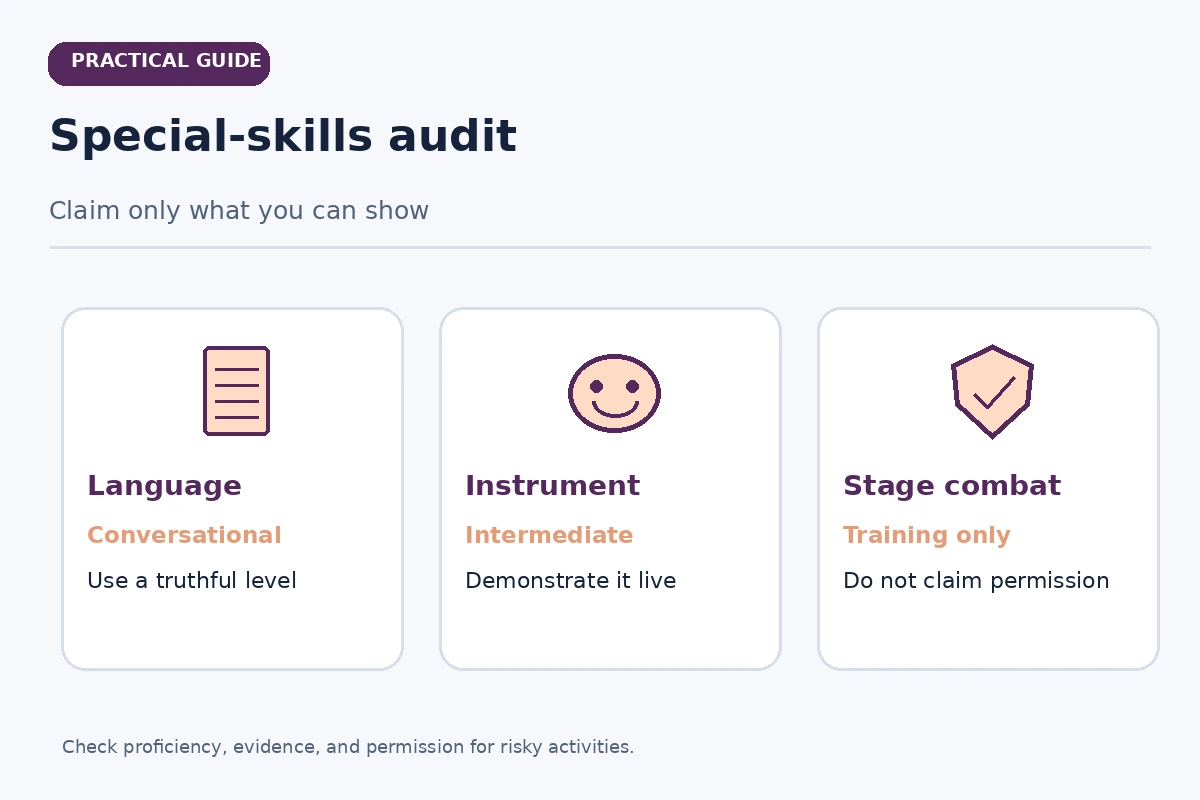
Special skills should survive a practical test. Can you perform the accent, speak the listed language, play the instrument or demonstrate the skill without extensive preparation? If not, use a truthful proficiency qualifier or leave it out. Do not claim stage-combat certification, stunt authorization, professional dance training, driving classes or union membership you do not have. Name only the specific ability relevant to performance, such as ‘read music’ instead of the vague ‘musical.’ A casting request could involve physical risk; describe past supervised training without implying you are qualified to perform a hazardous action independently.
Keep headshots and reels consistent with your resume
A headshot and a resume should identify the same performer and provide the same reliable contact path. Use a recent, accurate photograph, especially where the submission requires one. If you have a reel, label the scenes and your contribution clearly; a self-filmed practice scene should not be presented as a credited professional production. Some auditions request a self-tape directly rather than a reel. Check framing, audio, access permissions and file type from the notice before sending. Do not post classmates’ footage or private scripts without authorization merely to fill a media portfolio.
Protect your contact information and verify the notice
Use a professional email and a casting-safe contact method. Avoid a home street address, identity documents, private school details for minors or unrelated personal information. Never assume that a casting call is trustworthy because it has an attractive logo or asks for a profile. Confirm the production or casting channel independently, read fees and audition conditions carefully and tell a parent or guardian where appropriate. Do not pay an unfamiliar contact simply to secure a promised acting job. The resume itself should contain only what the legitimate selection process needs to evaluate your readiness.
Perform a final credit-by-credit and skills audit
Before exporting, ask three questions about every line: Did I personally do this? Can I describe or demonstrate it? Is the label clear about school, student, community or professional scope? Check spelling of productions and instructors, link access, phone or email, visual alignment and length. Keep a separate private list of audition dates and practice notes so the resume remains concise. When you earn a real new credit, update the page with the actual project and role. O*NET emphasizes auditioning, rehearsing and collaboration; your entry-level material should show readiness to do those things without claiming they have already produced a professional booking.
Use a practical no-credit review before applying
A practical exercise is to mark each line as a credit, a class, or a demonstrable skill. That single label resolves most beginner acting-resume confusion. Keep supporting notes private: a script title, date, the instructor or production, and your contribution. If a casting notice asks for a special format, adapt your resume to that request without altering the underlying facts. Short, accurate, and easy to contact is a stronger first impression than impressive-looking but uncheckable claims.
How We Research Entry-Level Resume Guidance
We compare official occupational descriptions and other relevant primary guidance with the narrow application intent, then build examples that mark training, permission, experience and credentials separately. Every sample person, project and resume bullet in this article is hypothetical; adapt examples only to events you can verify. We do not predict hiring outcomes or promise a particular applicant-tracking result.
Sources consulted November 11, 2026: onetonline.org — O*NET describes actors rehearsing scripted roles, auditioning, collaborating with productions, and preparing self-recordings.. backstage.com — Backstage explains how beginners may show verified school or student work and acting training without exaggerating professional credits.. backstage.com — Backstage provides guidance on truthful novice acting resumes, transferable performance experience, and relevant training..
This article is informational editorial guidance, not an employer endorsement. See the JobAsk affiliate disclosure for relationship and link policies. The internal next steps below are not paid recommendations.
More Resume and Cover Letter Guides
Lead with actual classes, training and testable special skills. Omit the credit section rather than inventing a short film or a character role.
Yes, if you genuinely appeared and can accurately name the production, role and school theater group. Clearly distinguish school work from professional credits.
No. A class scene is training or practice unless it was genuinely produced and credited as a project. Label practice material honestly.
No. A self-tape is usually a response to a specific audition request. A reel is a collection of sample footage; identify self-produced clips accurately.
Only if relevant to the casting instruction, and only accurately. Never describe yourself as a member of a union without actually holding that membership.