
An actuarial internship cover letter should connect a real numerical project with the insurer or consulting team’s work while keeping exam progress precise. Start with the position and a verifiable example: what data you used, which assumptions you tested, and how you checked an output. A student does not need to claim independent rate setting or a credential not yet earned. Use this guide to build a short letter that distinguishes classroom analysis from a reviewed professional decision, and tailor it to the actual posting rather than copying actuarial jargon. Treat every writing sample in this guide as hypothetical, not a claim about your own experience. Start with the requirements on the actual internship posting, the permitted application format, and your truthful contribution to a relevant class, club, or independent project. A cover letter complements a resume: it selects one defensible example and connects that example to a task, rather than repeating every course or job title. If the employer does not request a letter and the portal has no place for one, follow the instructions rather than adding unsolicited files.
Read the specific internship tasks before selecting evidence
Read the posting for tasks such as cleaning claims-related data, preparing spreadsheets, validating inputs, documenting calculations, or assisting analysts with reports. Separate tools you have used from tools the employer merely names. If a role asks for Excel and a programming language, a spreadsheet sensitivity model can be relevant even when you have not used the employer’s proprietary platform. The application should explain your contribution to the student project, not imply you handled insurer policyholder information.
Look closely at the practice area named in the announcement: life, health, retirement, property and casualty, or consulting. Different teams ask different questions. Your first paragraph may refer to mortality assumptions, reserve analysis, benefit calculations, or loss trends only if you understand and can discuss them. A general claim that you ‘love numbers’ is weaker than a statement that you tested how one changed assumption affected an estimate. Never invent a client assignment to create a better fit.
Choose one credible project and preserve the review boundary
Choose one course assignment with a known input, a method, and a check. For example, a hypothetical class exercise might compare projected costs under different frequency assumptions. Explain that it was a class exercise using supplied or simulated data. Say what part you built: cleaning rows, writing formulas, checking edge cases, or explaining an observed sensitivity. The distinction matters because a polished chart does not establish that its assumptions were approved for real insurance use.
If you mention exams, name only an exam you have actually passed and identify other stages accurately: scheduled, registered, preparing, or planned. Do not describe an exam as passed because you have taken a course covering similar material. If your program did not require an exam yet, emphasize statistics, probability, finance, versioned calculations, or reproducibility instead. The BLS describes a pathway involving a series of professional examinations; a cover letter should never turn that general pathway into a false personal certification.

Write a targeted opening and a complete example
A useful opening is more specific than ‘I am passionate about actuarial science.’ A hypothetical opening: ‘I am applying for the actuarial internship with [team]. In a probability modeling course, I built and checked a spreadsheet comparing scenarios under changed assumptions, then summarized where the estimate was most sensitive. I would welcome the opportunity to support your analysts with careful input checks and documentation.’ Use this only after replacing the bracketed information and confirming the project truly occurred.
Hypothetical letter excerpt: ‘Dear [Hiring Team], I am interested in the [internship] because the description emphasizes model review and clear analysis. In [course], I used [tool] to organize a supplied dataset and compare [two defined assumptions]. I checked formulas against [a manual test or instructor review] and documented where the results were uncertain. I have [accurate exam status, or omit this sentence]. I would value an opportunity to contribute careful documentation and learn your review process. Thank you for considering my application. Sincerely, [Name].’
A good application letter usually needs only a focused opening, one evidence paragraph, a clear statement of fit, and a polite close. The example above is deliberately hypothetical; bracketed fields are not facts. Replace each with your own course, team, tool, artifact, and actual result. If there is no named hiring manager, a professional team greeting is appropriate. Avoid making up the organization’s mission or personalizing the letter with details you cannot verify. Have someone read it without the job posting: they should still understand what you did and why that work relates to the internship.
| Letter section | What to include | What to avoid |
|---|---|---|
| Opening | Exact internship and relevant team task | Generic enthusiasm without a match |
| Evidence | One student artifact, own contribution, check | Inflated job title or invented result |
| Fit | Why that evidence suits the real posting | Copying the employer description |
| Close | Interest in supervised learning and thanks | Guaranteed outcome or demanded reply |
Keep professional authority and outcomes accurately described
Do not state that a student model determined a company’s premiums, reserves, solvency, or regulatory compliance. Unless you had genuine authority and documented experience, those are business decisions and regulated reporting contexts, not beginner achievements. Replace vague ‘predicted risk accurately’ with a checkable statement: you compared specified scenarios, examined sensitivity, or tested formula consistency. If you used public or simulated data, say so. Protect private customer information and never send internal spreadsheets from a past workplace as portfolio attachments.
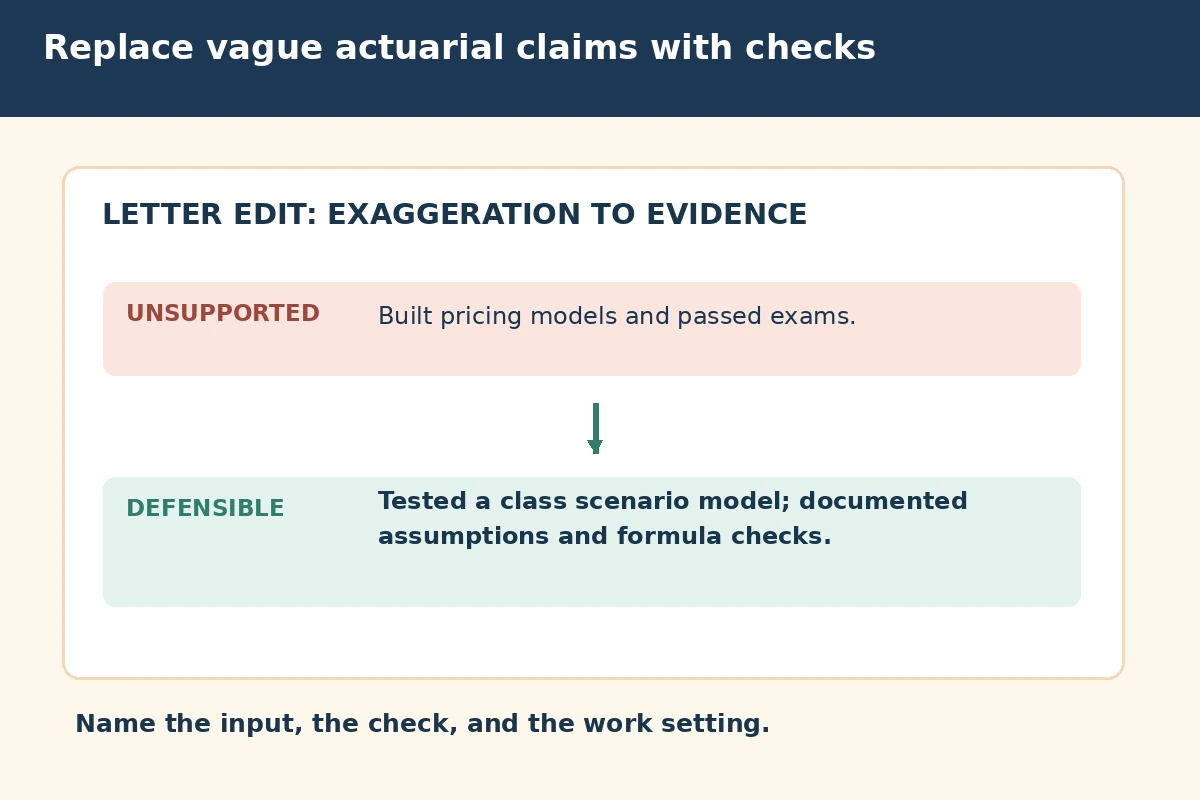
Common weak claims include ‘Passed all actuarial exams’ when only one is complete, ‘built a production pricing model’ for a class assignment, or ‘proved the forecast was correct’ without an external benchmark. These claims invite questions you cannot answer. A stronger sentence names the type of check and its boundary: ‘Compared the model’s output with a small hand-calculated example, then corrected a spreadsheet reference error.’ It is credible even without a flashy performance number.
Check the portfolio and application attachments before sharing
If attachments are allowed, a single sanitized project page can show inputs, assumptions, and one chart with a plain-English interpretation. Label simulated values and cite third-party data according to its license. Include formulas only when you are permitted to share them. A screenshot of a tidy worksheet is less persuasive than a brief explanation of what you checked. If the application portal accepts only a resume and cover letter, follow that instruction rather than trying to sneak in files or external links.
Separate evidence you own from work you merely saw or helped with. If a school assignment was collaborative, name the part you wrote, drew, analyzed, or coordinated. A working public link is not proof that a work sample may be redistributed: permissions, ownership, privacy and the employer’s portal instructions still apply. Avoid unnecessary personal details, private participant information, and invented logos. When an application asks for a specific file type or document order, prioritize its explicit requirement over general internet templates.
Adapt the evidence for different teams and internship formats
For an insurer-focused internship, emphasize careful data handling, audit trails and assumptions; for consulting, add concise explanations to a nontechnical audience; for pensions, refer only to calculations you genuinely studied. Ask your academic adviser whether an approved sample is shareable if it was coauthored. If you have no actuarial-specific project, choose a statistics or finance assignment with an explicit error check and describe its relevance without disguising the subject as insurance pricing.
A paid summer position, an academic-credit placement, and an independent internship can have different eligibility and scheduling requirements. Check the actual notice for student status, start date, worksite, expected hours, portfolio rules, and whether a university approval is needed. Do not write that a role awards academic credit, training hours, or professional credentials unless your school or governing body confirms the particular program. Those administrative terms belong in verified application details, not in an invented promise.

Make a final accuracy check before submission
Before sending, reread the letter with three colored marks: actual evidence, role-specific match, and claims that require proof. An exam date belongs in the letter only when current and useful; it should not crowd out a good example. Spell out an uncommon acronym once. Confirm that the recruiter name, internship term, application reference, and file format match the posting. Most importantly, make it easy for an interviewer to ask one follow-up about assumptions you truly understand.
Do one final pass for a mismatch between your claim and your evidence. A person interviewing you should be able to ask, “Which part was yours?” and receive a direct answer. Remove needless statistics, generic software lists, references to employer projects you have not verified, and unsupported claims about being “certified.” Test a PDF export for legibility and working links. Save the final version with a clear filename, then follow the application portal’s acknowledgement process. A polished letter may improve clarity, but it does not guarantee an interview or placement.
How We Research and Check Internship Cover Letter Advice
We checked the following primary professional and career-education sources on November 16, 2026: Actuaries analyze risk with statistical and financial methods; students use mathematical and analytical coursework and may take professional exams.. CareerOneStop explains when a cover letter is useful and how to connect skills to a specific employer need.. NACE career readiness competencies include communication, critical thinking, professionalism and technology.. We compared this subject with the supplied JobAsk WordPress list of both published posts and drafts, recent local JobAsk production batches, the original READY candidate set, and public search results. Those checks flag likely duplicate intents but cannot establish that an unlisted unpublished WordPress slug is available. Every email and example in this article is hypothetical: replace placeholders with documented personal experience and obey the specific organization’s submission rules. We do not claim that a letter produces a particular hiring result or that a portfolio meets every employer requirement. There is no paid product recommendation or confirmed affiliate promotion in this guide. Read the affiliate disclosure.
More Resume and Cover Letter Guides
No universal cover-letter rule requires a pass. Follow the specific posting and state actual exam status; coursework and careful analytical projects may be relevant depending on the employer.
Yes, if the exercise is honestly labeled simulated and you can explain the methodology. Never present a classroom model as an approved insurer model.
Only if the status is accurate and useful. Write scheduled or registered, not passed, and confirm the date before sending.
Describe what the spreadsheet computed, how you validated formulas, and which assumptions you changed. Software names alone do not demonstrate judgment.
Not without permission to disclose them. Use public, synthetic, or otherwise authorized examples and remove identifying information.