
Audiovisual event technician experience on a resume should describe the equipment you actually helped prepare, the checks you performed, and how you supported an event team when something changed. Specify whether you worked with microphones, screens, projectors, cables, playback systems or simple venue checklists. Do not describe yourself as an audio engineer, electrical installer or certified rigger simply because you assisted with a setup. Your useful contribution may have been accurate preparation, an orderly sound check, or a timely handoff to a senior technician—not ownership of the entire production.
Define the event, team and technical scope
Event AV support can occur in hotels, schools, conference centers, offices and performance spaces. Each has different responsibilities and levels of training. Start with the title you were actually given, employer or venue, and work dates. If you worked event-by-event for an agency, identify the real employment arrangement instead of implying continuous work at one venue. Add a brief line when necessary: “Supported meeting-room audio and projector setup under lead technician direction.” This makes the size and authority of the role understandable.
Name equipment at the level you used it. Saying “prepared wireless microphones and presentation screens for meeting rooms” gives better evidence than “managed advanced AV technology” if you were not responsible for engineering a system. A technician who assisted with loading cases and labeling cables should describe those duties, not invent live sound mixing experience. Distinguish the role from a producer’s decisions about program content or a venue manager’s decisions about staffing and event logistics.
Describe setup and breakdown as a controlled workflow
The most useful setup bullet names the assigned items, the preparation step and the check before a room opened. For example, an illustrative applicant could write, “Set out approved microphone kits and presentation cables, then reported missing accessories to the lead technician.” If you only carried equipment and organized storage, narrow the sentence accordingly. Recordkeeping, careful transport and the ability to follow a stage plan may be valuable, but they should not be made to sound like professional electrical installation or rigging.
During breakdown, focus on confirming that the equipment is accounted for and returned to its designated location, subject to your actual procedures. A clear bullet is “Logged returned adapters and packed assigned meeting-room equipment after events.” Avoid claims that you inspected electrical safety or certified the system for future use unless trained and authorized. The BLS describes a broad range of AV responsibilities across occupations; its list does not prove that every helper was permitted to perform all of them.

Explain tests without implying an engineering sign-off
A technician may perform a sound check, view a test slide, confirm a microphone is powered, or notice a missing connection under established instructions. Those are observable actions. Write “Performed assigned microphone and projector checks before scheduled sessions and informed the lead of issues” if true. Avoid “guaranteed flawless audio” or “certified venue systems.” If another team member approved readiness, preserve that distinction. Equipment can function in a rehearsal and still experience problems during a live program.
Where results are useful, use evidence you can substantiate: the equipment log was complete, the assigned test was recorded, or the problem reached the appropriate person before doors opened. Do not invent downtime reductions. If your employer tracked a real number of sessions or rooms and permits you to share aggregate figures, you may use those with a clear period. Never include customer recordings, private meeting slides or system credentials in a work sample solely to prove your experience.
Make live-event handoffs visible to employers
During an event, a support technician may relay a presenter’s request, signal that a connection needs attention, or route a fault to the operator who owns the sound or video system. A defensible bullet is “Communicated microphone issues to the lead operator and updated the event support checklist.” It shows composure and coordination without claiming you independently repaired equipment. If your assignment was to monitor a particular room, say so; if you were a runner between rooms, explain the handoff role instead.
Use one clear story about an equipment issue that does not identify a client or reproduce confidential material. Describe what you noticed, whom you informed, and the authorized next step. Do not frame a quick cable substitution as a certified electrical repair, and never imply you bypassed safety procedures to keep an event running. In technical support, knowing when to stop or refer an issue is often more relevant than pretending every problem was yours to resolve.

Tailor the same experience to different roles
For a conference AV position, prioritize microphone checks, room setup and show-time communication. For an equipment rental role, focus on inventory, kits and careful return records. For general operations support, describe schedule coordination, checklists, handoffs and precise tracking without relying on specialized jargon. Keep a short separate list of devices and software that you actually operated, such as a model of projector or a playback application, and add only tools relevant to the vacancy.
Do not copy qualifications from the posting into your work history just to match keywords. If a role asks for networked audio systems but you only used stand-alone speakers, explain your genuine skill and leave the advanced equipment unclaimed. If you completed a course, list it in training rather than pretending the class was a paid production assignment. A hiring manager should be able to ask follow-up questions about every technical noun you use and receive a calm, concrete answer.
Rewrite inflated experience into accurate support
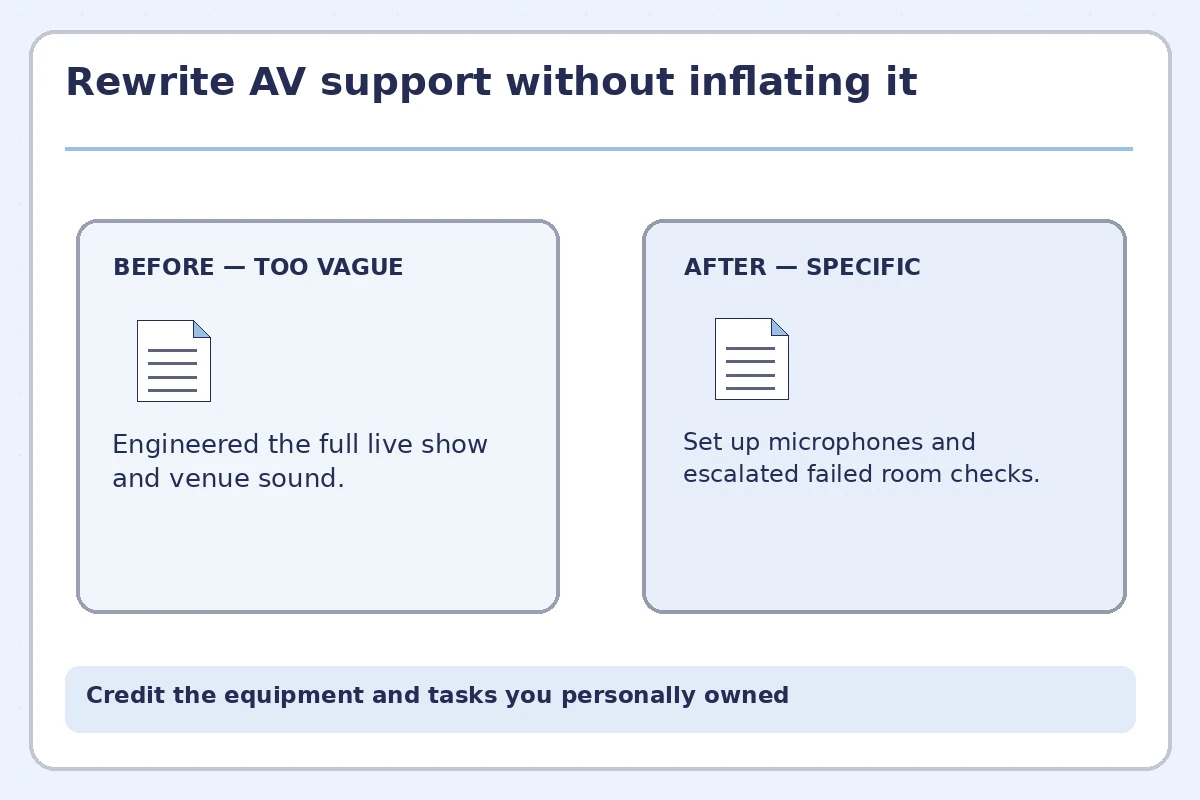
Weak: “Engineered and managed every aspect of live production.” Unless the worker genuinely held that responsibility, it masks useful junior-level work. A better hypothetical version is “Prepared presentation screens and microphones, completed pre-event checklists, and escalated technical issues to the lead operator.” The revision identifies tools, workflow and escalation. If you only prepared equipment, remove the troubleshooting part. You are allowed to sound competent without inventing an engineering role or an outcome you cannot prove.
Before sending the resume, verify the employer title, dates, event work arrangement and whether the term “technician” accurately describes the role. Check that images, recordings or customer names have not been included without permission. If your experience was intermittent, state the real contract or assignment dates rather than making it appear continuous. This level of precision prepares you to discuss a typical shift and demonstrates respect for technical and safety boundaries.
How We Research and Check These Examples
We compared occupational duties and established resume-writing principles against the primary resources below on 2026-11-10. The role-specific bullets and process diagrams in this article are fictional teaching examples, not verified employment histories, proprietary forms, sample patients, customers, students, donors, or real outcomes. The sources support the boundaries and common tasks; they do not establish what any particular applicant was authorized to do. BLS — BLS describes audiovisual setup, equipment operation, troubleshooting and variable technical training and tasks. CareerOneStop — CareerOneStop recommends accurate roles, dates, responsibility descriptions and relevant accomplishments in work experience. University of Colorado Boulder — University of Colorado Boulder discusses action, task and result statements, and nontraditional experience without title inflation. University of North Georgia — University of North Georgia recommends truthful titles, organization, dates, relevant work and reverse chronological presentation.
All examples are independent educational material, not employment verification or legal advice. Do not reuse personal records or protected workplace material in a portfolio. Review the JobAsk affiliate disclosure; this guide does not represent an approved paid partnership with the cited organizations.
More Resume and Cover Letter Guides
Yes. Describe the actual setup, checks, inventory or support work, including dates and whether it was employed, contract or volunteer experience.
Only when you really used them and the specific tool matters for the application. Do not imply operation of systems you merely observed.
That is useful support experience. Describe noticing issues, documenting them and handing them to an authorized technician.
Only if you truly had that authority. Otherwise describe the room, equipment or task you personally supported.
Use truthful dates and employer or agency information. Do not merge unrelated event periods into a fictional full-time job.