
List a bachelor’s degree on a resume by using the degree name shown on your transcript or diploma, your institution, your field of study and the date the degree was conferred. If you are still enrolled, label an expected graduation date rather than presenting a completed credential. For most applications, a short education entry is enough; choose extra details only when they clarify a qualification relevant to the vacancy. A degree is not the same as a major, a minor, a course of study or a college attendance record.
Copy the actual award from your academic record
Start with your official award: Bachelor of Arts (BA), Bachelor of Science (BS), or another designation granted by your institution. Write the institution name and the actual academic major rather than a more impressive-sounding approximation. The American Chemical Society advises using degree awarded, major, school and graduation year. If the diploma uses a different specialized title, use that exact wording. A recruiter should be able to compare your claim with the degree a registrar would verify.
For a hypothetical graduate, “Bachelor of Science in Biology — North Valley University — May 2025” is an illustrative education line. It is not a real school credential. A student who completed a concentration in data analysis should not turn that concentration into a separate degree. Check the terminology in your transcript; if the subject studied is not the formal degree title, label it as Major, Concentration or Minor as the institution does.
Distinguish completed degrees from current enrollment
If the school has formally awarded the degree, you may list the completion month and year. Finishing final examinations or participating in a commencement ceremony does not always mean the university has conferred the award. If conferral is pending, write “Bachelor of Arts in History — Expected May 2027” only if the date is a reasonable program estimate. You can also say “Degree in progress” and provide an expected month if the actual schedule is uncertain.
If you attended but did not graduate, do not write “Bachelor of Science” as an awarded credential. State the institution, the subjects you completed and attendance dates in a way that makes noncompletion explicit, such as “Coursework toward a BS in Business Administration, 2022–2024.” This article focuses on complete bachelor’s-degree records; use JobAsk’s separate unfinished-degree and degree-in-progress guides for situations where academic status is the main issue.
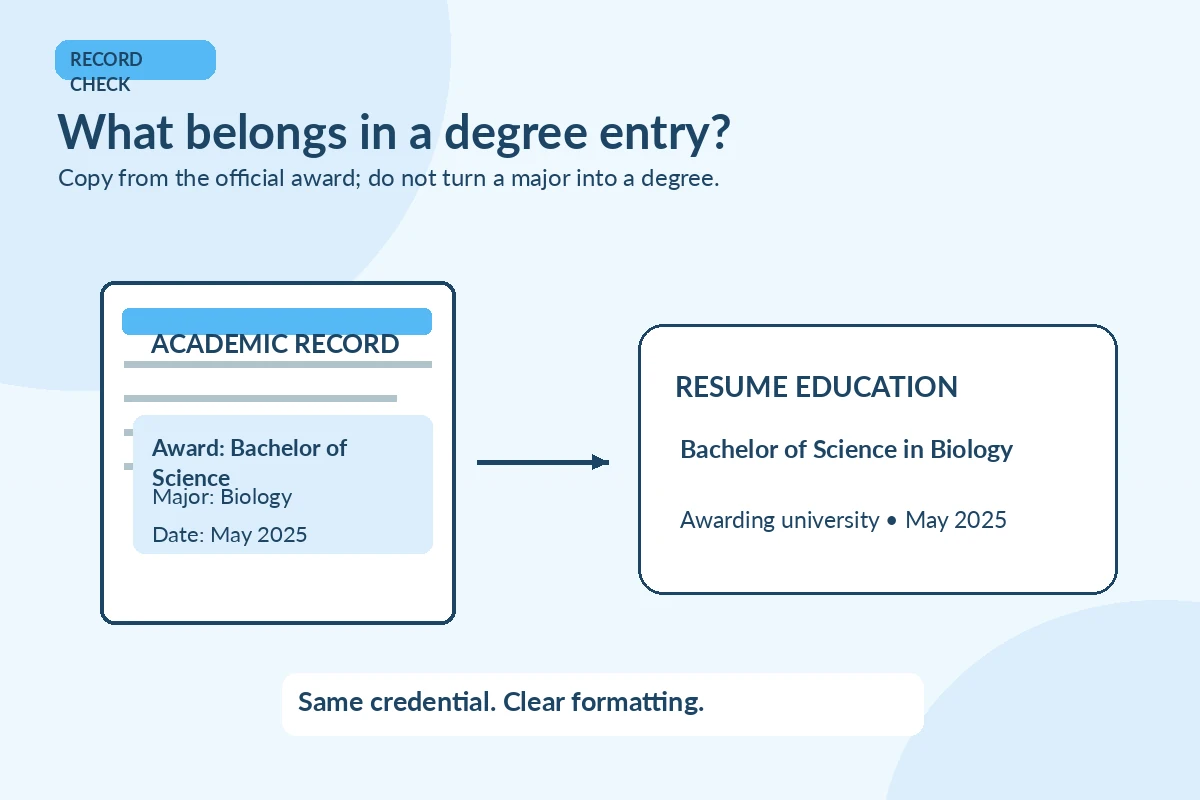
Keep majors, minors, and honors in their correct lanes
A double major is not necessarily a double degree. Some schools confer one bachelor’s degree with two majors; other students earn separate degrees under different rules. Read the registrar description instead of guessing from the number of subject areas. List an official minor only when it adds useful context. If a posting asks for a specific field, clarify whether your program gave you a degree in that field or a different degree with related coursework.
Honors may be worth a second line when recent and verifiable: for example, “magna cum laude” if the institution officially conferred it, or “Honors Thesis: [real title]” if relevant to a research position. Do not conflate an honors college program with Latin honors, or add an unverified ranking. The applicant’s role and project evidence usually deserve more space than a long list of academic distinctions.
Choose the location and name recruiters can verify
Use the institution that actually awarded the degree, not merely the school at which you spent the most semesters. If you transferred credits, the degree-granting college normally anchors the entry. If the university recently changed names, write its current official name and add its former name only where it would genuinely help a reader locate the record. A degree issued through an online program is still listed by its awarding institution and exact official credential.
For a school with multiple campuses, the campus might matter if it appears on the diploma or helps explain program accreditation; otherwise, resist adding unnecessary information. In most US resume conventions, city and state can be placed after the institution, but a remote or hybrid delivery mode is optional unless the job application asks for it. What matters most is an accurate, consistent, checkable education claim.

Decide which optional details earn their space
Relevant coursework can help an early-career applicant explain preparation for a specific role, particularly when the degree major is broad. Choose only completed or ongoing classes that actually map to job duties, and label courses correctly. A class project can be described under Projects when it demonstrates a concrete deliverable. Once substantial relevant work fills the resume, a concise one- or two-line education entry may work better than a long academic inventory.
GPA is not universally required. If you include it, distinguish cumulative from major GPA and use the scale and number that your institution reports. An American Chemical Society resume guide notes that recent bachelor’s graduates in chemistry may include a useful GPA and honors, whereas experienced candidates may omit it. Do not convert that field-specific example into a universal rule or manufacture a rounded number.
Verify a sample entry against the transcript
Suppose a fictional candidate earned a BS in Environmental Science with a minor in Geographic Information Systems. A defensible resume entry would include the university, the BS award, major, minor if relevant and the official graduation date. It would not say “BS in GIS” just because the candidate completed several mapping courses. Before submitting, review a copy of the academic record and make sure the date, school and field have not changed across application forms.
Check the resume and online profile together. A job application form may ask for degree level, major and exact conferral date separately. Use the truthful official record even if the form’s choices are awkward; explain the mismatch in any free-text field rather than selecting a degree you do not hold. If the employer asks for a transcript, follow its instructions and do not post student identifiers or records publicly.

Finish with a small education accuracy audit
Read the degree line aloud as a claim a registrar could confirm. Does “Bachelor of Science” appear as an awarded degree, is the field accurate, and does the date describe conferral or an openly identified estimate? Are honors and minors official? Are two degrees being incorrectly inferred from two majors? These checks catch more important problems than decorative resume formatting. A carefully labeled education section also helps interviewers ask better questions about related coursework.
Lastly, adapt placement to the reader. A recent graduate applying for a technical traineeship may put Education above Experience; an experienced applicant may lead with work achievements. Shenandoah University’s career guidance and the ACS both describe selecting education details appropriate to experience and relevance. The rule is not that every bachelor’s degree belongs at the top, but that it should be easy to find and accurately represented.
Compare the credential or experience with verified evidence
The comparison below is an editorial worksheet. It illustrates how to name your educational record, academic experience or application claim without exceeding what is documented. The real school, awarding body and application instructions determine your exact wording; examples in this page are fictional where labeled.
| Education situation | Truthful treatment | Avoid |
|---|---|---|
| Degree conferred | Official BA/BS title, major, institution, date | Changing major into degree |
| Still enrolled | Degree in progress; expected date if known | Calling it awarded |
| One degree, two majors | One award with both majors | Implying two awards |
How We Research Education and Resume Guidance
We reviewed the primary career-service, educational and occupational resources listed below on November 6, 2026, compared intended search purposes with the supplied JobAsk WordPress inventory, and checked current public search context. The examples are editorial illustrations, not actual academic awards, endorsements or hiring outcomes. Institution and employer policies always govern credential verification and permission to disclose student data. See the JobAsk affiliate disclosure.
Source references checked on November 6, 2026: www.acs.org — American Chemical Society career guidance on awarded degree, major, school, year, and optional academic details.; www.su.edu — Shenandoah University career guidance on education entries, minors, dates and section ordering.; career.ku.edu — University of Kansas advice on stating degree names, institutions and completion or expected dates..
More Resume and Cover Letter Guides
Either can be clear. Match the official degree and keep formatting consistent; write out the full title when ambiguity is possible.
Often yes, but it is optional when the institution is unmistakable. Prioritize official institution and degree details.
Yes, if officially recorded and relevant. Label the minor as a minor rather than another awarded degree.
Use the date the institution actually conferred the degree when available; the ceremony and award dates may differ.
Usually under Education after your stronger work evidence, unless a specific qualification is the main screening concern.