
Medical records clerk interviews commonly test whether you can locate and maintain the right record, protect patient information, and recognize when an access or amendment request needs an authorized reviewer. Prepare examples of verifying record identifiers, logging an issue, and making a careful handoff. Do not present yourself as a clinician, privacy officer, or person who can approve every release. The strongest answers explain what you check, what you document, and where you stop. Below are practice questions and sample responses, not transcripts from any particular hospital.
What interviewers may ask about record accuracy
A hiring manager may ask, “How would you keep records organized when two patients have similar names?” State that names alone are not enough to distinguish records. In a hypothetical answer, you would follow the organization’s authorized identifier and matching procedures, review available details within your permitted access, and stop rather than guess when a discrepancy remains. Explain how you would flag a possible duplicate to the correct health information team. Do not claim that you personally merge patient charts unless that is an assigned, trained responsibility.
Another question is, “Tell me about a time you noticed a document in the wrong folder.” For a real behavioral example, describe your role, what signaled the mismatch, how you protected the document from further exposure, whom you notified, and how you confirmed that the request had been routed. If you have no healthcare experience, use a non-sensitive class or office filing exercise and label the connection as transferable recordkeeping practice. Avoid stories containing identifiable patient details or screenshots from actual systems.
Practice a response about a record request
You may hear, “A caller says they need a relative’s record immediately. What do you do?” A sound interview response does not promise disclosure or give an invented universal policy. Explain that you would not release information based on a caller’s assertion alone; you would use the employer’s identity and authority verification process, identify the request channel, and refer questions outside your delegated responsibilities to the appropriate records or privacy staff. Ask the interviewer what workflow the organization uses instead of assuming all facilities use the same form.
Example, explicitly hypothetical: “I would start by listening and checking which request procedure applies. I would follow the established verification steps, log the request using the approved system, and route it to authorized personnel when the identity, authority, or requested material needs further review. I would not discuss the contents of a chart over an unverified call.” This answer shows appropriate judgment without turning a clerk into someone who decides legal entitlement in isolation.

Explain corrections without editing clinical facts
An interviewer might ask, “What if a patient tells you their chart contains a wrong address or medical fact?” Separate administrative updates from clinical documentation. An address change may have a defined verification procedure, while a disputed clinical entry typically needs a formal amendment or provider review process. Discuss identifying the relevant record, documenting the request in the approved channel, and explaining the next step without promising a specific outcome. HHS describes rights to request changes, but the exact steps and responsibilities vary by setting.
For an answer about your own mistake, give a real example of identifying it promptly rather than hiding it. State what was wrong, how you restricted additional use of the incorrect information, who approved the correction, and what you learned about double-checking before saving. A good answer is not “I never make mistakes.” It is a practical account of ownership, audit trail, and knowing which corrections you can make. Do not delete records to conceal an error or suggest that timestamps should be altered.
Use STAR while respecting patient confidentiality
A behavioral prompt may be, “Describe a time you handled sensitive records under a deadline.” You can use Situation, Task, Action, and Result to explain a real authorized task. Keep the situation general; name no patient, diagnosis, account number, or employer-secret system. Focus on the process you personally followed, such as confirming document destinations, using the correct work queue, and asking for clarification when information conflicted. The action is more informative than a dramatic story or an unsupported speed statistic.
Sample answer, hypothetical: “In an office practice project, two forms were labeled differently. My task was to organize the files without guessing which label was accurate. I compared the mock reference sheet, marked the conflict, and asked the instructor to decide how the project should be corrected. The final set had a documented explanation.” The project example is not a clinical achievement and should never be described as work at a medical facility. Replace it only with an authentic example you can discuss safely.

Prepare for questions about records systems
“Which electronic health record have you used?” is a test of honesty as much as software familiarity. Name systems only if you truly used them and specify your level of access: scanning, indexing, retrieval, data entry, or report preparation. If you used a general document management system, explain which principles transfer—version control, role-based access, consistent filenames—and what you would need to learn. Do not pretend that knowing a product name grants clinical coding experience, an information management credential, or a role in privacy policy decisions.
Ask the employer what training, access controls, and error-reporting tools are provided for this clerk position. A records department may have separate people for scanning, release-of-information requests, coding, and data integrity. Showing curiosity about that division demonstrates care without claiming a legal or clinical duty that is not yours. Avoid inventing a guarantee that the employer’s software automatically catches every duplicate, amendment request, or disclosure problem.
Choose questions to ask before the interview ends
Useful questions include, “Which record types would I handle directly?” “How do new employees learn the escalation process for a questionable match?” and “Who approves disclosure or correction requests that are outside the clerk’s authority?” These questions are stronger than asking only whether the office is busy. You can also ask what a successful first month looks like: clear documentation, accurate indexing, safe communications, or prompt routing. Listen for specific supervision and training rather than promising to work without assistance.
Do not make assumptions about federal and state requirements from a job title. HHS guidance explains important patient rights, but a particular workflow can involve facility procedures and trained privacy staff. If you are uncertain about a rule during the interview, say that you would verify it using the organization’s policy and ask the appropriate expert. That is usually more convincing than inventing an answer under pressure. Your goal is to demonstrate judgment and a teachable process.
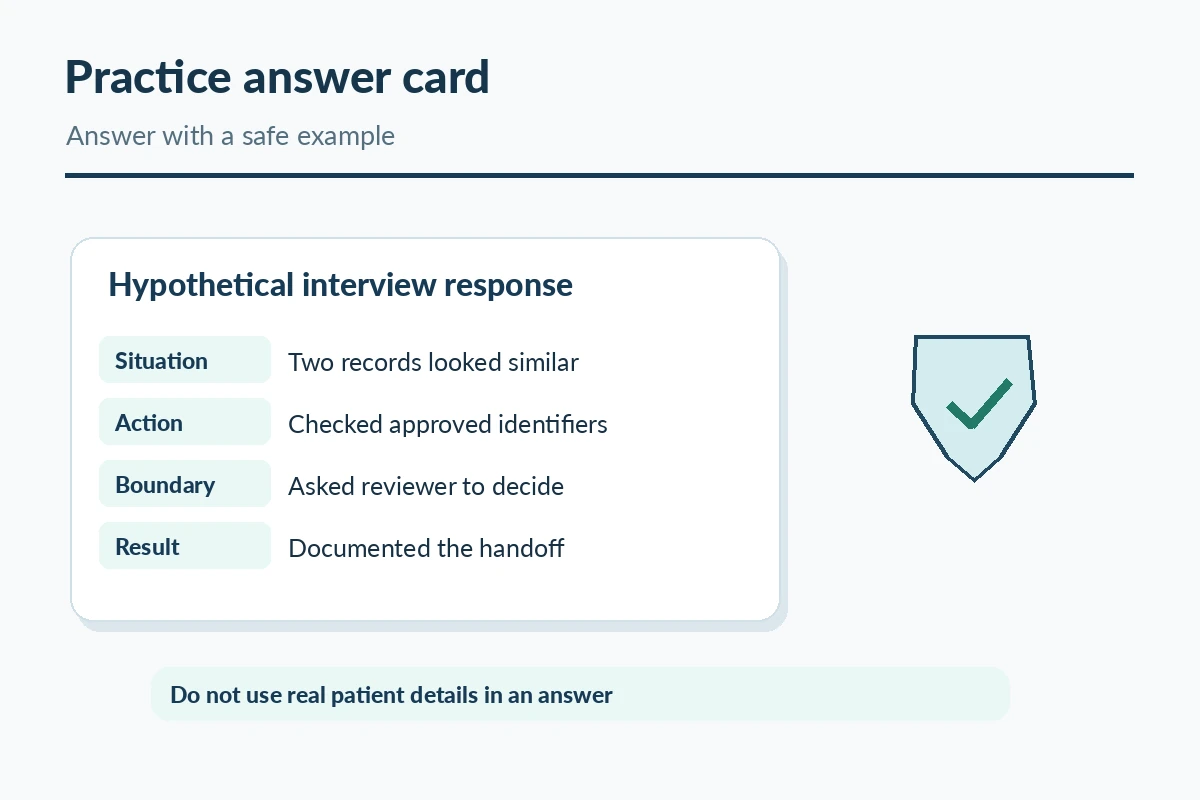
Run a concise practice check before interviewing
Write three evidence notes: one about finding an inaccurate record field, one about handling sensitive information respectfully, and one about learning a new filing or software routine. For each, keep a private statement of the task, your own action, and the actual result. Remove identifying material from interview notes. Rehearse aloud until you can answer without reciting a script, then compare your examples with the role posting. The examples need not all come from health care if you are seeking an entry-level clerk position.
A final check: can you state who verifies authority, who approves a correction, and what happens when identifiers conflict? You do not need to memorize policy language or discuss a real patient to show readiness. Explain that you would confirm the employer’s procedure before acting. This helps you answer the two biggest themes in medical records interviews—accuracy and confidentiality—without exaggerating access or promising outcomes you cannot control.
How We Research Role-Specific Interview Questions
We checked guidance from U.S. university career centers on practicing interviews and using evidence-based answers, then compared it with O*NET occupational descriptions and, where relevant, official agency guidance. The questions and responses are illustrative; they are not actual employer interview transcripts, hiring tests, or promises of employment. Duties, permissions, and training vary by employer and setting. Adapt each response to genuine, nonconfidential experience and verify the job posting.
Sources checked November 10, 2026: careerservices.fas.harvard.edu; careers.uw.edu; www.onetonline.org; www.hhs.gov; www.hhs.gov. Read our affiliate disclosure for editorial relationship information.
More Interview Preparation Guides
Explain the recordkeeping systems you have actually used, including permissions, indexing, and training needs. Do not claim experience with a clinical platform you have only read about.
Do not share identifiable or confidential information. Describe the workflow at a general level, with roles and outcomes you are permitted to discuss.
Approval depends on the organization and nature of the request. Describe your ability to document and route it, not an authority you have not been assigned.
Discuss using authorized identifiers, following duplicate-resolution procedures, and escalating uncertain matches. Never suggest deleting or merging charts based only on a name.
No. Coding may involve specialized classifications and qualifications; a records clerk interview often emphasizes indexing, access, accuracy, and secure handoffs.