
Budgeting skills belong on a resume when you can name the specific financial work you performed: tracking spending, updating a budget-to-actual worksheet, compiling estimates, investigating variances, supporting a forecast, or preparing a report for review. “Managed a $500,000 budget” is not a safe shortcut if you only entered transactions into someone else’s workbook. Separate preparation and analysis from decisions you were authorized to make, and use amounts only when they are accurate and disclosable.
Describe the actual part of the budget cycle
Budget work moves through planning, tracking, comparison, explanation, recommendation, and approval. Different employees own different steps. A program assistant may organize receipts; a coordinator may maintain an expense tracker; an analyst may review assumptions; a manager may authorize a change. Start by deciding which step you can prove. O*NET identifies budget analysts with comparing estimates, analyzing budget reports, and preparing recommendations, but that profile does not mean every applicant performed every step.
A useful Skills entry might say “budget-to-actual tracking,” “expense coding,” “variance documentation,” or “forecast support.” Those phrases are more informative than “finance expert.” If a resume headline includes budgeting, make sure a work or project bullet makes the statement concrete. The goal is to let the reader understand your method without confusing responsibility for data preparation with financial control.
Distinguish expense tracking from budget ownership
Suppose your role was to enter approved invoices into a departmental spreadsheet and flag transactions that did not match a cost category. This is important budget support. Write “Maintained expense tracking sheet and flagged coding differences for finance review,” not “Owned departmental spending.” Actual budget ownership may involve setting allocations, changing authorized limits, or signing off commitments, and those responsibilities require independent evidence.

If you reconciled a purchase log to a monthly report, mention the two sources and the purpose of the comparison. If a supervisor determined how discrepancies were handled, include that handoff. Without confidential figures, you can still show frequency, categories, documentation standards, and how errors were escalated. A modest, accurate task frequently provides better hiring evidence than an unsupported six-figure budget claim.
Explain variance work in plain English
Budget variance is the difference between a planned amount and an actual result for the same period and category. On a resume, say whether you calculated the difference, investigated possible causes, prepared commentary, or recommended a response. Do not claim you “corrected the budget” if your job ended when you sent the question to a manager. An interviewer can ask you to walk through an illustrative category without seeing proprietary financial records.
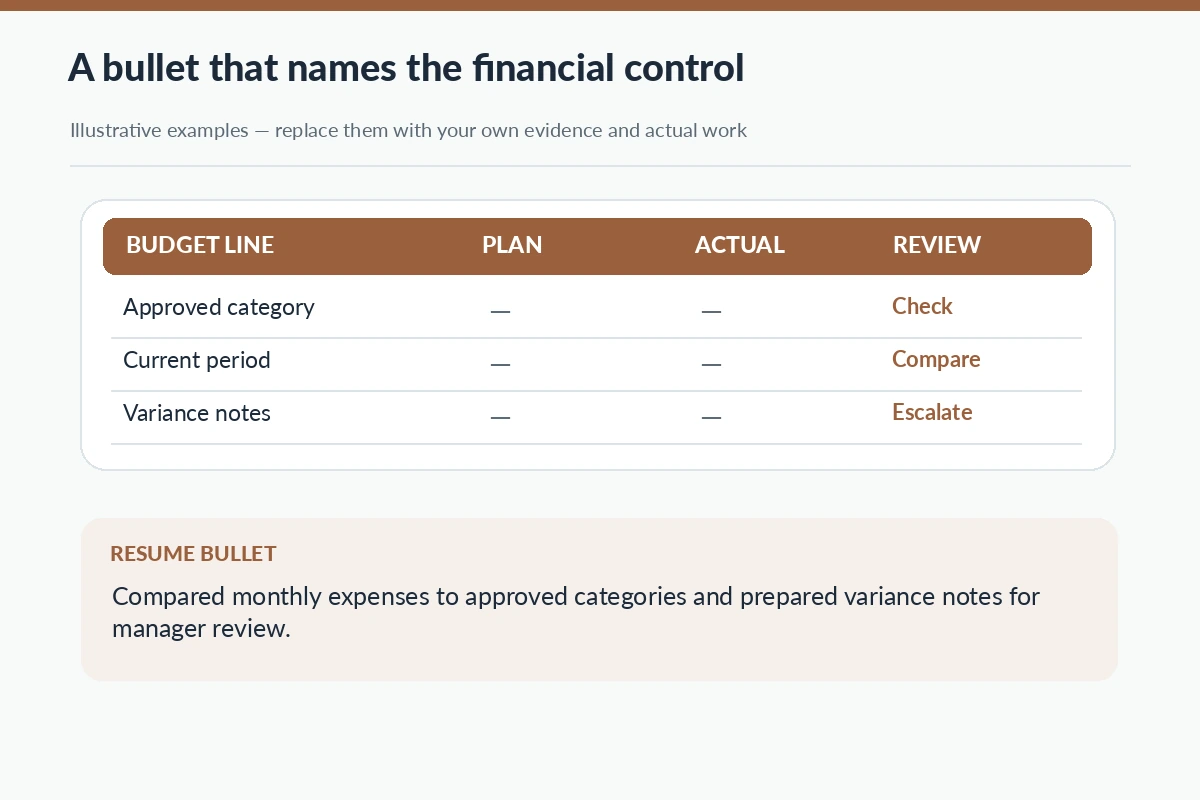
Example: “Compared monthly office-supply spending with approved category limits and prepared a variance note for the budget owner.” This is stronger than “Improved financial performance” because it explains the work. If your team used percentage thresholds or review limits, include them only when they are part of a verifiable, shareable procedure; avoid inventing a numerical benchmark to make the bullet look impressive.
Separate a forecast from a promise
Forecasting uses assumptions and information available at a point in time; it is not a guarantee that the future will match the model. If you updated a forecast spreadsheet with actual spending, state who supplied the assumptions and who reviewed them. If you created scenarios, explain the variables you tested. “Updated scenario workbook using approved expense assumptions” makes the analytic contribution visible without claiming sole ownership of the business outlook.
Do not describe a basic expense log as predictive modeling. Similarly, preparing a chart for a manager is not the same as presenting an approved budget to the board. If your task was limited to data cleaning or chart preparation, say so. Budget roles often involve review and accountability that the resume should reflect rather than erase.
Show spreadsheet techniques with a work artifact
A legitimate budgeting skill may involve SUMIFS, pivot tables, lookup checks, protected input cells, budget-versus-actual formulas, or formatting that alerts reviewers to exceptions. Name a function only when you can reproduce the process. If the employer used an enterprise planning platform, identify your actual tasks in that platform, such as entering approved changes or exporting reports.
A sample budget can demonstrate competence for entry-level candidates. Label it clearly as a personal or class project, use fictional categories and reasonable sample assumptions, and explain how you verified formulas. Never present hypothetical costs or projected savings as a real employer outcome. Place the exercise in Projects rather than Work Experience when it was not professional work.
Choose examples by position level and authority
An administrative assistant may need tracking and receipt organization; a nonprofit program coordinator may monitor grant expense categories; a budget analyst role may expect variance analysis and recommendations. Match a posting by specific responsibilities instead of putting all finance terms on every resume. If you provided supporting documents to an auditor, you did not necessarily perform an independent audit.
Use relevant keywords naturally, with proof nearby. CareerOneStop describes a Skills section as an optional place for job-relevant capabilities, especially technical ones. Avoid a giant grid of jargon, which makes it harder to tell whether you actually worked with forecasts, budgets, or expense records. A short, accurate cluster can be enough.
Preserve confidentiality and control boundaries
Budget documents may reveal vendor rates, employee compensation, restricted grant terms, or internal decisions. Do not include screenshots or precise private figures in a public resume or portfolio without authorization. Use generic categories such as “program operations expenses” where necessary. If numbers are permitted, specify whether they refer to your own tracked portion or the team’s wider budget.
Approval language deserves special care. “Prepared requests for approval” and “approved spending requests” are not interchangeable. “Identified an exception for manager review” differs from “authorized a reallocation.” Choose the first description when it matches the actual scope, even if the second sounds more senior. Employers hiring into controlled financial processes will notice this distinction.
| Experience | What you did | Proof to describe | Limit to respect |
|---|---|---|---|
| Tracking | Entered approved expenses | Updated monthly worksheet | Do not claim allocation authority |
| Variance analysis | Compared actuals to plan | Explained difference for review | Do not claim automatic correction |
| Forecast support | Updated approved assumptions | Prepared scenarios | Do not promise outcomes |
Prepare a defensible budget example for interviews
Select one example you can recreate using fictional amounts: an invoice coded to the wrong line, an estimate that needed a revised assumption, or a report that disagreed with the source data. Explain the original input, how you checked it, what recommendation you made, and who approved any change. That sequence shows analytical judgment without disclosing protected records.

Before submitting, check every listed tool, period, dollar amount, and authority claim against reliable records. A clear story of how you discovered a discrepancy can be more valuable than an unverified claim that you controlled an entire department budget. If a result is shared across a team, describe your contribution rather than taking credit for the whole outcome.
How We Research and Verify Resume Examples
This article uses publicly available occupational and career guidance to distinguish a task a worker might perform from a claim a particular applicant can honestly make. All sample resume statements are illustrative, not biographies or verified employer results. The sources listed below were reviewed on 2026-11-05. Skills, authority, training, and credential requirements depend on the actual job and organization. For the site’s relationship policy, read the affiliate disclosure.
Source basis: CareerOneStop Resume Guide — CareerOneStop recommends relevant, role-specific technical skills with evidence elsewhere in the resume.; O*NET OnLine occupational profile — Budget analyst tasks include cost analysis, budget estimates, variance-related reporting, and recommendations for approval decisions.. Review original requirements before making legal, licensing, financial, or other consequential claims about your own scope of work.
More Resume and Cover Letter Guides
List the tasks you performed, such as expense tracking, coding checks, report preparation, or variance support, and identify approval as another person’s responsibility.
Only when the figure is verified, meaningful, not confidential, and accurately reflects the budget portion you actually handled.
It can count as expense or budget tracking when it captured real financial categories and supported a defined process; do not inflate it to budget ownership.
Yes as a clearly labeled personal or academic project, with the assumptions and calculations described honestly.
A budget establishes a plan or allocation; a forecast estimates expected results from current assumptions. The resume should identify which activity you completed.