
A claims adjuster resume should prove how you collect facts, review coverage materials, document communications, resolve discrepancies and communicate next steps. A list of “negotiation, investigation, multitasking” is too vague. The most useful skills connect a claim file to an action and a decision owner. If you worked as a claims assistant, trainee or examiner, explain your actual review and escalation work without claiming that you made coverage determinations or approved settlements beyond your assignment. The examples below are hypothetical unless a stated source explains an occupational duty. Replace sample duties with your own verified work; no employer can guarantee interviews or automated-screening outcomes from a skill keyword. Always read the particular vacancy and any relevant state requirements before representing a qualification.
Separate relevant skill labels from real responsibility
The Bureau of Labor Statistics groups claims adjusters with appraisers, examiners and investigators but notes differences among jobs and licensing conditions. Claims intake is not the same as field inspection, and a desk examiner’s tasks may differ from a property adjuster’s site visits. A professional might investigate facts, interpret policy language, estimate loss or settle within a designated authority. Your resume should reveal which stages you performed and under whose approval. Read the target job description to distinguish independent adjuster work from claims processing support.
A strong evidence-review bullet identifies what was checked and why: date of loss, photographs, repair estimate, incident narrative, witness information or other permitted records. Avoid disclosing private claimant details. If you noticed inconsistent dates and sent the file for a senior review, the skill is careful comparison and escalation—not fraud detection conclusively established by a junior employee. Claimant contact can demonstrate calm interviewing and precise notes, but say whether you asked factual questions, scheduled an inspection or explained the company’s documented process.
Turn technical know-how into verifiable evidence
Coverage knowledge should not be framed as legal advice. You may have summarized policy sections, checked exclusions for review, or worked from a supervisor-approved checklist. If the final interpretation belonged to an authorized adjuster or legal reviewer, state that. Some licensed adjusters do make decisions within authority limits. For those candidates, mentioning the claim type, the decision threshold as permitted, and the documented approval process can distinguish real responsibility. Avoid listing a state adjuster license without checking its current status and how it applies to the role.
For each resume bullet, draw an evidence path: reported loss, source record, your inspection or document review, discrepancy, communication, and supervisor or authorized outcome. This chain demonstrates analytical judgment without leaking customer information. If the work was a simulation in an insurance course, identify it as a simulation. A certificate in insurance fundamentals does not transform someone into a licensed public adjuster. Keep notes about which estimating or claims management platforms you personally used and what tasks you completed in them.

Rewrite an overstated bullet into a truthful example
Hypothetical file-note example: “Reviewed incoming auto claim documents for missing dates and repair-estimate attachments, contacted the claimant for permitted information, and referred unresolved coverage questions to the assigned adjuster.” A licensed adjuster with the necessary authority might truthfully describe evaluating specified claims and documenting approvals, but should still avoid proprietary settlement values and guaranteed savings. The point is not that one bullet is more prestigious; it is that each precisely matches the worker’s level of responsibility and can be corroborated.
An effective bullet follows a verifiable sequence: identify the material or case, describe the part you personally completed, name a meaningful review or exception check, and explain the next approved handoff. You do not need an impressive percentage to be useful. If a manager could not verify the action, change the sentence before submitting it. The sample sentences are illustrations, not statements about an actual applicant.
| Claim to check | Evidence that helps | Risky wording to avoid |
|---|---|---|
| Role and scope | Specific task, level and reviewer | Claiming full team authority |
| Tools and methods | Program used for a named task | Listing tools only from a tutorial |
| Credentials | Exact current issuing status | Confusing coursework with a license |
| Results | Record-backed, shareable outcome | Invented percentages or promises |
Use credentials and role limits precisely
State rules vary: some claims roles and public adjuster arrangements require a license or other conditions, while exemptions exist in some situations. BLS advises verifying the applicable jurisdiction. List a license with its correct issuing state and current status, and never imply that an insurer’s organizational licensing extends your personal license to another jurisdiction. Avoid stating that your credentials cover every type of loss. A trainee should name training and supervised tasks; a seasoned professional can foreground lines of insurance and actual delegated settlement responsibility.
Use two or three groupings: “Claims review and documentation,” “Communication and investigation,” and “Systems and licensing.” Prove a key claim in the work history near the role where it occurred. For a career changer from customer service, emphasize verified fact gathering, calm communication and confidential records, not assumed policy interpretation. For an experienced adjuster, prioritize the kind of claim in the advertised position and the decisions actually made. Resume skills are strongest when the same capability appears in a concrete work bullet.

Remove the claims that would fail a reference check
Common exaggerations include claiming to “detect fraud” from a mere flag, describing an estimate as a final paid amount, or treating a customer call as independent settlement negotiation. A property claim should not imply inspection of an unsafe structure without the training, precautions and permission required. Distinguish desk documentation from field assessment. Do not paste photos or claim forms containing personal data into a public portfolio. If software estimates were reviewed by someone else, say so. Avoid invented accuracy and cycle-time figures.
Review the resume as an occupational supervisor would
Read each line as though an insurer’s supervisor or licensing reviewer will ask for proof. Check policy terminology, date ranges, authority language, license status and whether every metric comes from an actual record you may disclose. Confirm the title is consistent with your contract and that the body does not suggest legal conclusions you lacked authority to reach. If a work sample is requested, request permission and use a synthetic file. Check all PDF exports and hyperlinks before submitting.
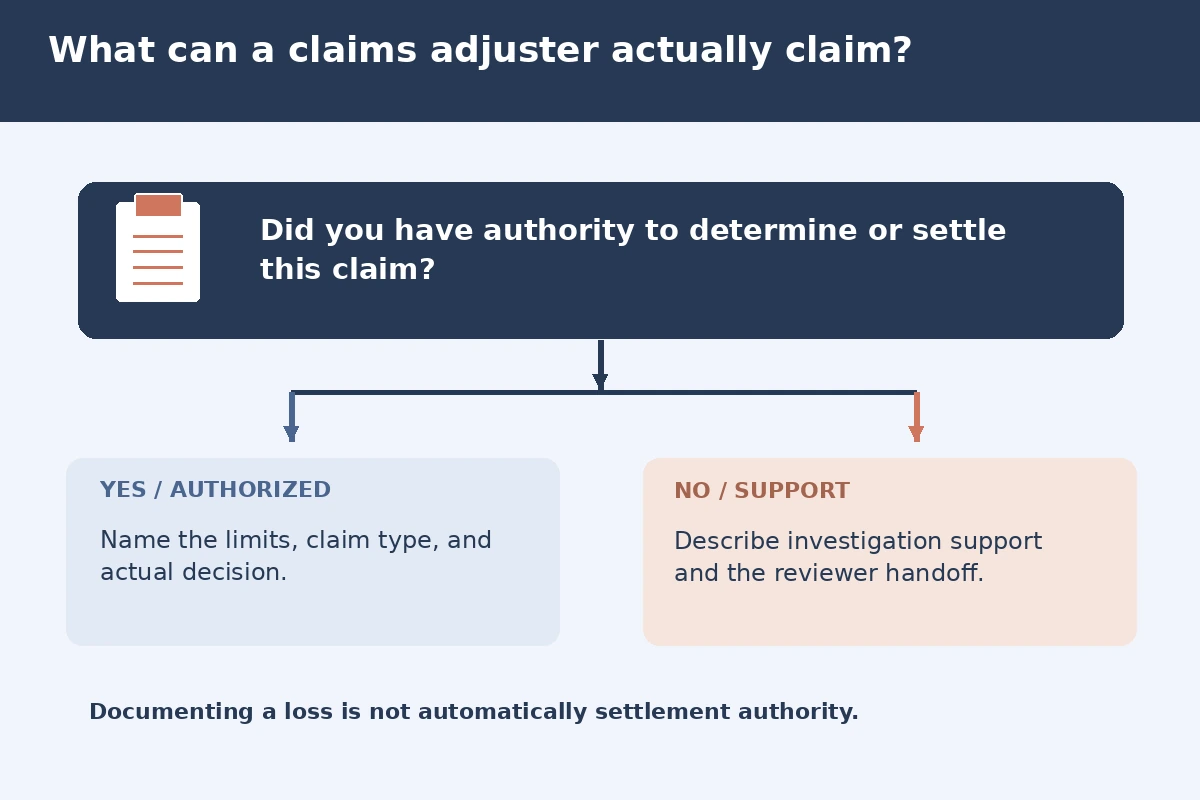
A final skills check has three questions: Could you explain the work without a script? Could a supervisor, instructor or authentic project artifact confirm it? Does the resume distinguish your decision from another person’s approval? If any answer is no, narrow the statement or omit it. Make the finished document easy to scan with familiar headings, consistent punctuation and working project links. Do not add an unsupported credential or promise that a particular keyword will pass an applicant tracking system.
How We Research and Check Job-Specific Resume Skills
On November 16, 2026, we reviewed these occupational sources: BLS outlines claims evaluation, supervised entry-level work, and state-dependent licensing. O*NET identifies claims record review, investigation, customer contact, and authority limits. These are educational resume examples, not legal, clinical, engineering, insurance or procurement authorizations. For site policy, read our affiliate disclosure.
More Resume and Cover Letter Guides
Yes, but show actual intake, documentation or review support and identify when coverage or settlement decisions were escalated.
List only credentials you hold and verify that they are active and applicable. State requirements differ by jurisdiction and role.
Use precise language. Flagging inconsistencies or referring a suspicious pattern is different from independently determining fraud.
Only if the number is accurate, permitted to disclose and directly attributable to your authorized work. Otherwise describe the process.
Describe the real claim file stage you handled, the records you checked and the senior adjuster review or handoff.